 Bellwether
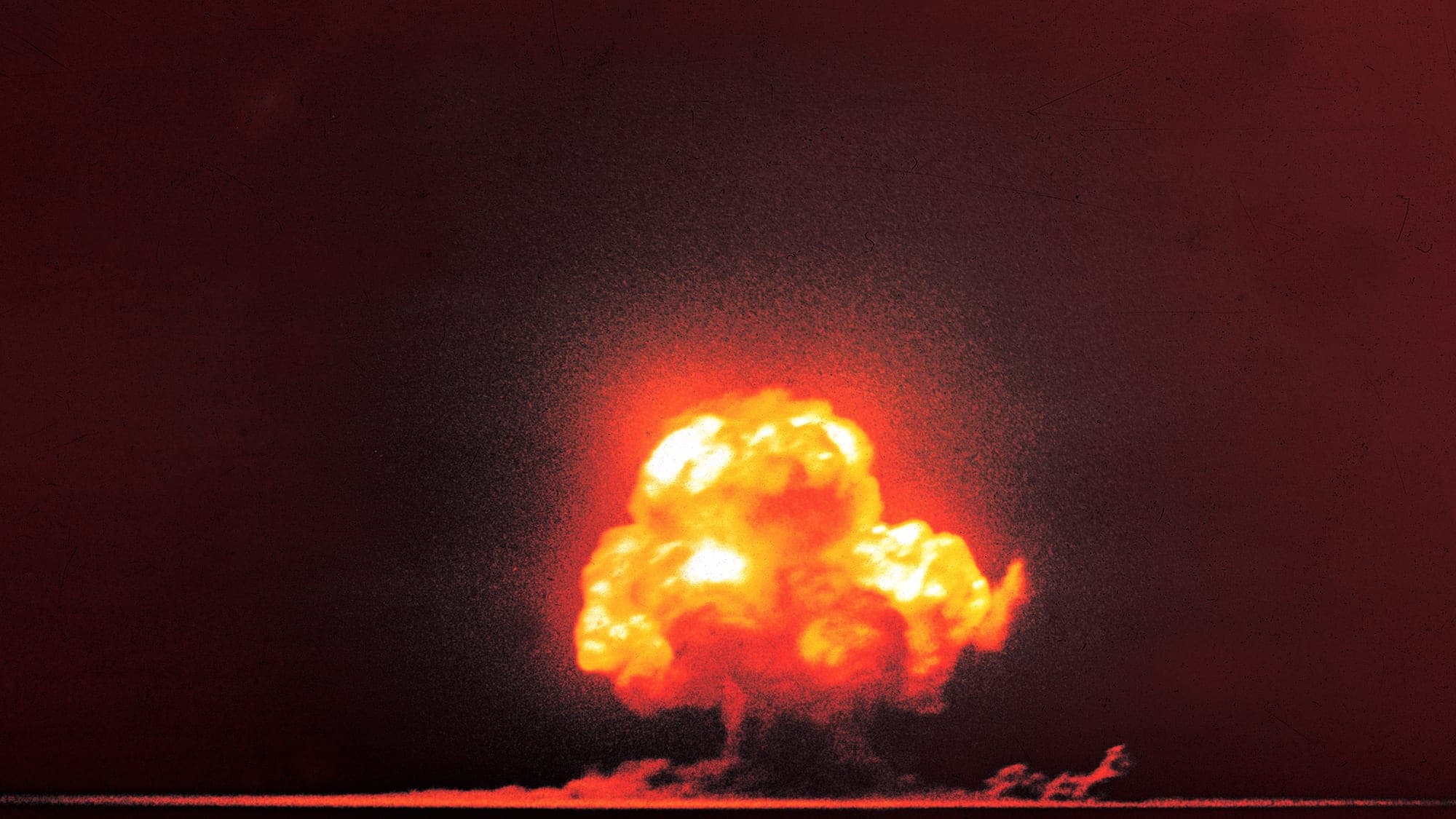
On the night of 15 to 16 July 1945, a storm broke over the New Mexico desert. Rain, thunder, lightning. On top of a steel tower about thirty metres high stood a device that nobody had ever detonated before, and a few miles away a group of men waited for the sky to clear.
General Leslie Groves, the officer who ran the entire project, was furious. According to accounts of that night, at two o'clock he summoned the meteorologist and demanded that he sign a forecast of clear skies for dawn, threatening to have him hanged if he was wrong. Then he phoned the governor of the state to warn him that, if anything went wrong, it might be necessary to declare martial law.
Around four o'clock the sky began to clear. At 5:29 in the morning the desert lit up as nobody had ever seen it.
Among the men watching was J. Robert Oppenheimer, the physicist who had led the laboratory where that device had been designed. He was 41 and had just become the most important, and most tormented, man of twentieth-century science. Behind that explosion lay three years of work, tens of thousands of people and almost two billion dollars spent in secret.
What does it cost to build the end of the world?
A letter and a race against time
It all begins with a fear. At the end of the 1930s European physicists discovered that the nucleus of the uranium atom can be split, releasing enormous energy. It was a fascinating and terrible discovery at once, because in theory it made a weapon unlike any before possible. And the discovery had happened in Hitler's Germany.
In August 1939 Albert Einstein, the most famous physicist in the world, signed a letter addressed to the American president, Franklin Roosevelt. The message was simple: such a weapon was possible, and the Germans might get there first. The president received it only on 11 October, when an economic adviser summarised it to him aloud. Roosevelt understood at once and called an aide: "This requires action!" Even so, for a couple of years the United States moved slowly: it funded some research and set up a few committees.
Everything changed after the country entered the war. In the summer of 1942 the American army took over the project and gave it a deliberately bland name: Manhattan, after the New York district where its first office was located. In September command passed to Groves, a military engineer who had overseen the construction of the Pentagon. He was a hard, practical, impatient man, the opposite of a scientist.
Groves needed someone to run the secret laboratory where the bomb would be designed. His choice surprised everyone. Oppenheimer was a brilliant, cultured theoretical physicist, but he had never directed anything like it and had no Nobel Prize. On top of that, in the previous years he had moved in circles close to communism, and the security services viewed him with suspicion.
Groves chose him anyway, in October 1942, after a long conversation that had convinced him. To grant him a security clearance he had to bend the rules. Eleven years later, that same clearance would become the cause of his ruin.
Oppenheimer picked the site for the laboratory: an isolated plateau in New Mexico, Los Alamos, which he had known since he was a boy. There, in a few months, a town arose that did not appear on any map, home to some of the best scientists in the world.
Where the money really went
When we think of the atomic bomb, we picture scientists in front of a blackboard covered in formulas. That is the image of Los Alamos, and it is true. But if you look at where the money went, the story becomes a different one.
The Manhattan Project cost almost two billion dollars of the time. According to the reconstruction by the Brookings Institution, one of the most important American think tanks, Oppenheimer's laboratory absorbed only about 4% of it. More than 80% of the spending went on building and running the plants that produced the material for the bomb.
The reason is simple. A nuclear weapon needs a few kilograms of a very rare material: "enriched" uranium or plutonium. The first is obtained by separating, atom by atom, a particular form of uranium that makes up less than 1% of the natural total. The second barely exists in nature and has to be produced inside a nuclear reactor. In 1942 nobody had ever done that on an industrial scale.
So the American government built two factory cities from scratch. At Oak Ridge, in Tennessee, gigantic plants rose to enrich uranium: on their own they took almost two thirds of the total spending. At Hanford, in Washington State, the reactors for plutonium were built. At its peak the project employed about 130,000 people, and the great majority worked without knowing what it was for.
The bomb, in short, was first of all an enormous industrial undertaking, and as such it had supply problems. The Oak Ridge plants needed large quantities of copper for their magnets, but copper was needed for the war and was scarce. The solution was silver, which conducts electricity even better.
A colonel from the project went to the Treasury to ask to borrow a few thousand tons of it. The official who received him answered with a line that became famous: "Young man, you may think of silver in tons, but the Treasury will always think of it in troy ounces." In the end the army borrowed more than 13,000 tons of silver from the federal vaults. The metal was returned after the war: the last shipment went back to the Treasury only in 1970.
A two-billion-dollar secret
Spending a sum like that without anyone noticing was not easy. Anyone who asked too many questions was stopped, even in the Senate.
The most curious episode involves the future president himself. In 1943 Harry Truman was a senator and chaired a committee investigating waste in wartime spending. At one point the committee became interested in an enormous tract of land bought by the government in Washington State: it was the Hanford site. The Secretary of War asked Truman to drop it for reasons of national security. Truman agreed.
Without knowing it, he had brushed against the greatest secret of the war. In the meantime his career changed suddenly: in 1944 he was elected vice president alongside Roosevelt, at his fourth term, and on 20 January 1945 Truman left the Senate and was sworn in as vice president. Not even then was he told about the bomb. On 12 April 1945, after just 82 days as vice president, Roosevelt died and Truman became president. On 25 April the project's leaders finally explained to him what was being built with all that money. Less than four months later it would be he who decided to use the bomb.
The morning of Trinity
The first test was called Trinity, a name chosen by Oppenheimer. The story goes that the inspiration came from a poem by the English poet John Donne, but this is not certain, and Oppenheimer himself later said he could not remember well why he had chosen it.
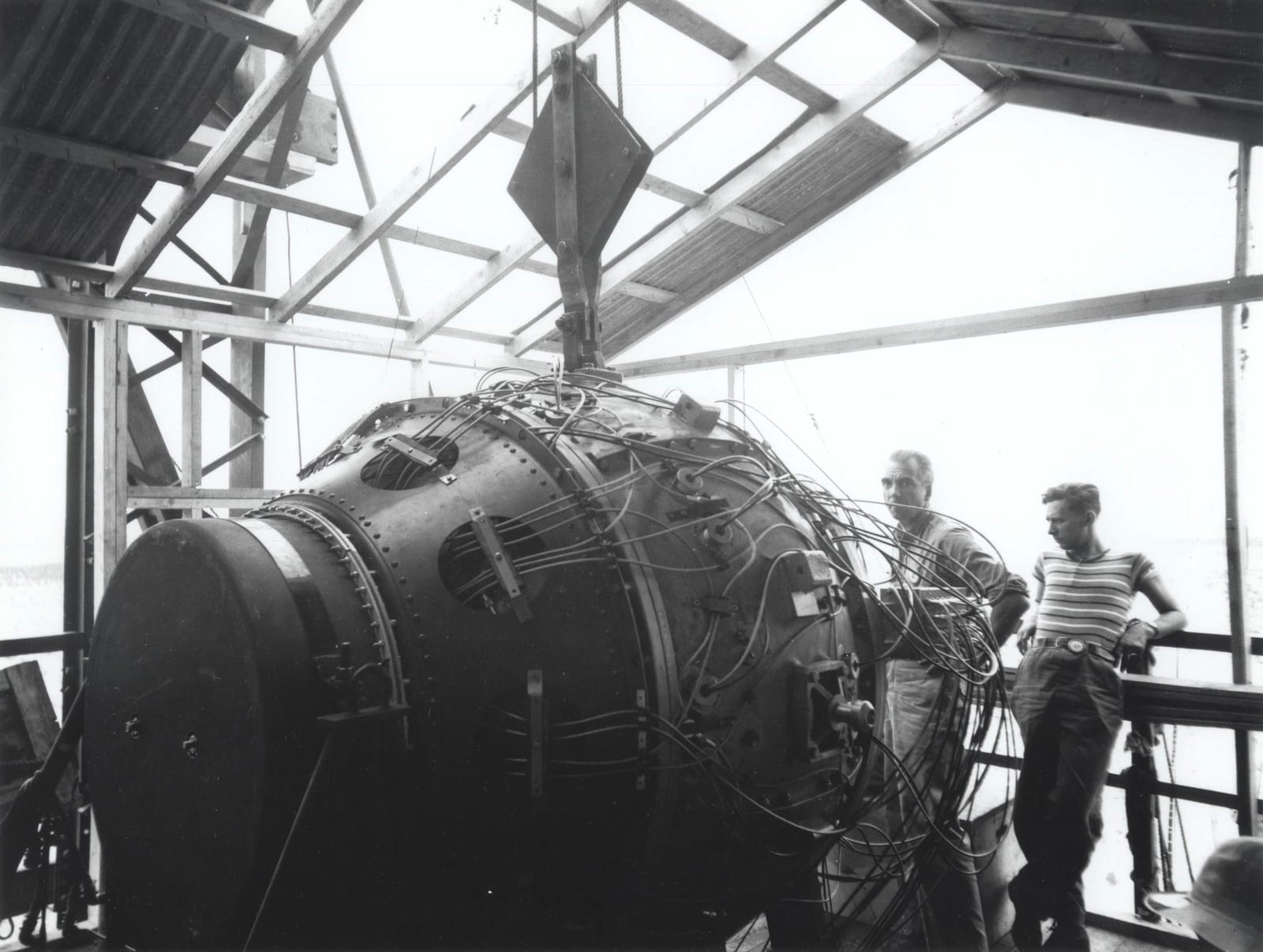 The "gadget", as they called it at Los Alamos, in the Trinity tower awaiting detonation, in 1945. Norris Bradbury on the left, Boyce McDaniel on the right.
Trinity was not a bombing but a trial. The device was not dropped from an aircraft: it was mounted on top of the steel tower in the middle of the desert and set off from the ground. It was a plutonium bomb, the same model that a few weeks later would fall on Nagasaki, and it was the more complicated type: the scientists were not sure it would work. Plutonium, moreover, was so precious that they thought about how to recover it in case of failure. They built a gigantic steel container of over 200 tons, nicknamed Jumbo, inside which the bomb would be exploded: if it fizzled, the material would remain inside. In the end they decided not to use it, and Jumbo was left hanging from another tower, about 700 metres from the point of the explosion. That tower was swept away, Jumbo stayed intact, and it is still at the Trinity site today.
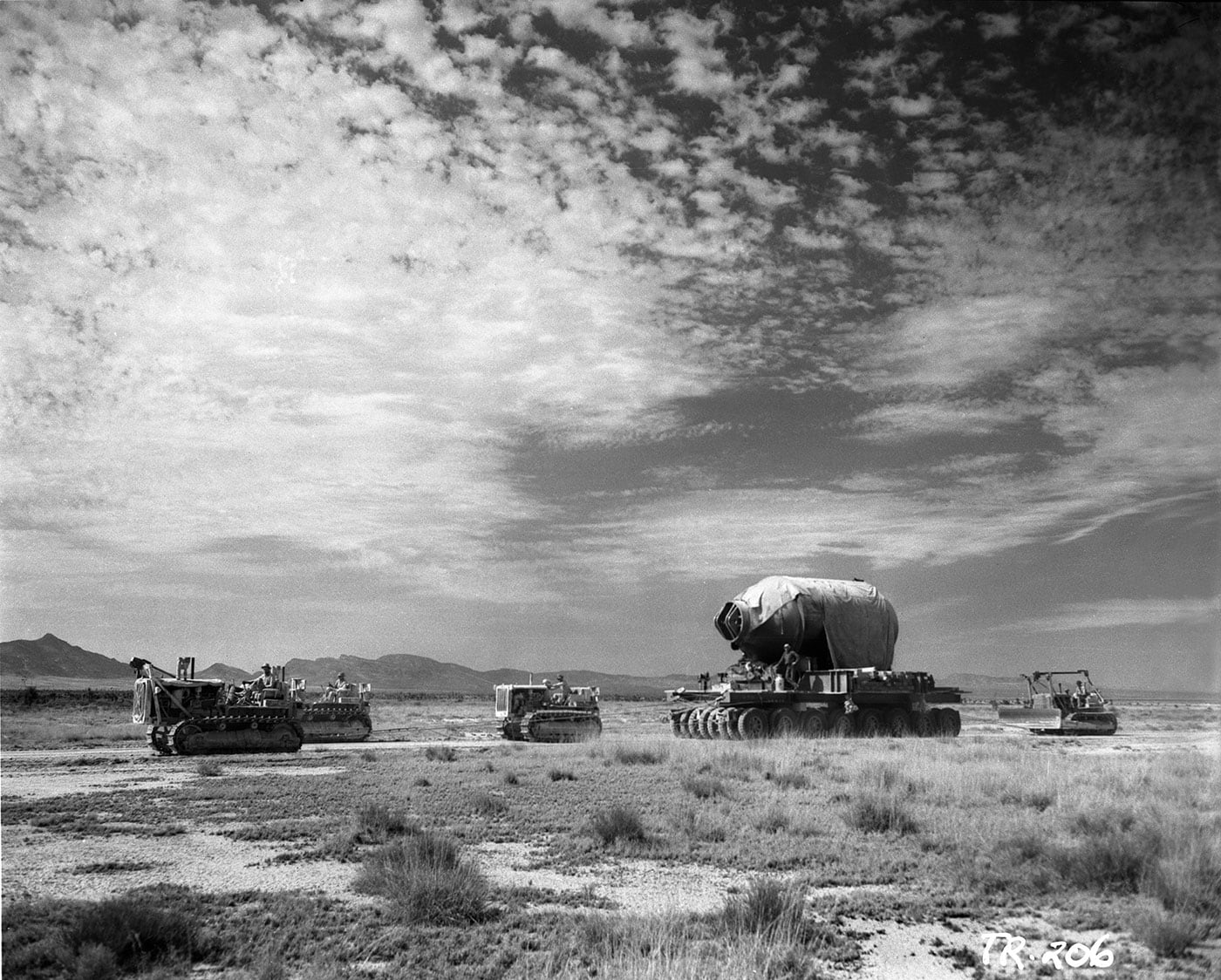 Jumbo, the steel container built to recover the plutonium, brought to the Trinity site in 1945.
In the days before the test, black humour also circulated among the scientists. Months earlier some of them had discussed, in theory, the possibility that the explosion might ignite the atmosphere, but the calculations had ruled it out. Enrico Fermi, the great Italian physicist who had emigrated to the United States, amused himself by taking bets: would the atmosphere catch fire? And if so, would it destroy only New Mexico or the whole world? It was a joke, but the soldiers on guard did not take it well.
Then came the storm, the tense night and the dawn of 16 July. When the light burst over the desert, one of the physicists present, about ten miles away, remembered above all the heat on his face, many times stronger than that of the rising sun.
The reactions of those minutes have become legend. Oppenheimer, leaning against a post as he waited, had murmured: "Lord, these affairs are hard on the heart." After the explosion, according to his brother Frank's recollection, he said only: "It worked." The test director, the physicist Kenneth Bainbridge, is credited with the bluntest line of all, addressed to Oppenheimer himself: "Now we are all sons of bitches."
The most famous line appeared in print for the first time in 1948, and the version everyone remembers dates from 1965. In a documentary by the American television network NBC, an Oppenheimer by then elderly recalled a verse of the Bhagavad Gita, the sacred Indian text: "Now I am become Death, the destroyer of worlds." He added that, one way or another, everyone had thought so.
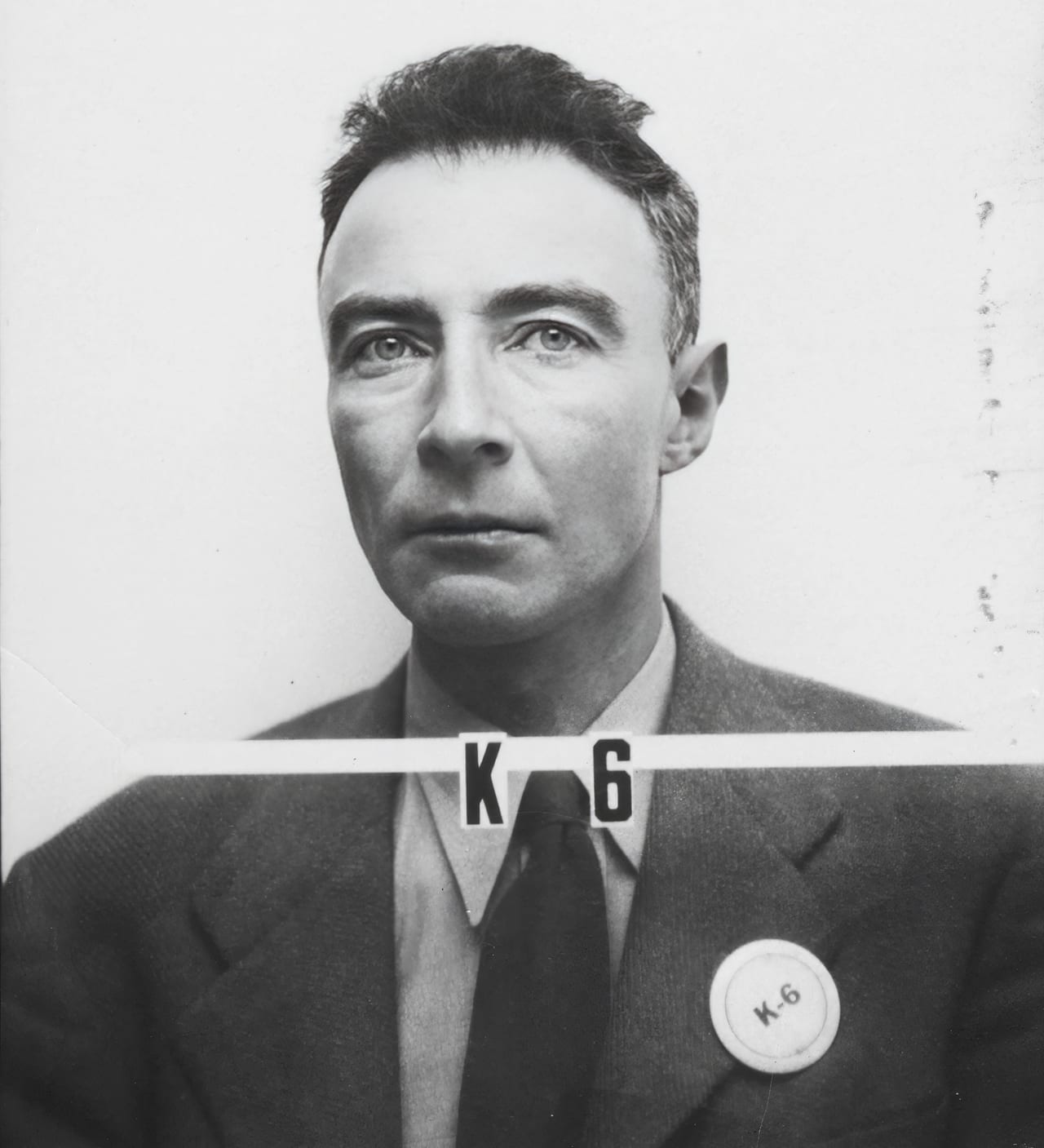 J. Robert Oppenheimer in the photograph for his Los Alamos badge, dating from the 1940s.
Hiroshima and Nagasaki
Three weeks later the bomb left the desert. On 6 August 1945, at 8:15 in the morning, an American bomber, the Enola Gay, dropped a uranium bomb on Hiroshima. On 9 August a plutonium bomb, twin to the one at Trinity, exploded over Nagasaki.
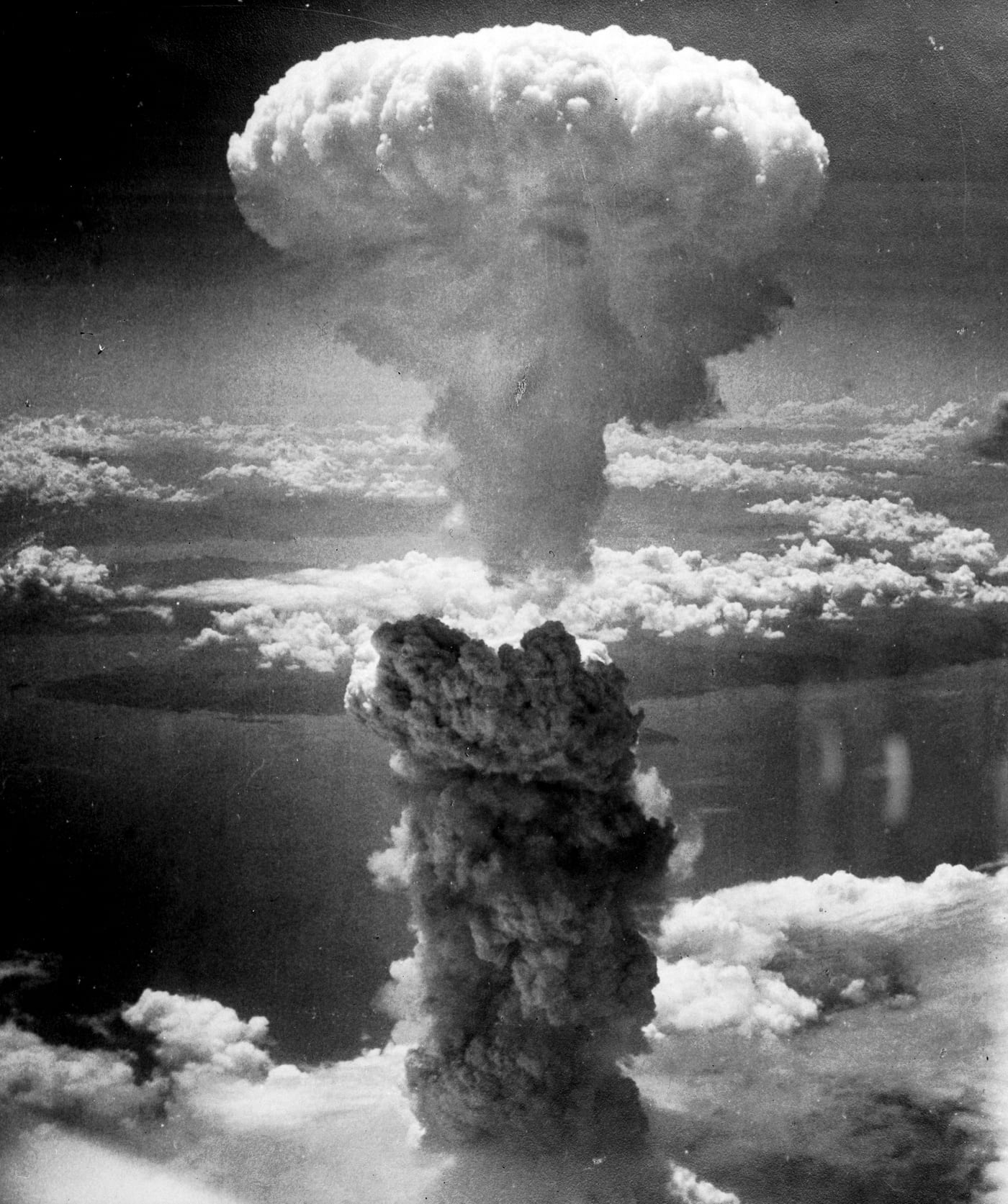 The atomic mushroom cloud over Nagasaki on 9 August 1945, photographed from the aircraft by Charles Levy.
How many died will never be known precisely: the records were destroyed and whole families vanished without a trace. According to estimates from the Japanese-American institute that has studied the survivors for decades, in the following two to four months between 90,000 and 166,000 people died in Hiroshima and between 60,000 and 80,000 in Nagasaki. On 15 August Japan announced its surrender.
For the United States it was the moment of triumph. Oppenheimer became a celebrity, the "father of the atomic bomb". But something inside him had broken.
Hands stained with blood
In October 1945 Oppenheimer was received at the White House by Truman. It was a disastrous meeting. According to accounts, at one point the scientist told the president he felt he had blood on his hands. The versions of how Truman replied differ, but on one thing there is no doubt: the president was irritated. In a private note written the following year he called him a "cry baby" scientist. For Truman the responsibility for the bomb was his, the president's, and not that of the people who had built it.
Two years later, at a lecture at the Massachusetts Institute of Technology, Oppenheimer uttered another famous line: physicists, he said, "have known sin".
Meanwhile the world was racing on. On 29 August 1949 the Soviet Union detonated its first atomic bomb: the American monopoly had lasted just four years. In Washington a new weapon was immediately discussed, the hydrogen bomb, far more powerful. Oppenheimer, who chaired the committee of scientists charged with advising the government, opposed it on moral grounds: such a weapon, they wrote, would take the logic of exterminating civilians even further. Truman did not listen to him and in January 1950 gave the go-ahead.
That stance cost him dearly. These were the years of the hunt for communists, and the old suspicions about his past resurfaced. In 1954 a closed-door hearing of the Atomic Energy Commission revoked his security clearance. The commission that examined him found no evidence of disloyalty, but his old associations weighed against him, as did what the commission called "fundamental defects" in his character. The committee that questioned him also wrote that, without his opposition, the hydrogen bomb would have been developed more vigorously. From then on he could no longer work for the government. The man who had given the United States the bomb was set aside like a suspect.
In 1963 the government tried to mend fences, awarding him an important scientific prize. Oppenheimer died in 1967, aged 62. Only in December 2022 did the American Department of Energy officially annul the 1954 decision, acknowledging that it was the product of a flawed process.
And today?
The Manhattan Project was a bill paid once: four years of work, an enormous cost for the time, and then the end. Today's nuclear weapons work in a completely different way. They are an expense that never closes.
According to the Swedish institute SIPRI, the international reference on these matters, at the start of 2026 there were about 12,000 nuclear warheads in the world, of which almost 10,000 in military stockpiles, that is, potentially usable. Nine countries possess them: the United States, Russia, China, the United Kingdom, France, India, Pakistan, North Korea and Israel, which has never officially admitted it. The United States and Russia alone hold more than four in five. China is the country growing fastest.
After decades in which the number of warheads had fallen, the trend is reversing. In February 2026 New START expired, the last treaty setting binding limits on the strategic arsenals of Washington and Moscow, with no new agreement to replace it.
How much does an atomic bomb cost today? The honest answer is that there is no public price for a single warhead. Governments do not buy bombs the way you buy a car: they maintain an entire system made up of missiles, submarines, aircraft, laboratories, bases and thousands of people. It is that system that costs.
And it costs a lot. According to ICAN, the international campaign for the abolition of nuclear weapons, in 2025 the nine countries spent together, by its estimates, about 119 billion dollars, the highest level ever recorded. The United States alone spent more than all the others put together.
The most striking figure comes from the Congressional Budget Office, the independent office that does the sums for the American Congress: maintaining and renewing United States nuclear forces will cost about 946 billion dollars between 2025 and 2034. Almost a thousand billion in ten years for a single country, and the figure covers the whole system: missiles, submarines, bombers, command and control, laboratories.
Comparing dollars from different eras is always approximate, but the proportions are clear. Brookings revalues the Manhattan Project at about 21.6 billion 1996 dollars. Today, according to the CBO, the United States plans to spend about 95 billion a year on nuclear forces, on average. These are orders of magnitude, not a precise calculation, but the distance is plain.
Many years after that morning in the desert, Oppenheimer was asked how the nuclear arms race could have been stopped. He replied with a bitter line: "It should have been done the day after Trinity."
The information contained here is not financial advice: before any investment decision, consider your personal situation or consult a qualified adviser. The data comes from public sources (Brookings, SIPRI, ICAN, CBO, Department of Energy) and is current as of the end of October 2026.
Image credits
- Cover: "Trinity shot color.jpg", photo by Jack W. Aeby, 16 July 1945, via Wikimedia Commons, public domain. Cropped to 16:9 and resized.
- In the text: "The gadget in the Trinity Test Site tower (1945).jpg", photo by Los Alamos National Laboratory, 1945, via Wikimedia Commons, public domain. Resized.
- In the text: "Trinity - Jumbo brought to site.jpg", photo by the United States federal government, 1945, via Wikimedia Commons, public domain. Recompressed.
- In the text: "Oppenheimer-j r.jpg", badge photo of J. Robert Oppenheimer, Los Alamos National Laboratory, 1940s, via Wikimedia Commons, public domain. Resized.
- In the text: "Nagasakibomb.jpg", photo by Charles Levy, 9 August 1945, U.S. National Archives and Records Administration, via Wikimedia Commons, public domain. Resized.
Sources
- Atomic Heritage Foundation, "Einstein-Szilard Letter" (delivered to Roosevelt on 11 October 1939). ahf.nuclearmuseum.org
- Brookings Institution, "The Costs of the Manhattan Project" (Atomic Audit, 1998). brookings.edu
- U.S. Department of Energy, T. R. Fehner and F. G. Gosling, "The Manhattan Project" (2012). energy.gov
- U.S. Department of Energy, "Harry Truman" (the Truman committee and the briefing of 25 April 1945). osti.gov
- U.S. Senate, inauguration of Roosevelt and Truman on 20 January 1945, and Chattahoochee Valley Libraries, "Harry S. Truman" (82 days as vice president). webarchive.library.unt.edu and cv.libguides.com
- Y-12 National Security Complex, "14,700 tons of silver at Y-12". y12.doe.gov
- The Conversation, "This is what happened the morning the first atomic bomb created a new world". theconversation.com
- U.S. Army, "Trinity Site 80th Anniversary Commemoration: Jumbo". army.mil
- Ralph Nobles, "Trinity" (Atomic Heritage Foundation). ahf.nuclearmuseum.org
- Restricted Data, on the Bhagavad Gita line and the 1965 NBC interview. blog.nuclearsecrecy.com
- American Institute of Physics, "Remembering the Trinity test, seventy-five years". aip.org
- Radiation Effects Research Foundation, FAQ (estimates of the dead in Hiroshima and Nagasaki). rerf.or.jp
- Contingent, "Blood on Our Hands", 7 December 2023 (the Oppenheimer-Truman meeting). contingentmagazine.org
- J. Robert Oppenheimer, "Physics in the Contemporary World", lecture at MIT, 25 November 1947, in The Open Mind (1955). todayinsci.com
- Wikipedia, "J. Robert Oppenheimer" (biography, hydrogen bomb, 1954, 1963, 1967). en.wikipedia.org
- Wikipedia, "RDS-1" (first Soviet test). en.wikipedia.org
- U.S. Department of Energy, order of 16 December 2022 vacating the 1954 decision. energy.gov
- SIPRI, "Increasing focus on nuclear weapons amid heightened escalation risks", 8 June 2026. sipri.org
- ICAN, "Premeditated: Nuclear Weapons Spending in 2025", June 2026. icanw.org
- Congressional Budget Office, "Projected Costs of U.S. Nuclear Forces, 2025 to 2034", April 2025. cbo.gov
- Oppenheimer
- Manhattan Project
- atomic bomb
- Trinity
- nuclear weapons
- history