In early 1965 Ralph Liebert, owner of a small refrigeration business in Columbus, Ohio, takes an air conditioner he has built in his garage to Chicago to show it to IBM. The problem he wants to solve is easy to explain and hard to fix: rooms full of mainframes get hotter than ordinary air conditioning can handle, and temperature and humidity need to be controlled with a precision nobody has attempted before. IBM sees the potential and helps him arrange a presentation at a computer trade show in Philadelphia. A few months later the Liebert Corporation is born. The year before, on the other side of the ocean, in Vigorovea, a hamlet of Piove di Sacco near Padua, three brothers, Claudio, Giuliano and Vittorio Rossi, had started a company with exactly the same problem in mind. Sixty years later those two stories have ended up in the same company, and the problem has become enormous: today it is no longer a mainframe that needs cooling, but the data centres where artificial intelligence is trained. So who keeps artificial intelligence cool?
The origins: two air conditioning stories
The American story begins with Ralph Liebert, who arrived in Columbus from Cincinnati with his family, little money and a toolbox. In 1946 he founds Capitol Refrigeration Industries, which makes its living installing systems for a major air conditioning brand. In his garage, though, he is building something different: a precision air conditioner designed for computer rooms. After the 1965 presentation, at the end of that year the Liebert Corporation is founded, devoted to a new and very fast-growing market, what is now called CRAC, computer room air conditioning. The company grows, moves into power distribution with UPS units (the uninterruptible power supplies that keep computers alive during a blackout) and in 1981 lists on the Nasdaq. In 1987 Emerson Electric buys it in a share exchange worth about $430 million, as reported at the time by the New York Times.
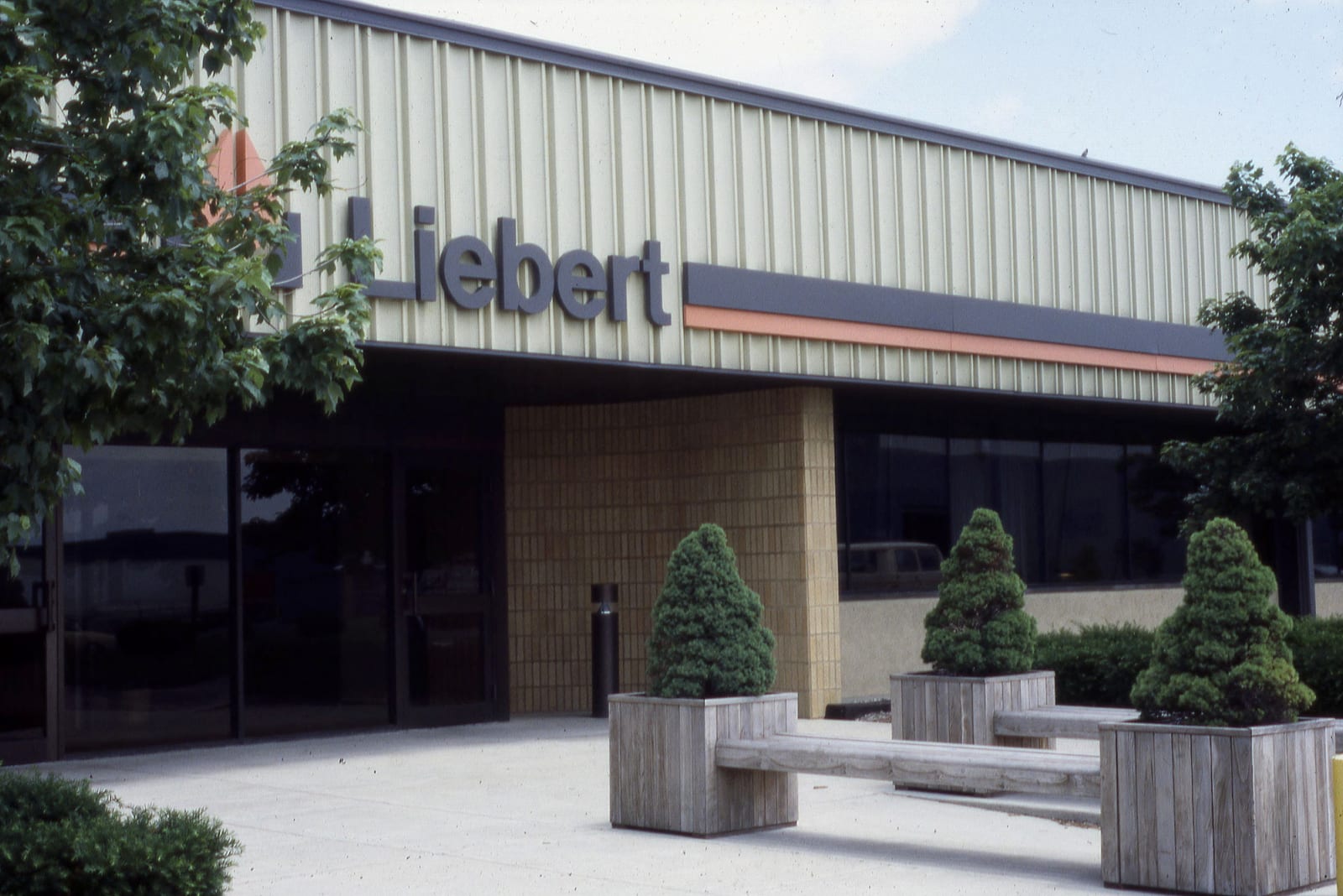 The entrance of the Liebert Corporation, in a slide held by the Columbus public library. Under Emerson the company would become Emerson Network Power, and then Vertiv.
The Italian story begins with Claudio Rossi, an engineer born in Piove di Sacco itself in 1929. In 1964, together with his brothers Giuliano and Vittorio, he founds Hiross in Vigorovea, also specialised in refrigeration and precision air conditioning. The company becomes the linchpin of what locals call the distretto del freddo, the "cold district": dozens of companies in the Saccisica, the area around Piove di Sacco, work in the same supply chain. According to the Mattino di Padova newspaper, the district gave the Veneto region Europe's highest concentration of companies in the sector, with output equal to almost 60% of the total. Emerson buys Hiross too, in 1998, and folds it into the same division as Liebert.
From Emerson to Vertiv: how today's company was born
In 2000 Emerson brings together Liebert, Hiross and the other acquisitions made in the meantime, later joined by Knürr in 2006, Avocent in 2009 and the British group Chloride in 2010, under a single brand, Emerson Network Power. For years it remains an internal division of a large industrial conglomerate, with no stock market identity of its own.
The change comes in December 2016: the private equity firm Platinum Equity buys Emerson Network Power for more than $4 billion and renames it Vertiv, with Emerson keeping a small stake. The return to the markets does not go through a traditional listing but through a SPAC, a shell company listed specifically to merge with a private business: GS Acquisition Holdings Corp, sponsored by Goldman Sachs and chaired by David Cote, former chief executive of Honeywell. The merger is completed on 7 February 2020 and on 10 February Vertiv debuts on the New York Stock Exchange under the ticker VRT.
The first two years as a listed company are not easy: the debt inherited from the Platinum Equity buyout and the supply problems of the pandemic push the stock down to a low of $8.21 in 2022. Then comes the explosion in demand for artificial intelligence infrastructure, and 2023 ends with the stock up about 250%. Since January 2023 the chief executive has been Giordano Albertazzi: Italian, a degree in mechanical engineering from the Politecnico di Milano, a master's from Stanford, he joined Emerson Network Power in 1998 after a spell at Kone. He has climbed every rung, from plant manager to president for the Americas, all the way to the top job.
What Vertiv does today
Vertiv does not make the chips that run artificial intelligence, nor the models that run on them. What it does is closer to plumbing and wiring on an industrial scale: it builds and sells the power and cooling that keep data centres alive. Its catalogue is split into three areas: power management (uninterruptible power supplies, switchgear and distribution systems, strengthened by the $1.8 billion acquisition of E+I Engineering in 2021), thermal management (the historical core inherited from Liebert and Hiross, now increasingly focused on liquid cooling) and management and monitoring software, based in part on Avocent's technology.
Why artificial intelligence chips run so hot
A traditional server was cooled with air: fans, hot and cold aisles, room air conditioners. The GPUs used to train artificial intelligence models, by contrast, pack into a small space an amount of electrical power, and therefore heat, that air alone can no longer remove efficiently beyond a certain density. The solution that is taking hold is direct-to-chip liquid cooling: a coolant flows through plates in contact with the processor and carries heat away far better than air. That is why Vertiv, over the last three years, has bought one company after another in this field: Britain's CoolTera in December 2023 and America's Strategic Thermal Labs in April 2026.
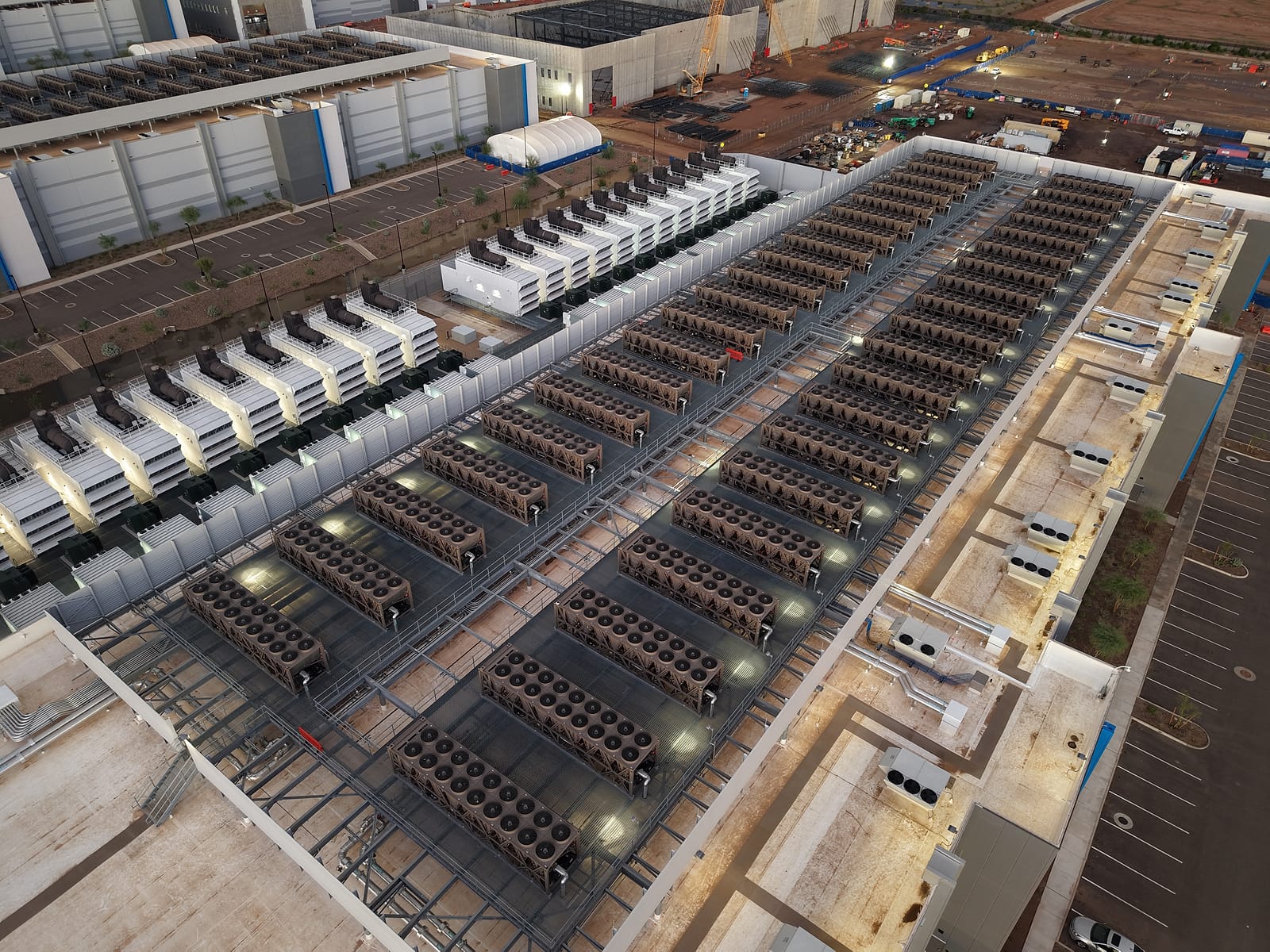 The roof of a data centre in the Phoenix area, Arizona, photographed in November 2025: rows of cooling units and backup generators, the two things Vertiv sells.
The Veneto at the heart of the group: Tognana and ThermoKey
In Italy, when you type "vertiv" into Google, the first suggestion is "vertiv piove di sacco". The reason is that there, in the hamlet of Tognana, stands what used to be Hiross's historic plant, now one of the group's European hubs: 422 employees, mostly working in research and development and in the production of cooling systems, with a centre where customers can watch their own equipment being tested live. This is where Vertiv develops the prefabricated modules of its OneCore platform, designed to be assembled quickly in the new "AI factories": according to the company, the goal is to cut the time it takes to build a data centre of this kind by up to half.
In June 2026 the group added a second piece in Italy's north-east, this time in Friuli-Venezia Giulia: the acquisition of ThermoKey, a company from Rivarotta, near Udine, specialised in dry coolers and heat exchangers for low environmental impact refrigerants, with about 320 employees. Its chief executive Giuseppe Visentini, who stays in charge after the acquisition, said that with Vertiv they will take that expertise around the world while staying in Friuli. Two different companies, two different regions, the same bet: that Italy's north-east remains one of the places where data centre cooling is designed.
How it makes money, and how much
In 2025 Vertiv had revenue of $10.23 billion, 27.7% more than the year before, with organic growth (that is, excluding acquisitions and currency effects) of 26%. The figure that best signals where the business is heading, though, is the backlog: at the end of 2025 it stood at $15 billion, more than double (+109%) a year earlier. In the fourth quarter of 2025 alone, the ratio of new orders to revenue was about 2.9 times: for every dollar billed, almost three dollars of new orders.
2026 has kept up the same pace. In the second quarter sales were $3.27 billion, up 24% year on year (18% organic growth), with an adjusted operating margin up to 22.6%, more than four points higher than a year earlier, and adjusted free cash flow more than tripled, to $925 million. After these results the company raised its guidance for the whole of 2026: revenue of around $14 billion, with organic growth of 31%. Albertazzi described demand for artificial intelligence infrastructure as continuing to intensify, with ever more complex installations.
Then there is a new front where Vertiv is moving just as aggressively: energy. Building an artificial intelligence data centre today often means waiting years just to be connected to the power grid. On 2 September 2026 Vertiv announced an agreement to acquire UtilityInnovation Group, which specialises in microgrids and power systems installed directly at the data centre: $1.45 billion at closing, plus up to $1.15 billion tied to profitability targets over the following 12 and 24 months, for a maximum of about $2.6 billion. Closing is expected in the fourth quarter of 2026, subject to regulatory approval. The idea is to sell customers not just cooling, but also a way to get power sooner.
The stock
Vertiv is listed on the New York Stock Exchange under the ticker VRT and has been part of the S&P 500 index since 23 March 2026. From its 2022 low of $8.21 the stock rose almost without pause alongside the rush to invest in artificial intelligence, reaching a high of $379.94 over the past year. On 25 September 2026, however, it closed at $253.28, about a third below that peak, for a market capitalisation of about $97.5 billion. The price/earnings ratio remains high, at around 57 times, and according to the average compiled by StockAnalysis, analysts' mean price target at the end of September was about $338.
Source: Yahoo Finance, weekly closing prices. Data as of 25 September 2026.
The doubts to keep in mind
The first is the same one that hangs over the whole artificial intelligence supply chain: Vertiv's growth depends on the big data centre operators continuing to invest at the current pace. A $15 billion backlog is a guarantee only as long as those orders are not slowed down or cancelled.
The second is competition, which is moving onto exactly the same ground. Schneider Electric, a much larger and more diversified group, bought 75% of America's Motivair in 2024 for $850 million precisely to strengthen its position in liquid cooling. Eaton made an even bigger move: it bought Boyd Thermal for $9.5 billion, a deal closed in 2026, with the stated aim of offering data centres everything, from the grid to the chip. It is the same promise Vertiv makes, made by competitors with bigger balance sheets.
The third is the pace of acquisitions. Between 2021 and 2026 Vertiv acquired E+I Engineering, CoolTera, Strategic Thermal Labs and ThermoKey, and in September 2026 it announced the agreement for UtilityInnovation Group. Integrating all of it while trying to grow by about 30% a year is no small task: it is an execution risk before it is a financial one.
The fourth is the price. Even after the late-summer fall, the market is paying for growth at Vertiv that has to continue for years, not quarters: a price/earnings ratio of around 57 times leaves little room for disappointment.
Vertiv has spent sixty years cooling machines ever hungrier for power: first IBM's mainframes, now the chips that train artificial intelligence models. The two companies it grew out of, one in Ohio and one in the Veneto, started a year apart to solve exactly the same problem. Will the artificial intelligence boom last long enough to justify today's price?
The information contained here does not constitute financial advice: before making any investment decision, consider your own personal situation or consult a qualified adviser. The market data cited are as of 25 September 2026 and may change quickly.
Image credits
- Cover: "NOIRLab HQ Server Racks (6V6A0395-CC).jpg" by NOIRLab/NSF/AURA/T. Slovinský, via Wikimedia Commons, licensed under CC BY 4.0. Cropped and resized.
- In the text: "Liebert Corporation - DPLA - 2f49cabd753660f24720aca0f5ef8e1e.jpg" by David E. Lucas, Columbus Metropolitan Library, via the Digital Public Library of America and Wikimedia Commons, public domain (No Copyright - United States). Cropped and tone-adjusted.
- In the text: "Data center roof.jpg" by Rsparks3, via Wikimedia Commons, licensed under CC0. Resized.
Sources
- Vertiv Holdings Co. — Fourth Quarter and Full Year 2025 Results (11 February 2026, filed with the SEC) and Second Quarter 2026 Results (August 2026).
- Vertiv — press releases on UtilityInnovation Group (2 September 2026), ThermoKey (12 June 2026), Strategic Thermal Labs (April 2026) and CoolTera (December 2023); biography page of Giordano Albertazzi.
- Vertiv and Business Wire — "Vertiv Lists on the New York Stock Exchange Following Business Combination with GS Acquisition Holdings Corp", 10 February 2020; Vertiv press release on the sale of Emerson Network Power to Platinum Equity (2016).
- Ironton Tribune — "Company will build air control equipment", 28 March 2000: the founding of Liebert.
- HandWiki — "Liebert", citing the New York Times on Emerson's 1987 acquisition.
- Il Mattino di Padova — "Una via intitolata a Claudio Rossi, ha creato la Hiross", 10 January 2012.
- Il Nord Est — "Vertiv trasforma il polo veneto nell'hub europeo delle AI factory".
- Il Friuli — "Dal Friuli ai data center AI: ThermoKey entra nel gruppo Vertiv".
- S&P Dow Jones Indices — S&P 500 rebalancing announcement, 6 March 2026.
- StockAnalysis.com — share price, market capitalisation and analyst consensus as of 25 September 2026.
- Macrotrends — share price history 2020-2023.
- Eaton — press release on the completion of the Boyd Thermal acquisition (2026).
- Schneider Electric and Motivair — press releases on the acquisition of the controlling stake (2024).
- data centres
- artificial intelligence
- liquid cooling
- Piove di Sacco
- Italy
- S&P 500
- NYSE