In 2014 Palmer Luckey is 21. Two years earlier, still a teenager, he had co-founded Oculus VR in a camper van parked in his parents' driveway. Oculus made the Rift, the headset that revived virtual reality. Facebook bought the company for $2bn. It was a Silicon Valley cover story. Luckey stayed at Facebook for almost three more years as one of the public faces of Zuckerberg's VR project. Then, in 2016, he donated roughly $10,000 to Nimble America, a pro-Trump group that put up anti-Hillary billboards. The story broke, and in March 2017 Facebook pushed him out, with a settlement of at least $100m according to the Wall Street Journal. Facebook has always denied that politics played any part. What is certain is that later in 2017 Luckey founded another company, this time making drones and missiles for the American military. By July 2026 it was in talks at a $100bn valuation, more than triple the figure of a year earlier. It is not listed on any stock exchange, which may be part of why it gets less attention than it deserves.
Origins: another Peter Thiel protégé
Anduril was founded in June 2017 in Costa Mesa, California, by Palmer Luckey together with Trae Stephens, who came from Palantir, plus Brian Schimpf, Matt Grimm and Joe Chen.
The idea dated back to 2014, when Luckey and Stephens found they agreed on a single point. American defence bought its technology from slow giants and traditional contractors, while the real innovation sat in Silicon Valley start-ups that would not dream of working with the military. The money to start came, once again, from Founders Fund: Peter Thiel's vehicle, the same one that had backed Palantir two decades earlier when nobody else would.
The name follows the same script. Palantir takes its name from the seeing-stones of The Lord of the Rings; Anduril is Aragorn's sword, the Flame of the West, reforged from the shards of a broken blade. The parallel is not accidental. Thiel is behind both companies, and both tell the same story about themselves: the rebuilding of an American defence industry that, in their telling, had fallen asleep.
What Anduril actually builds
Unlike Palantir, which sells only software, Anduril builds real hardware — drones, missiles, towers, submarines — held together by a single software layer called Lattice. Lattice is the operating system that fuses every sensor's data into one map and coordinates the systems autonomously. It is the same principle as Palantir's Gotham, applied to machines the company manufactures itself rather than to other people's data.
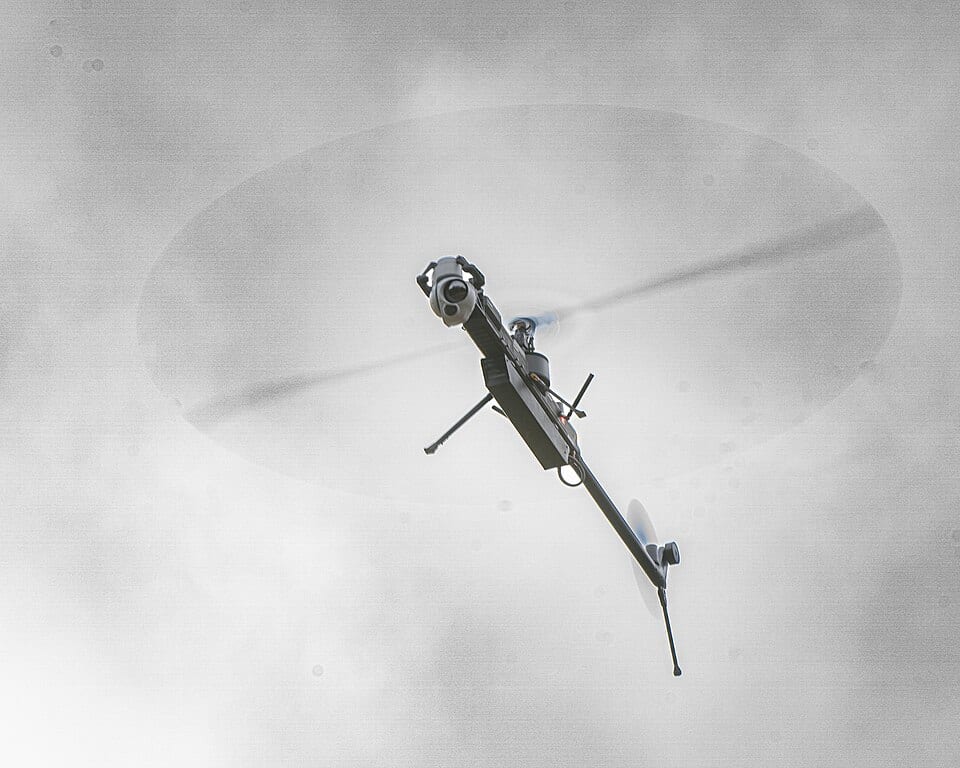
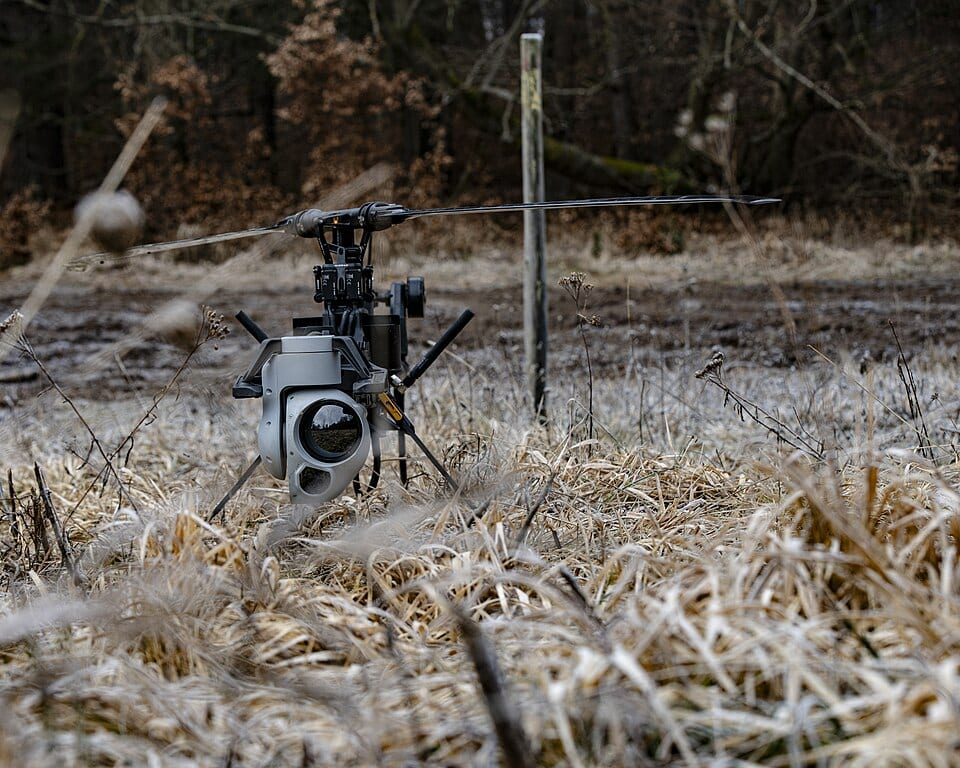
Ghost and Anvil. Ghost is the reconnaissance drone family, with more than ninety minutes of flight endurance. Anvil is its opposite: a small drone built specifically to intercept and bring down enemy drones. It has become one of the most sought-after products since drone swarms turned into the primary threat on modern battlefields.
Fury, designated YFQ-44A. The uncrewed combat aircraft selected by the US Air Force, alongside rival General Atomics, for the Collaborative Combat Aircraft programme: war drones designed to fly beside crewed fighters such as the F-35, at a unit cost the Air Force wants to hold below $30m, roughly a third of an F-35. The stated target for this first batch is more than 150 aircraft by the end of the decade, inside a longer plan aiming at around a thousand CCAs for the Air Force.
Barracuda and Roadrunner. Barracuda is a missile family with ranges up to 800km. Roadrunner is stranger: something between a drone and a missile, able to launch, intercept a target and — if it finds nothing, or the mission is called off — fly back and land itself, to be used again. A recoverable missile is a concept very few others are building.
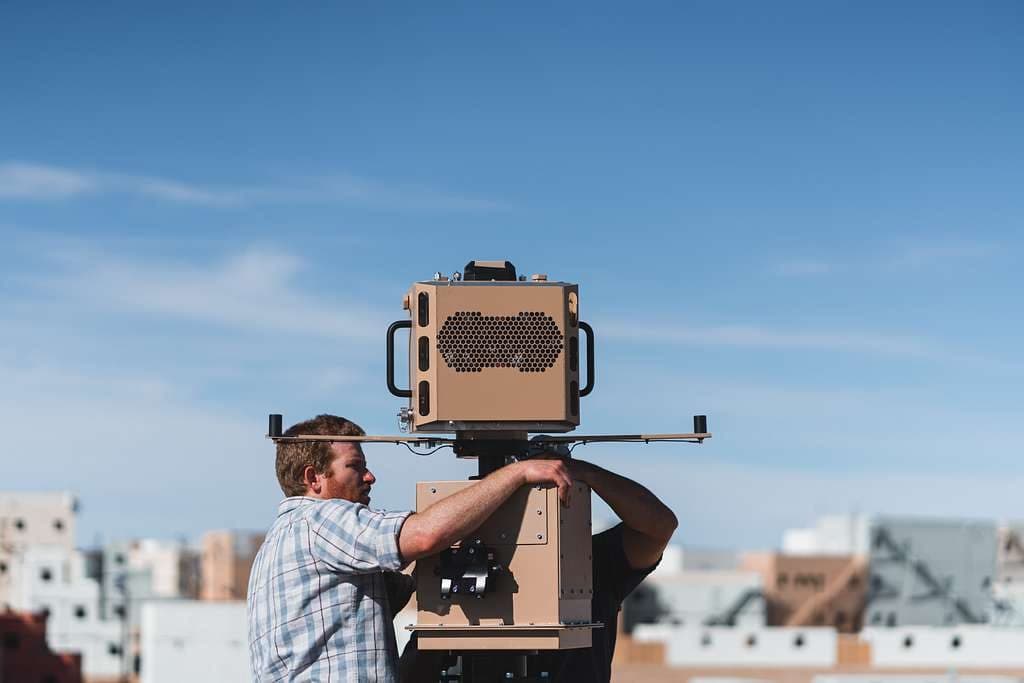
Sentry Towers. Solar-powered autonomous surveillance towers with radar and thermal cameras, designed to monitor borders and perimeters without permanent staff. This was the product that first won Anduril American government contracts, from 2018, with Customs and Border Protection along the Mexican border.
Ghost Shark. An autonomous submarine developed for the Australian navy, capable of uncrewed undersea surveillance missions. It is the sign that Anduril does not stop at air and land.
All of this is made in real factories. The largest is Arsenal-1, a $1bn plant in Ohio announced in January 2025, built for series production — not by hand, as defence contractors traditionally work, but on something closer to automotive lines.
The government relationship
Here the resemblance to Palantir gets closer still. Anduril works almost exclusively with governments and armed forces, and over the past eighteen months it has landed a run of contracts that put it at the centre of American defence strategy. In February 2025 Microsoft announced it would hand Anduril control of IVAS, the augmented-reality headset programme for the US Army, a contract originally worth $22bn that Microsoft was struggling to deliver. In March 2026 the US Army signed a ten-year framework agreement with Anduril worth up to $20bn, consolidating more than 120 separate procurement processes into a single ordering channel, with a declared focus on defending against enemy drone swarms — the threat redrawing modern warfare, from Ukraine to American civil aviation. In June 2026 came selection for the Air Force's Collaborative Combat Aircraft programme. Around the same time the United States approved a possible sale to Kuwait of nearly $2bn in counter-drone systems, and Australia committed A$1.7bn to the Ghost Shark fleet. The contested front is there too, the same one that shadows Palantir: the surveillance towers on the US-Mexico border have operated since 2018 under contract with Customs and Border Protection, for immigration control, a subject that remains politically divisive in the United States. And in July 2024 China sanctioned Anduril over its arms sales to Taiwan, a measure of how far the company is now seen as a geopolitical actor rather than a supplier.
Who put up the money
Anduril's investor list includes JD Vance personally, who invested through the Rise of the Rest Seed Fund before becoming vice-president of the United States, having previously co-founded another fund, Narya Capital. It is a detail worth knowing for anyone tracking how close the ties have become between Washington and this new generation of defence companies. Alongside the other funds — Founders Fund, Andreessen Horowitz, General Catalyst, Thrive Capital, Lux Capital — names such as 8VC and Valor Equity Partners have joined over time.
The numbers: very fast growth, and losses
Anduril's revenue went from $236m in 2022 to $1bn in 2024 and $2.2bn in 2025, a rise of 120% year on year. Guidance for 2026 points to roughly $4.3bn, nearly double the previous year. But there is a detail that readers of headlines often skip: in that same 2026 the company expects an operating loss of about $1.2bn. Anduril is growing at extraordinary speed and burning cash just as fast. Building factories, hiring engineers and developing military hardware from scratch costs money, and revenue does not yet cover it.
The valuation tells an equally steep story: $1bn in 2019, $4.6bn in 2021, $8.5bn in 2022, $14bn in August 2024, $30.5bn in June 2025, then $61bn in May 2026 on a $5bn round led by Thrive Capital and Andreessen Horowitz. By July 2026 Anduril was already in talks for a new round at a $100bn valuation, more than triple the level of a year earlier, and this before the previous round had fully settled. Headcount went from about 90 in 2019 to more than 8,500 by March 2026.
A difference that matters: it is not listed
Unlike Micron, Palantir, SanDisk and Marvell — the other companies covered here so far — Anduril has no stock you can buy. It remains a private company, financed by venture capital and private equity rather than public shareholders. Anyone who is not an institutional or accredited investor cannot own a share of it today. An IPO has been discussed for some time, but the company has so far preferred to keep raising private capital at ever higher valuations rather than list, a choice that lets it grow without quarterly public-market pressure. It is exactly what Palantir did for 17 years before its 2020 debut.
The doubts worth keeping in mind
The first is the simplest: Anduril loses money. It is growing impressively, but it has not yet shown it can turn that growth into profit, and there is no guarantee it will do so on the timetable the private market is pricing in at these valuations.
The second is the speed of the re-rating. Going from $8.5bn to $100bn in roughly four years is a pace that would make many Wall Street managers wince, and it rests almost entirely on the expectation that defence contracts keep growing at this rate — an expectation that depends on public budgets, and therefore on political decisions that can change with an administration.
The third is competition. Anduril competes with the established defence giants — Lockheed Martin, RTX, Northrop Grumman, all with decades of settled relationships at the Pentagon — and in part with Palantir itself on software, as well as with the Chinese defence industry on low-cost drones.
The fourth is less financial but real: reputation. The border surveillance work and the increasingly close ties between its backers and the sitting administration cut both ways. They open the door to enormous contracts, and they expose the company to precisely the political and public-opinion risk already seen with Palantir.
In under ten years Anduril has gone from a rented warehouse in Orange County to a company designing the next generation of automated warfare, at a valuation rivalling that of century-old banks. The problem, for anyone watching from outside, is that because it is not listed its accounts remain largely private. What we know, we know because the company or the press has told us, not because a certified quarterly filing requires it. How long that holds — and how long this expansion in defence budgets lasts — is the right question to ask.
This article is for information and editorial purposes. It is not investment advice: consider your own circumstances or consult a licensed adviser before making any investment decision. Anduril is not a listed company: the revenue and valuation figures cited come from private funding rounds and company statements, not from audited accounts.
Image credits
Photo 1: Matt Reed, a technology operations team member at Anduril Industries, assembles a Sentry Tower during Service Level Training Exercise 2-20 at Marine Corps Air Ground Combat Center, Twentynine Palms, California, 24 January 2020. U.S. Marine Corps photo by Lance Cpl. Colton Brownlee (VIRIN 200124-M-ET234-1092), public domain, via DVIDS. Cropped and tonally adjusted.
Photos 2 and 3: Ghost family drones. U.S. Army photo by Sgt. Scyrrus Corregidor, 4 February 2025, public domain, via Wikimedia Commons.
The appearance of U.S. Department of Defense visual information does not imply or constitute Department endorsement of this publication or its contents.
- defence
- drones
- venture capital
- Peter Thiel
- private companies
Newsletter
Was this analysis useful?
We publish one a week: a company taken apart piece by piece, or a story that changed the markets. It arrives by email, without the noise.