In May 2024 Novo Nordisk is worth $570bn on the stock market, more than the entire gross domestic product of Denmark, the country where it was founded. The month before, it had displaced LVMH as Europe's most valuable company. The reason is a weekly injection that millions of people associate more with Hollywood than with a hundred-year-old Danish pharmaceutical company: Ozempic, and its sister drug for weight loss, Wegovy.
Two years later the shares have lost more than 70% from that peak, the foundation that controls the company has removed the chief executive, and Novo Nordisk has cut 9,000 jobs. Meanwhile its American rival Eli Lilly has overtaken it both on the stock market — it is now worth roughly seven times as much — and, for some months now, in obesity drug sales outside the United States. How do you invent the most successful drug of the decade and still risk losing the race you set off yourself?
The origins: two Danish rivals who spent sixty years spiting each other
In 1920 the Danish physiologist August Krogh won the Nobel Prize in Medicine. The following year, on a trip to the United States, his wife Marie — herself a doctor, and diabetic — persuaded him to stop in Toronto, where a group of researchers had just isolated insulin. Krogh obtained permission to produce it in the Nordic countries and returned to Copenhagen in December 1922. The next year, together with the physician Hans Christian Hagedorn and the pharmacist August Kongsted, he founded Nordisk Insulinlaboratorium. From the outset the founders decided profits would serve scientific and humanitarian ends, and tied the company to a foundation.
In 1924 an internal dispute led to the dismissal of two employees, the brothers Harald and Thorvald Pedersen. When they announced they intended to set up on their own and produce insulin themselves, Krogh dismissed them with "you will never manage it"; the reply, "we will show you", set off a rivalry that would last decades. In 1925 the Pedersens founded Novo Terapeutisk Laboratorium, itself tied to its own foundation from 1951. For sixty-four years the two companies fought over the same market — insulin — a few kilometres from each other. Only in January 1989 did the two foundations announce a merger into a single Novo Nordisk Foundation, opening the way to the corporate merger into Novo Nordisk A/S.
That foundation still controls the company today, and it does so in a way almost no other large listed company in the world replicates. Through the holding company Novo Holdings A/S, it owns all the class A shares — unlisted, carrying 100 votes each, and which under the articles can never legally be sold — plus a block of B shares, the ones traded in Copenhagen and New York with 10 votes each. The result is that Novo Holdings owns roughly 28% of the capital but controls 77% of the votes at the annual meeting. For anyone buying Novo Nordisk shares on the market, that means a company run with a very long horizon and shielded from hostile takeovers, but also a voting power that stays, whatever the share price does, in the same hands.
What it actually sells: from insulin to the most-discussed drug of the decade
For seven decades the heart of the business was diabetes care: from NPH insulin in 1946, to the world's first insulin pen launched in 1985, through to the modern NovoRapid, Levemir and Tresiba, which still reach millions of patients alongside two smaller but profitable lines — NovoSeven for haemophilia, from 1996, and Norditropin, a growth hormone.
Then, on December 5th 2017, America's Food and Drug Administration approved Ozempic, a weekly semaglutide-based drug for type 2 diabetes. Doctors and patients soon noticed an enormous side effect: those taking it lost a great deal of weight. Novo Nordisk decided to bet on it, developed a higher-dose version aimed explicitly at obesity and called it Wegovy: the FDA approved it on June 4th 2021. It is the turn that changed the company. By 2023 Ozempic and Wegovy together accounted for roughly 55% of all revenue at a group that until a few years earlier was known, on a good day, as "the insulin company". Rybelsus, the same molecule in tablet form for diabetes, had arrived in 2019, and in 2026 Novo Nordisk launched the world's first semaglutide pill designed specifically for weight loss, an oral extension of Wegovy.
The demand that exploded over recent years far outstripped the company's manufacturing capacity, opening the door to pharmacies preparing "compounded" versions of the active ingredient — unauthorised copies, sold at a lower price — and forcing Novo Nordisk to invest enormous sums in new plants: roughly $6bn and then a further $2.3bn purely to expand semaglutide production, plus the purchase in 2024 of three sterile fill-finish sites at Anagni (Italy), Brussels and Bloomington (Indiana) for $11bn, sold on by Novo Holdings after it had acquired the whole of Catalent for $16.5bn. In October 2025 the company also bought Akero Therapeutics for $5.2bn, a sign that it is trying to build a second growth pillar — a drug for fatty liver disease — beyond GLP-1 alone.
The climb and the fall
In September 2023 Novo Nordisk passed LVMH to become Europe's most valuable company, with a market capitalisation of around $423bn. From there it kept climbing to reach $570bn in May 2024 — more than Danish GDP — and, in June 2024, an all-time high of $148.15 a share.
Then came the turning point. On December 20th 2024 Novo Nordisk published the results of the phase 3 REDEFINE-1 trial of CagriSema, the combination of semaglutide and cagrilintide that the market regarded as the real next blockbuster. The drug produced 22.7% body weight loss over 68 weeks: more than semaglutide alone (16.1%) or cagrilintide alone (11.8%), but below the 25% analysts had expected from a combination designed to beat its individual components decisively. A second figure made the reading worse: only 57% of patients had reached the drug's highest dose, a sign of tolerability problems the market did not like. The shares fell 20% in a single day — the steepest daily drop in their history — burning roughly €90bn of value, while Eli Lilly rose.
2025 is the year the rest of the problems surfaced all at once: competition from Eli Lilly (Zepbound and Mounjaro) grew more aggressive, compounded products kept eroding US market share, and in May chief executive Lars Fruergaard Jørgensen announced his resignation on the same day the company cut its growth forecast for the year from 13-21% to 8-14%. On August 7th 2025 he was succeeded by Mike Doustdar, until then head of the group's international operations and the first non-Danish chief executive in the company's history. A month later, in September, Doustdar announced 9,000 job cuts — 11.5% of the global workforce — to save $1.3bn a year by the end of 2026.
The numbers of a year the company had never seen before
On February 3rd 2026 Novo Nordisk published its first full-year guidance for 2026: adjusted sales down between 5% and 13% at constant exchange rates, the first time in the company's history that annual guidance called for a fall in revenue rather than growth. In May it revised that slightly, to a decline of between 4% and 12%, and on August 4th, after the quarterly results, improved it again to a range between 0% and -6% — still a year expected to be flat or down, but less bad than had been feared a few months earlier. In the second quarter of 2026 alone, adjusted sales nonetheless grew 7% at constant exchange rates, to DKK 78,488m, with adjusted operating profit of DKK 33,389m (+11%); over the first six months of the year net sales reached DKK 175,311m. The market, it must be said, was not entirely persuaded: despite the raised guidance, the shares lost around 5% in the days following the August results.
Part of the improvement comes from the Wegovy pill launched in 2026: by mid-July it had already passed 265,000 weekly prescriptions in the United States, the strongest launch by volume ever seen for a GLP-1 drug in the country, with roughly $355m of revenue in its first quarter on sale alone. Novo's advantage here is that its pill uses the same molecule, semaglutide, already familiar to doctors from the injectable version; Foundayo, the rival pill Eli Lilly launched in April 2026, is based on a new molecule instead, and so far is growing more slowly.
It was not enough, however, to stop Eli Lilly overtaking Novo Nordisk: in May 2026 first-quarter data showed Lilly already ahead of Novo in GLP-1 market share outside the United States, with Mounjaro alone billing $8.7bn internationally and Zepbound $4.2bn in the United States in that quarter alone — Lilly raised its 2026 guidance to $82-85bn of total revenue. In mid-September 2026 Novo Nordisk trades at around $43 a share, with a market capitalisation of roughly $145bn; Eli Lilly is worth about $1trn, nearly seven times as much, and the market rewards it with a price/earnings multiple of about 37 times against Novo Nordisk's 11 — the clearest picture of how fast expectations have flipped between the two.
On the legal front, in February 2026 Novo Nordisk sued Hims & Hers for selling an unauthorised compounded version of Wegovy; the dispute closed within days with a commercial agreement, signed on March 9th 2026, under which Hims undertook to sell only genuine Novo Nordisk products and to stop promoting compounded copies — Novo Nordisk, however, reserved the right to reopen the case in future.
The risks worth keeping in mind
The first is dependence on a single family of molecules: GLP-1, in all its forms (Ozempic, Wegovy, Rybelsus), now accounts for the overwhelming majority of growth and much of the group's revenue. Another disappointing clinical readout like CagriSema's, on any drug in the family, risks weighing on the whole company at once.
The second is Eli Lilly, which has already overtaken Novo Nordisk on market share outside the United States, has a far larger market capitalisation and a competing pill of its own on the market: if it keeps gaining ground on the oral front too, Novo's room for manoeuvre narrows further.
The third is legal: in July 2026 a group of shareholders brought a claim against Novo Nordisk alleging the company had communicated expectations for CagriSema misleadingly ahead of the December 2024 collapse. The litigation is still open and could carry both financial and reputational costs.
The fourth is price pressure: after years in which demand outran supply, the arrival of compounded alternatives and increased competition have pushed down the effective prices of the genuine drugs, and the new chief executive has had to defend the economics of the Wegovy pill publicly at the very moment he was announcing its commercial success.
The fifth is governance: the Novo Nordisk Foundation's permanent control, through shares that under the articles can never be sold, guarantees stability and a very long-term view, but it also means 77% of the votes stay in the same hands whatever the rest of the market thinks.
Novo Nordisk remains the company that did more than any other to create the modern obesity drug market, and in two and a half years it has gone from being Europe's most valuable company to having to explain to investors why its stock is worth a fraction of its main rival's. It has not lost the patients who use Ozempic and Wegovy every week, nor its position as the first company to open that market: it has lost the bet that nobody else would manage to keep up so quickly.
The paradox of Novo Nordisk is that the collapse in the share price does not necessarily mean the company has become mediocre. It means expectations had become extraordinary, and that the market is now valuing it as a pharmaceutical company facing competition, rather than as a monopolist of obesity. Its position remains enormous, but the market no longer credits it with the certainty of dominating on its own the sector it helped create.
Staying in charge of a market you invented yourself, it turns out, is harder than creating it.
This article is for information and editorial purposes. It is not investment advice: consider your own circumstances or consult a licensed adviser before making any investment decision. The financial figures and guidance reported here come from official releases by Novo Nordisk and Eli Lilly; the market shares, stock market multiples and competitive comparisons cited are in part estimates from outside sources rather than certified data. Market data is current as of mid-September 2026 and can change quickly.
Image credits
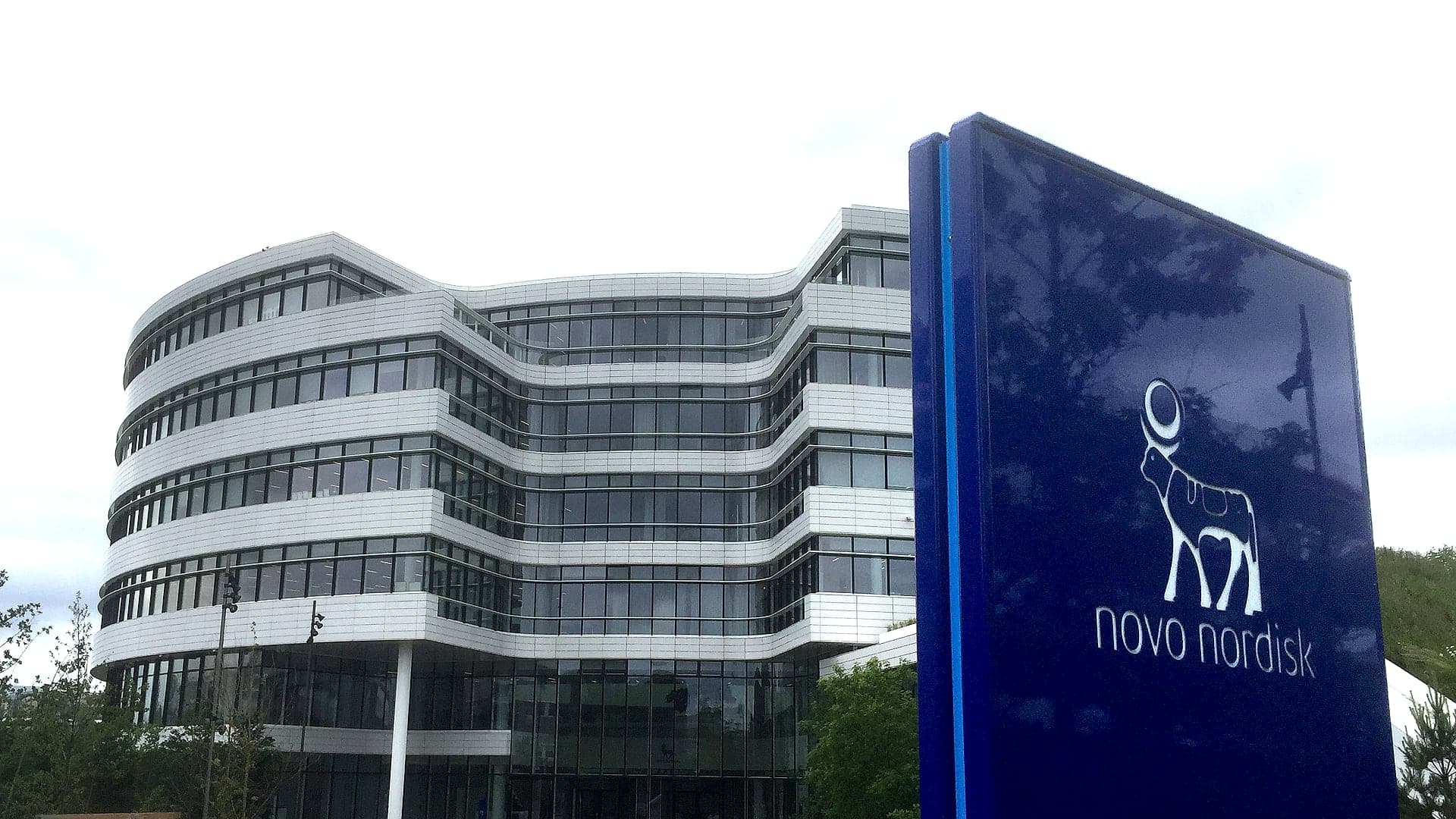
Photo: Novo Nordisk's headquarters in Bagsværd, Denmark. © News Øresund — Johan Wessman, via Wikimedia Commons, licensed CC BY 3.0. Resized and tonally adjusted.
- pharmaceuticals
- obesity
- GLP-1
- Denmark
- foundations