Colleferro, fifty kilometres south-east of Rome, was known for most of the twentieth century for one thing only: gunpowder and explosives. Thousands of workers were employed there, in dangerous conditions: in 1938 an explosion at the plant killed 59 people, as the Italian news site Il Post has reconstructed. Yet it was from that same factory that, decades later, the road began that led Italy to take the industrial lead in building one of Europe's space launchers. Did you know that the rocket that sends Europe into orbit was born in a former explosives factory?
From explosives to rockets: the story of Colleferro
It all begins in 1912, when senators Giovanni Bombrini and Leopoldo Parodi Delfino found Bombrini Parodi Delfino, BPD, in Colleferro: ammunition and explosives, first for the army and later also for civil and mining use. It is a war company, which grew during the two world wars, with all the risks that entails: the 1938 tragedy proves it.
The turning point comes later, between the 1920s and the early 1960s. As early as 1927 the first experiments with chemical rocket propellants begin at the Colleferro plant. After the war BPD starts developing ever more sophisticated propulsion systems for missiles, until in the 1960s it becomes part of the San Marco programme: between 1961 and 1964 an Italian team led by the engineer Luigi Broglio builds San Marco 1, the first Italian satellite, and puts it into orbit. The launcher was not yet Italian (it was carried into orbit by a NASA Scout rocket, launched from Wallops Island in the United States), but the launch operations were run by an all-Italian team: an achievement that made Italy the third country in the world, after the Soviet Union and the United States, to put its own satellite into orbit. In 1966 comes the first real international space contract: the European agency ELDO entrusts BPD with apogee motors for satellites. The propulsion supply chain born in those years in Colleferro is the same one that, decades later, will build the engines of Europe's launchers.
From Fiat to Cinven: sixty years of changing owners
From here on, Avio's story is also a story of changing owners. In 1968 BPD is bought by SNIA Viscosa and becomes SNIA-BPD. In 1975, the year ESA is founded, the company develops the separation motors for the European Ariane rocket, and in the following years becomes the supplier of solid-propellant boosters for later generations of the launcher. In parallel there is another story, that of Fiat Aviazione, which has been making aircraft engines since 1916: in 1989 it becomes FiatAvio S.p.A. and in 1994 it absorbs SNIA-BPD, bringing aircraft engines and space propulsion under the same roof for the first time.
In 2003 FiatAvio is sold for 1.5 billion euros to a consortium of Carlyle (70%) and Finmeccanica (30%), and takes the name we know today: Avio S.p.A. In 2006 the British fund Cinven takes over Carlyle's stake for 2.57 billion euros. It is in these years, between 2006 and 2012, that Vega is developed: an ESA programme involving seven member states (Belgium, France, Italy, the Netherlands, Spain, Sweden and Switzerland), with Italy in a leading role and Avio as prime industrial contractor, through its subsidiary ELV, of which it owns 70% (the rest belongs to the Italian Space Agency). The first flight comes in February 2012.
In 2013 comes an important split, still a source of some confusion today: General Electric buys the aircraft engine division for 3.3 billion euros, and it becomes Avio Aero, now part of GE. The space business, the launchers, stays with Cinven and Finmeccanica under the name Avio S.p.A.: that is the company this article is about, different from its aeronautical "cousin". In 2015 Giulio Ranzo arrives as chief executive and general manager, replacing Pier Giuliano Lasagni, after a career in strategy consulting for aerospace and defence. Finally, on 10 April 2017, Avio lists on the Italian stock exchange by merging with the SPAC Space2: according to the company's own statements at the time, it becomes the first space launcher maker to go public.
What it does today: building (and now also selling) space launches
Avio's best-known product is Vega, the rocket that carries small and medium satellites into orbit for the European Space Agency, lifting off from the spaceport of Kourou, in French Guiana. The original Vega flew from 2012 to September 2024, with 20 launches and 18 successes, before retiring after its last flight on 5 September 2024, which carried the Sentinel-2C satellite into orbit. Its successor, Vega C, had a difficult start: on 21 December 2022 flight VV22 failed because of the erosion of a second-stage component, the nozzle of the Zefiro 40 motor, supplied by a Ukrainian company, as the independent inquiry commission established in March 2023. Vega C only returned to flight on 5 December 2024, with the Sentinel-1C satellite, after two years of grounding and checks.
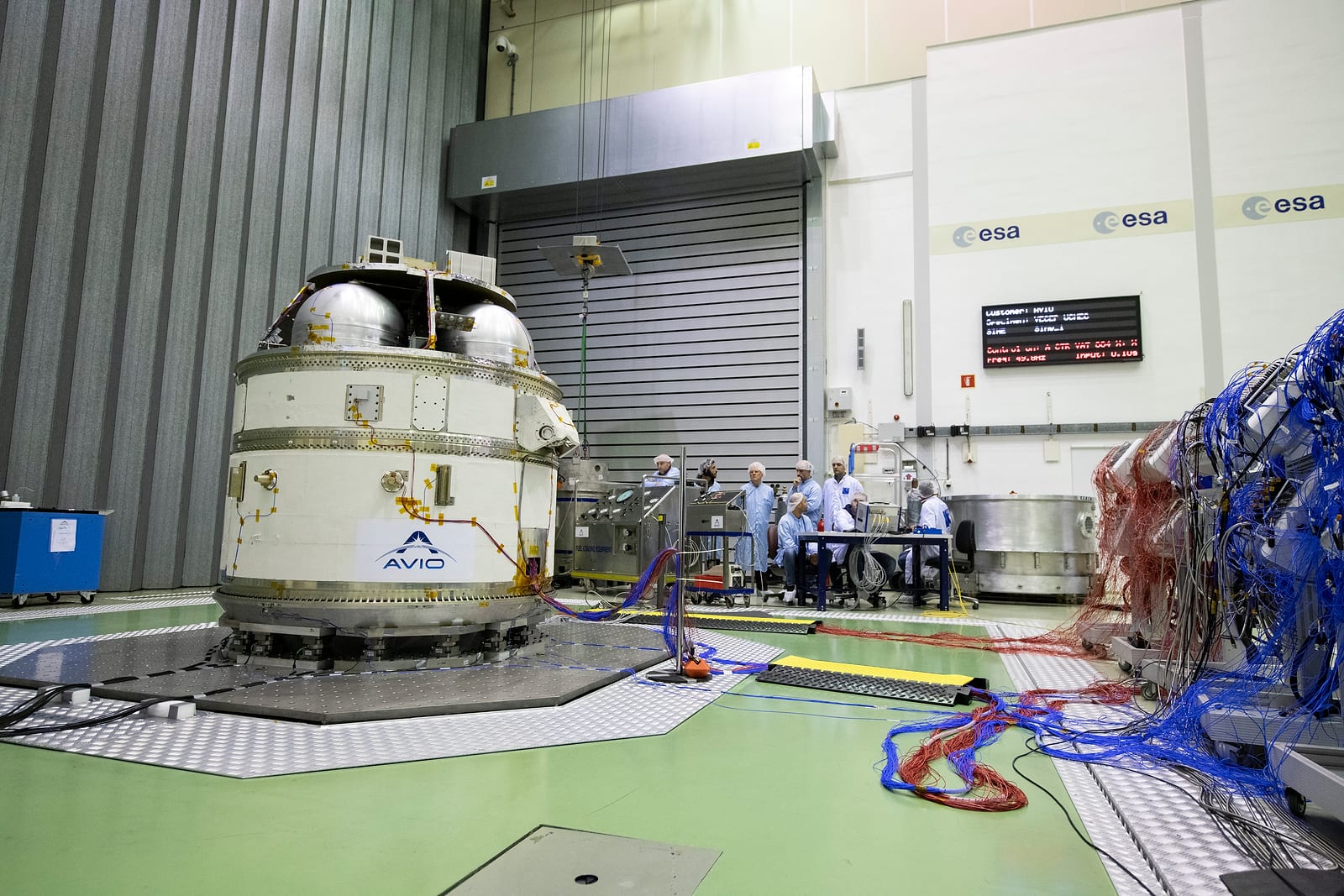 The last stage of Vega C, AVUM+, during vibration testing at ESA's ESTEC centre in Noordwijk, the Netherlands, in November 2018: the table simulates the shaking of a launch.
The most important change, though, is more recent and concerns Avio's very role: since 19 May 2026 the company no longer just builds Vega C, but has also become the direct operator of its launch services, a handover of responsibility from Arianespace that ESA had already announced in 2024. The first flight run by Avio in this new role, mission VV29, carried Smile into orbit, a joint science mission of ESA and the Chinese Academy of Sciences. It is no small change of business model: from building the rocket on behalf of others to directly providing and selling the launch service, capturing a bigger share of the value of every mission.
Vega E, the next step
The next chapter is called Vega E: it keeps the first two stages of Vega C but replaces the solid-propellant upper stages with a single liquid-fuel stage, driven by a new engine, the M10, which burns methane and liquid oxygen and was successfully tested in 2022. The first flight is expected in 2027; according to Avio it will be simpler to build and more sustainable than the solid-propellant stage it replaces.
Not just rockets: motors for Ariane 6 and for defence
Vega is not the only product. Avio also takes part in the Ariane 6 programme, Europe's new heavy launcher, through Europropulsion, a 50-50 joint venture with France's ArianeGroup that makes the P120C solid-propellant motor: the same motor, unmodified, serves both as the first stage of Vega C and as a booster for Ariane 6. On 14 November 2025 the two companies signed a contract worth more than 200 million euros, running until 2029, which mainly concerns the P160C, as well as additional turbopumps for Ariane 6's Vulcain engine. The P160C is a larger version of the P120C, one metre longer and carrying about 15 tonnes more propellant, designed for the next generations of both launchers (Vega C Block 2, Vega E and Ariane 6 Block 2), and it already made a successful debut on Ariane 6 in June 2026.
Then there is a third business, the one growing fastest: defence. Avio makes solid-propellant motors for European tactical missiles, in particular the Aster 30, used in air defence, and the CAMM-ER, supplied to the missile group MBDA. According to figures reported by Startmag and attributed to management, defence's share of revenue has gone from a historical 5% or so to around 10% recently, with a forecast of 17% for 2026 and a target stated by Ranzo of about 40% within five years: figures that come from the company itself, not from an independent source. On this front Avio is also entering the United States: on 10 November 2025 it signed, on the same day, a memorandum of understanding with Raytheon (RTX) and a term sheet with Lockheed Martin to build a new American plant for solid-propellant motors, including the Mk104 motor for Raytheon. Both defence giants will have priority access to part of the production capacity, while Avio will remain an open supplier to other customers too. Funding for this expansion arrived in July 2026 from the American fund Advent International, which subscribed to a reserved capital increase, acquiring 6.54% of Avio for 109.4 million euros, at 33.40 euros per share.
The stock
The results for the first half of 2026, released in September, mark a turning point: net revenue of 276 million euros, up 17.5% on the previous year (the fourth half-year in a row of double-digit growth), and a return to net profit, 9.2 million euros against a loss of 187,000 euros in the same period of 2025. Reported EBITDA rises to 11.9 million euros (+19.1%), but consolidated EBIT, the operating result after the heavier depreciation that comes with stepping up Vega C production, remains thin: 1.2 million euros. The order backlog, while still above 2 billion euros, fell 5.4% from the end of 2025, although about 160 million euros of new orders came in during the half, about two thirds of them linked to defence.
In the session after the results were published, the stock rose 6.75%, closing at 29.90 euros. Avio confirmed its guidance for the whole of 2026 (revenue between 560 and 590 million euros, reported EBITDA between 27 and 35 million, net profit between 8 and 13 million), and Equita SIM raised its price target from 28 to 45 euros, while keeping a neutral rating and calling the guidance itself "conservative" in light of the first half's momentum.
Source: Yahoo Finance, weekly closing prices. Data as of 29 September 2026.
The doubts to keep in mind
The first is structural: launching into space from Europe costs more than doing it from the United States. A 2026 study by Alessio Terzi and Francesco Nicoli, published in Economics Letters and based on more than 6,700 launches between 1960 and 2025, estimates a unit economic cost (not the price paid by customers, but recurring production costs) of 3,225 dollars per kilogram in the United States against 9,897 dollars in Europe: a gap that mainly reflects SpaceX's advantage in launch cadence and rocket reuse. Independent access to space has political and strategic value for Europe, but it does not erase the competitiveness problem on the commercial market.
The second is margins: consolidated EBIT of just 1.2 million euros on 276 million of revenue, for the whole group, space and defence together, shows how thin margins remain even as revenue grows at double digits. Avio's bet is that higher volumes and becoming the direct launch operator, rather than just a supplier, will improve these margins over time, but that is still to be proved in the numbers.
The third is technical: the 2022 failure showed how a single faulty component, supplied by a third party, can ground the entire fleet for two years. With production rising and new engines in development (Vega E, the P160C), the risk of technical problems remains real.
The fourth is reusability, or rather the delay in achieving it: the European demonstrator Themis, designed to test recovering and reusing rockets, has fallen behind the original plans of the early 2020s and by mid-2026 had still not carried out its planned demonstration flight. Until Europe catches up on this front, the cost gap with SpaceX is unlikely to close.
The fifth is the American bet: entering US defence means competing, and at the same time cooperating, with giants such as Raytheon and Lockheed Martin in a market where Avio is a newcomer, still without an operating production plant on American soil.
Avio tells two stories at once: that of an industrial success that took Italy from the gunpowder of Colleferro to leading the construction of a European launcher, and that of a company now trying to grow bigger by betting on defence and the United States, with margins still razor-thin and a cost gap with America that remains open. What counts more, the history that brought it this far, or the numbers it still has to prove?
The information contained here does not constitute financial advice: before making any investment decision, consider your own personal situation or consult a qualified adviser. The market and financial data cited are as of September 2026 and may change quickly.
Image credits
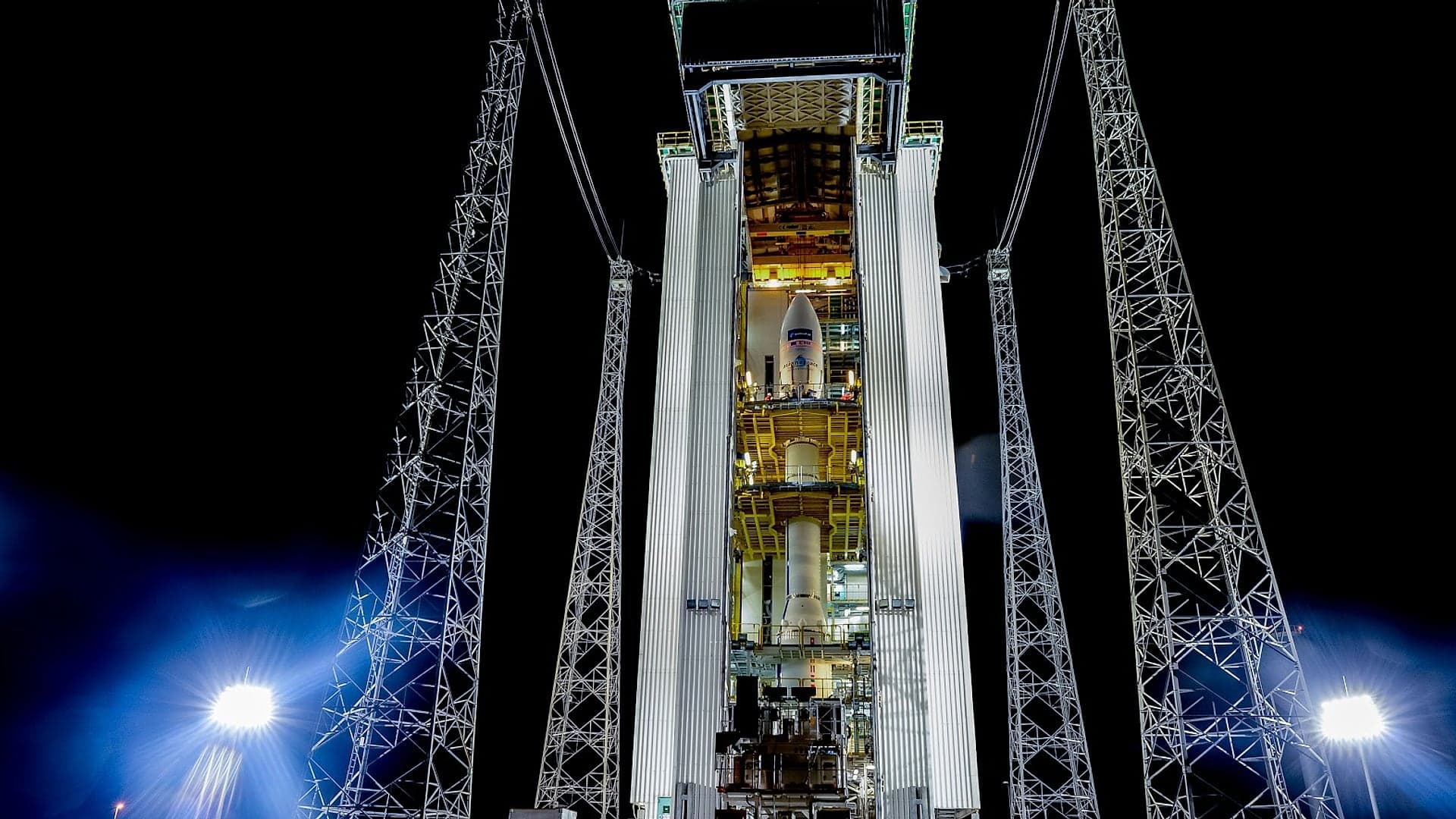
- Cover: "Vega VV05 assembled in ELV.jpg" by ESA–M. Pedoussaut (ESA_events), via Flickr and Wikimedia Commons, licensed under CC BY-SA 2.0. Cropped and enlarged; the modified version is distributed under the same licence.
- In the text: "Vega-C upper stage shaker test.jpg" by the European Space Agency, via Wikimedia Commons, licensed under CC BY-SA 3.0 IGO. Resized; the modified version is distributed under the same licence.
Sources
- Avio — "History" (avio.com); Wikipedia, "Avio (azienda)".
- Il Post — "I razzi di Colleferro", 7 March 2022.
- ANSA and INAF — the 60th anniversary of the San Marco 1 launch, December 2024.
- ESA — "Vega organisation" (esa.int): the seven member states of the programme and the industrial role of ELV and Avio.
- Formiche.net — "Chi è Giulio Ranzo, il nuovo AD di Avio", October 2015.
- Il Fatto Quotidiano — "Vega C, commissione d'inchiesta: 'Volo fallito per problemi al motore Zefiro 40'", 3 March 2023; Wikipedia, "Vega C flight VV22".
- ASI, Borsa Italiana and Teleborsa — the VV29/Smile launch and Avio's debut as Vega C launch operator, 19 May 2026.
- Avio — "Solid Propulsion" page (P120C and P160C) and press release on the Ariane 6 contract with ArianeGroup, reported by Analisi Difesa, 14 November 2025.
- Avio — press releases "Risultati primo semestre 2026" (September 2026) and on Advent International's investment (July 2026).
- Avio — press releases on the agreements with Raytheon/RTX and Lockheed Martin for the new US plant, 10 November 2025.
- Startmag — defence's share of revenue, according to management.
- Forbes Italia — "Avio torna in utile e prepara nuove acquisizioni. E il titolo vola in Borsa", 11 September 2026.
- Terzi A., Nicoli F. — "Geopolitics and Space Access: Cost Asymmetries and Strategic Dependence", Economics Letters, August 2026, as summarised by New Space Economy; Tom's Hardware, on the risks for the Italian supply chain.
- space
- launchers
- Vega
- Ariane 6
- defence
- Colleferro
- ESA
- Milan stock exchange