In October 2025 AMD signed a contract with OpenAI and, to win it, handed the customer the right to buy 160 million of its own shares at a cent apiece. Four months later it did the same with Meta: another 160 million shares. Together that is roughly a fifth of the company, promised to its two largest customers to induce them to buy its chips.
It is an unusual arrangement even by Silicon Valley standards, and it explains where AMD stands right now better than any chart: a company that after ten years of rebuilding finally has a competitive artificial-intelligence product, but which — to get into a market where the incumbent holds almost everything — has to pay an enormous entry price. If it works, AMD becomes the second source the AI industry has been looking for for three years. If it does not, it will have sold off a piece of itself for nothing.
The origins: fifty years chasing Intel
AMD was founded on May 1st 1969 in Sunnyvale, California, by Jerry Sanders III together with seven former colleagues from Fairchild Semiconductor. The original model was "second source": manufacturing chips designed by others under licence, guaranteeing customers a second supply line. Out of that came the relationship that would define the next fifty years. In 1982 an agreement with Intel allowed AMD to produce x86 processors for IBM PCs, and from that agreement came a legal battle lasting more than a decade, which AMD won in 1995, securing the right to develop x86 processors of its own. In the early 2000s the Athlon 64 beat Intel on its own ground and introduced the 64-bit architecture that still carries the name AMD64.
Then came the fall. In 2009, crushed by costs and the financial crisis, AMD spun its factories out into a separate company, GlobalFoundries. It was a symbolic reversal as much as an industrial one, because Jerry Sanders had become famous for one line in particular: "real men have fabs". From that point on AMD designs and nothing more, and has its chips built by others — today above all by TSMC. Rock bottom came in the middle of the last decade, with the Bulldozer architecture proving something of a disaster and market share in free fall.
On October 8th 2014 Lisa Su became chief executive. Born in Tainan in 1969, an electrical engineer with a doctorate from MIT, her choice was to walk away from low-margin markets and concentrate everything on a new modular architecture, Zen, built around "chiplets": instead of one giant chip that is expensive to manufacture, many smaller blocks assembled together. Zen arrived in 2017 with Ryzen processors for PCs and EPYC for servers, and within a few years handed AMD back share it had been losing for two decades. The two acquisitions that followed explain where the company is heading today: Xilinx, the programmable-chip specialist, completed in February 2022, and ZT Systems, a data-centre infrastructure maker, bought for $4.9bn and integrated in 2025. The second in particular gave AMD a capability it did not have before: designing and selling not a chip, but an entire rack.
What AMD does today
The company reports its accounts across three segments. Data Center is the heart of it and on its own accounts for more than half of revenue: it contains EPYC, the server processors with which AMD has been eating into Intel's share for eight years, and Instinct, the AI accelerators that compete directly with Nvidia's GPUs. Client and Gaming gathers Ryzen processors for PCs, Radeon graphics cards and the semi-custom chips for consoles, since PlayStation and Xbox both run on AMD silicon. Embedded is the Xilinx inheritance: programmable chips for industry, automotive and telecoms, the segment with the highest margins and the slowest growth.
Behind all of it sits ROCm, the software platform that lets developers run AI models on AMD hardware. It is the least eye-catching and most decisive piece of the story, because it is exactly the ground on which Nvidia built its hardest-to-attack advantage, with CUDA, over nearly twenty years of work.
Helios: AMD stops selling chips and starts selling racks
On July 23rd 2026, at the Advancing AI conference in San Francisco, Lisa Su made the most important announcement in the company's recent history. Not a chip: a complete system.
First, though, a piece of naming that the press releases make confusing. MI400 Series is the accelerator family, MI455X is the flagship model fitted inside Helios, and the contracts almost always refer to "MI450 Series", the commercial name used before the individual designations were settled. In practice they all describe the same generation.
Helios is a data-centre rack, as tall as a person and twice the width of a standard one, holding 72 MI455X accelerators and 18 EPYC "Venice" processors, plus AMD's networking and software. The point is not the individual component: it is that all 72 accelerators work as though they were a single enormous graphics card. It is how Nvidia sells its NVL72 systems, and it is why this announcement matters: until yesterday, large customers bought Nvidia chips inside Nvidia systems and loose AMD chips to assemble themselves. From now on they can buy the rack from either. There is a difference of philosophy too: to link its accelerators together AMD uses UALink, an open standard backed by Broadcom, Google, Intel, Meta and Microsoft, while Nvidia uses NVLink, which is proprietary.
From the stage, Su said Helios was already in production, with first shipments expected by the end of September 2026 and demand running ahead of the company's internal expectations.
Helios technical specifications, for those who want them
The figures below are those published by AMD on its own website, and they are theoretical peak values stated by the manufacturer: not independent measurements.
A single MI455X accelerator carries 432GB of HBM4 memory, with stated bandwidth of up to 23.3TB/s and around 40 PFLOPS of compute at FP4 precision. Memory is the line AMD leans on as its main argument: more memory on board means larger models can sit inside a single accelerator without being split across several cards, and in today's AI workloads it is often memory, not compute, that is the real bottleneck. A complete rack reaches 31TB of HBM4, 2.9 exaFLOPS at FP4 and 1.4 exaFLOPS at FP8, across 18 compute trays of four accelerators each. The chips are manufactured by TSMC on a 2-nanometre process.
FP4 and FP8 are low-precision number formats: they indicate how many bits are used to represent the numbers the chip grinds through. Fewer bits means faster calculations and less memory occupied, at the cost of lower precision. FP4 is typically used for inference, that is, for running an already-trained model, while FP8 is also used for training, where more precision is needed. That is why the same chip quotes two very different numbers. Which leads to the caveat that matters most of all: these values are not comparable with another manufacturer's except at identical format and identical workload, and neither of them tells you how fast a real model will actually run. That is what independent benchmarks on delivered systems tell you, and for Helios they do not exist yet.
The contracts, and what "six gigawatts" actually means
What makes AMD's 2026 different is not the products themselves, but the fact that some of the largest customers in the world have committed in advance to buying them.
A preliminary note is needed, because the way the press reports these numbers is often misleading. A "6-gigawatt" contract is not an order for a quantity of chips, nor a value in dollars: it is a commitment to install AMD hardware up to a certain level of electrical capacity drawn, spread across several years and several product generations. It is measured that way because in today's data centres the constraint is not the number of processors available, but the power that can be brought into a site and dissipated there. These are almost always "up to" commitments, with tranches tied to successive milestones, rather than firm orders already paid for.
OpenAI, October 2025. A multi-year agreement to deploy 6 gigawatts of AMD GPUs, with the first gigawatt due in the second half of 2026. The part that pushed the stock up more than 20% in a day, though, is the warrant, whose exact terms are in AMD's filings with the SEC — the right to purchase up to 160 million AMD shares at $0.01 each, exercisable until October 5th 2030. The shares vest in tranches tied both to the volumes OpenAI actually buys and to AMD's share price reaching certain levels. Set against shares outstanding, those 160 million are worth roughly 10% of the company. It is worth remembering that a few days later, on October 13th 2025, the same OpenAI announced 10 gigawatts of self-designed accelerators with Broadcom: none of these agreements is exclusive.
Meta, February 2026. Same structure and same scale: 6 gigawatts over five years, the first gigawatt in the second half of 2026, accelerators customised for Meta's workloads and a second warrant for up to 160 million shares. AMD's release gave neither an exercise price nor thresholds: the figure of $600 for the final tranche circulates via the Wall Street Journal and reconstructions of the conference call, not from an official source. Chief financial officer Jean Hu did, however, say openly that the agreement should generate revenue on the order of "tens of billions of dollars per gigawatt".
Anthropic, July 2026. Up to 2 gigawatts of accelerators inside Helios systems, the first gigawatt in the first half of 2027. No warrant here, but a commitment by AMD to invest up to $5bn in Anthropic stock, alongside an engineering collaboration that involves using Claude, Anthropic's model, to accelerate ROCm development.
The most concrete and most precisely dated commitment of all, though, comes from Oracle: on October 14th 2025 the two companies announced that Oracle Cloud Infrastructure would be the first cloud operator to offer a publicly available supercluster based on MI450, with an initial deployment of 50,000 accelerators from the third quarter of 2026. That is a unit count, with a date: in a sea of announcements measured in gigawatts, it is the only one that is genuinely verifiable. Microsoft has confirmed it is using Helios racks on Azure for large-scale inference.
How big is AMD next to Nvidia, really
Here comes the question everyone asks and almost nobody answers honestly, because no precise answer exists: there is no certified data on market share in AI accelerators. No authority publishes it, the companies do not disclose it, and the estimates in circulation come from private research firms using different methodologies. Those available for 2026 put Nvidia at between 73% and 86% of the market by revenue and AMD at between 5% and 10% — the range is wide because it depends on whether you include the custom chips the cloud giants have designed for their own use, such as Google's TPUs or Amazon's Trainium, drawn up alongside partners like Broadcom and Marvell.
There is, though, one comparison that requires nobody's estimates, because it can be read straight off the accounts: in the quarter closed in August 2026 Nvidia reported roughly $89bn of revenue from its data-centre segment alone, while AMD's entire data-centre segment — AI accelerators and server processors combined — made $6.7bn. A ratio of more than thirteen to one. That is the context in which every contract described above should be read: AMD is not threatening Nvidia's leadership, it is trying to become the credible second source in a market that today has only one.
And this is where the story becomes more interesting than a league table. The significant thing is not any single 6-gigawatt contract: it is that Meta, Oracle, Microsoft and Anthropic are all moving in the same direction at the same time. Part of AMD's value to those customers lies not in the chips they buy today, but in finally having an alternative to put on the table when they negotiate with Nvidia. AMD does not need to reach 30% of the market for this to work: it needs only to be credible enough that every large buyer can say that, if price and terms are not right, it can go elsewhere. It is a less spectacular role than that of the challenger dethroning the leader, but it explains why customers who could have carried on buying only Nvidia have decided to bankroll the rise of a second supplier.
One piece of colour that lands oddly in this rivalry: Lisa Su and Jensen Huang, Nvidia's founder and chief executive, are related. She confirmed it herself in 2020, describing it as "a complicated second-cousin relationship"; a Taiwanese genealogist, Jean Wu, later worked out that Huang's mother is the sister of Su's grandfather, and an Nvidia spokesperson confirmed the connection to CNN. They did not grow up together and met only as adults, already inside the chip industry.
The numbers
The figures below come from the official second-quarter 2026 results release, published on August 4th.
AMD posted record revenue of $11.5bn, up 50% year on year, with net income of $2.3bn. The Data Center segment reached $6.7bn, up 107%, accounting for 58% of the total. The client business grew 23% to $3.1bn, gaming fell 31% to $779m on lower semi-custom revenue, and embedded came in at $977m. For the third quarter the company guided to around $13bn. To give a sense of the change of pace: across the whole of 2025, AMD's revenue was $34.6bn.
Two less-celebrated details. Operating expenses grew 40% year on year, to $3.4bn. And on the conference call management said explicitly that manufacturing yields on a product as complex as Helios will improve over the first quarters of the ramp, with an effect on early margins.
The quarter, it has to be said, was received badly: despite record numbers and guidance above expectations, the stock lost around 9% in after-hours trading. It is the same script seen three weeks later at Nvidia, which beat estimates on August 26th and still closed down. At these valuations, beating consensus is no longer enough: the market already prices exceptional growth as the base case, and moves only on what accelerates or slows relative to that expectation.
The doubts worth keeping in mind
The first is dilution. Warrant vesting is tied in part to share-price thresholds, so the scenario in which AMD really does hand over a fifth of itself is the same one in which the stock has risen a long way — but it remains value taken from existing shareholders, and it is not always discounted with the same seriousness as the promised revenue. Underneath sits an even more interesting question: how much of the next few years' revenue will be organic demand, from customers choosing AMD because it makes sense, and how much will stay tied to financial incentives granted by the company. It will never appear in the accounts as a separate line, but it can be observed indirectly: by watching whether new customers arrive, without warrants or cross-investments, willing to buy on the same terms as everyone else.
The second is circular financing, the same pattern encountered in the Nebius story. AMD commits to investing up to $5bn in Anthropic, and Anthropic buys chips from AMD. Nvidia does the same with its own customers. As long as demand for AI compute grows at current rates the mechanism feeds itself; if it slows, the effect propagates down the chain, because everyone is simultaneously supplier, customer and shareholder of somebody else.
The third is software. The real cost of switching to AMD is not the price of the hardware, but the amount of code already written for CUDA that would have to be reworked: as long as that work stays onerous, a customer picks Nvidia even at equal performance. It is the line on which the gap is genuinely measured, and the one on which keynotes say nothing verifiable.
The fourth is execution. In February 2026 the research firm SemiAnalysis wrote that, because of production problems, Helios would see only engineering samples and low volumes in the second half of 2026, pushing mass production to the second quarter of 2027. AMD denied it publicly and in very sharp terms, and in July declared Helios in production with shipments by September — which, on the question of start dates, proves it right. What stands is the part on which the two accounts never met: starting to ship is one thing, the volume ramp is another.
The fifth concerns supply and geopolitics. The HBM memory that AI accelerators need is made by very few suppliers and prices are rising: Nvidia itself has pointed to this as the main reason for the compression in its own expected margins, and AMD, which buys from the same suppliers on structurally lower margins, feels it proportionally more. It is the same supply-demand imbalance that, on the other memory front — NAND — has blown out the margins of SanDisk: when a component is scarce, bargaining power shifts entirely to whoever makes it. On the political front, in the second quarter of 2025 the company took an $800m inventory write-down over American export controls on shipments of the Instinct MI308 chip to China — a reminder of how quickly an administrative decision can erase an entire market.
In little more than ten years AMD has gone from a company at risk of dropping out of the markets that matter to a supplier some of the biggest names in the industry have decided to bet on, and the difference from two years ago is that the bet is no longer just an analyst thesis: it is written into signed contracts. One number in this whole story is worth keeping circled over the next two years, and it is none of the ones that make headlines. Not the 6 gigawatts announced, not the exaFLOPS — how many megawatts of Helios systems are actually installed, powered up and used by outside customers by the end of 2027. An announcement is a statement of intent, a shipment is an invoice, but only a system running inside somebody else's data centre proves the product does what it promises.
This article is for information and editorial purposes. It is not investment advice: consider your own circumstances or consult a licensed adviser before making any investment decision. The financial figures and technical specifications reported here come from the company's official communications; market shares are estimates from outside analysts rather than certified data, and different sources report them with significant variation. Data is current as of September 15th 2026 and can change quickly.
Sources
AMD Investor Relations (second-quarter 2026 results release and announcements on the OpenAI, Meta and Anthropic partnerships); AMD 10-K/A for the terms of the OpenAI warrant; the AMD Helios product page for the technical specifications; Oracle's October 14th 2025 release on the MI450 supercluster; Tom's Hardware and The Next Platform for the SemiAnalysis episode and AMD's response; CNN and Tom's Hardware for Jean Wu's genealogical work; Nvidia's releases for the comparative data-centre figures; market-share estimates from Silicon Analysts, IDC and TrendForce as reported by secondary sources.
Image credits
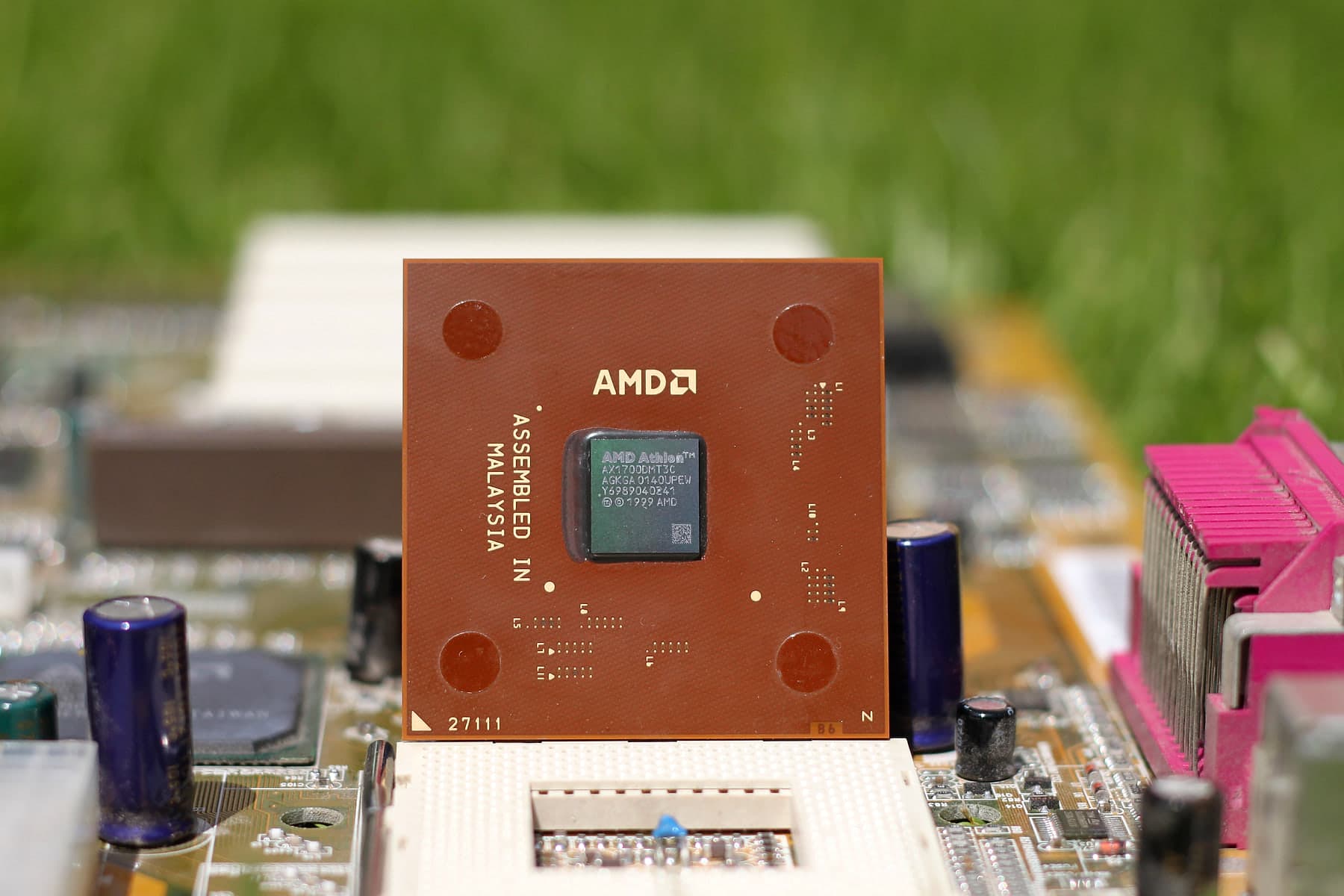
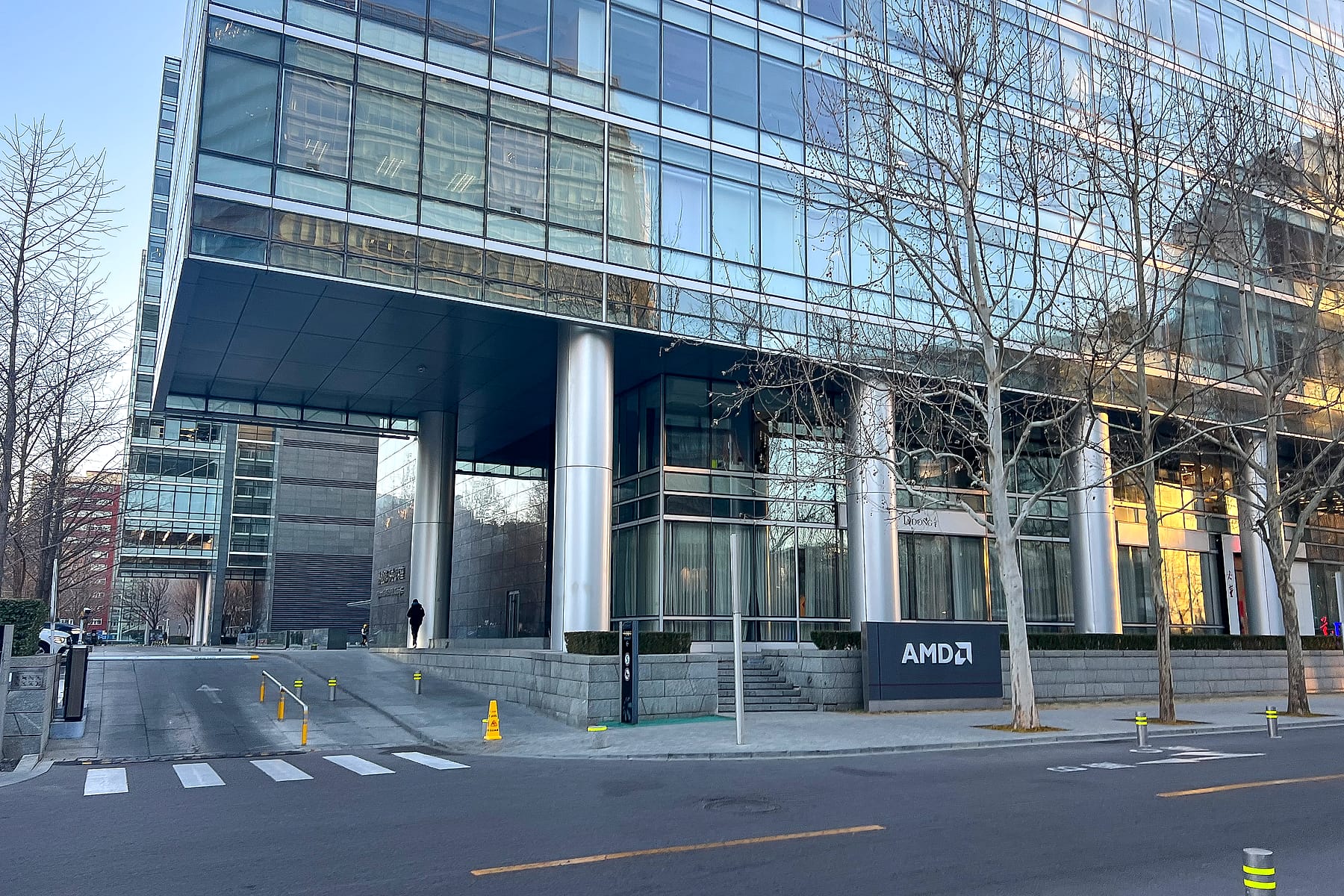
Cover: "AMD Athlon XP Palomino.Jpg" by Matthieu Riegler, via Wikimedia Commons, licensed CC BY 3.0. In the text: "North entrance of Raycom InfoTech Park Building C (20250208171243).jpg" by N509FZ, via Wikimedia Commons, licensed CC BY-SA 4.0. Both resized and tonally adjusted; the modified versions are distributed under the same licence as the originals.
- semiconductors
- artificial intelligence
- data centres
- GPUs
- custom silicon