 Bellwether
On April 1st 1984 a small group of engineers moved into a shed next to Philips's offices in Eindhoven. The rain came in. Their task was to sell a machine that Philips had spent almost ten years developing and could not afford to build just for itself. That small joint venture is now worth more than €540bn on the stock market, and it is the only company in the world that builds EUV machines, the ones needed to produce the most advanced chips in volume, from the processor in your phone to the ones that run artificial intelligence.
This is the story of how you go from a flooded shed to being irreplaceable.
The shed that leaked
ASML started life as ASM Lithography, a joint venture between Philips and ASM International, a Dutch maker of semiconductor equipment founded by Arthur del Prado. Its mandate was to sell the PAS 2000, a "stepper", the machine that projects the design of a circuit onto a disc of silicon, developed in Philips's laboratories.
The PAS 2000 was a failure, technical and commercial. It ran on a hydraulic system that leaked, and one of the first employees, Martin van den Brink, has recalled spending his time plugging leaks just before demonstrations to customers. Van den Brink would stay at ASML for forty years, rising to head of technology.
In 1985 the company, already a hundred strong, moved to new premises in Veldhoven, where it still is today. In 1986 came the PAS 2500, the first truly competitive stepper, and the same year the collaboration with Germany's Carl Zeiss on lenses began, a relationship that would prove decisive. But the money was not enough: in 1988 ASM International pulled out and Philips considered shutting the whole thing down. The company was saved by Henk Bodt, a member of Philips's board, who persuaded his colleagues to grant one last round of funding.
In 1991 the PAS 5500 came out, the first real commercial success. In 1995 ASML listed in Amsterdam and on the Nasdaq. In the years that followed Philips gradually sold its stake.
The bet on a light that does not exist on Earth
To understand the bet that made ASML what it is, you need just one idea. A lithography machine works like a projector: it shines light through a mask carrying the design of the circuit and prints it, shrunk, onto the silicon. The shorter the wavelength of the light, the smaller the details you can print.
For decades the industry used "deep" ultraviolet light, DUV, with wavelengths down to 193 nanometres. The next step was extreme ultraviolet, EUV, at 13.5 nanometres: a light found naturally in space, but which on Earth has to be produced artificially. It has an enormous problem: practically everything absorbs it, air included. So no lenses, only mirrors, and everything in a vacuum.
It took ASML about twenty years to make it industrial. Japan's Nikon and Canon, which still build lithography machines, do not make EUV.
The most delicate moment came in 2012. Development cost too much for one company alone, and ASML found an unusual solution: it asked its three biggest customers to fund it. Intel, TSMC and Samsung committed €1.38bn over five years to research and together bought 23% of ASML for €3.85bn: Intel 15%, TSMC 5%, Samsung 3%. There is a detail almost nobody mentions. The €3.85bn for the shares did not stay in the bank: ASML returned it to its other shareholders through a share buyback. What actually funded the research was the €1.38bn; the shares, which moreover carried no voting rights save in exceptional cases, served to give the customers an economic stake in the project's success. In practice the three chip giants paid to bring into being the sole supplier they would come to depend on.
The same year ASML announced the purchase of Cymer, the San Diego company that was developing the EUV light source, one of its suppliers. The deal closed in May 2013 for €3.1bn. ASML's annual report puts it bluntly: without the acquisition, Cymer would not have had the resources to finish the source on its own. In 2016 the same logic was applied to Zeiss: ASML bought 24.9% of Carl Zeiss SMT, the division that makes the mirrors, for €1bn, plus about €760m of support for research and investment.
The first EUV machine, an NXE:3100 intended for development, shipped in 2010. Mass production arrived only at the end of the decade.
Inside the machine
An EUV machine contains about 100,000 components. Delivering one takes 40 containers, 20 trucks and three cargo planes; it is taken apart into modules and reassembled at the customer's site.
The heart of it is the light source. A generator fires droplets of molten tin at about 70 metres per second. A first laser pulse flattens them into a kind of pancake, a second, much more powerful pulse vaporises them into a plasma hotter than the surface of the Sun. That plasma emits the EUV light. The process repeats 50,000 times a second. The light is then collected and guided by Zeiss mirrors, which must be smooth almost to the atomic level, to the design to be printed.
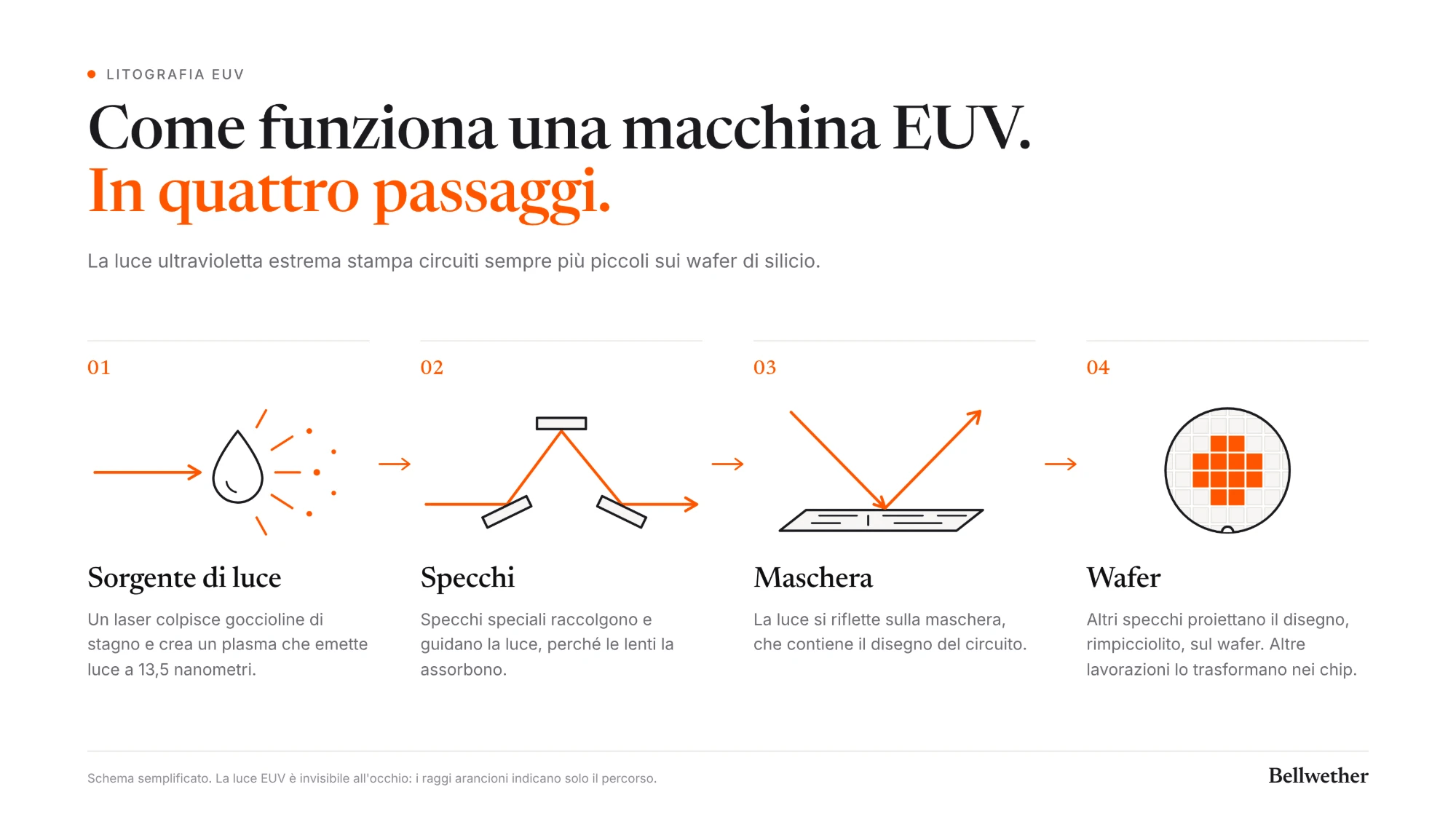 How an EUV machine works, in four steps (the labels are in Italian: light source, mirrors, mask, wafer). A simplified diagram: EUV light is invisible to the eye, and the orange rays only show its path.
The point is that ASML's advantage does not lie in a patent: it lies in a network built over forty years among German optics, lasers, software and thousands of specialised suppliers. You can steal a design; you cannot copy an ecosystem.
How ASML makes money
The model stands on two legs. The first is selling machines: few units, at very high prices. The latest generation, called High-NA, costs more than €350m apiece. Alongside EUV, ASML still sells many DUV machines, used for less advanced chips and for the less critical layers of advanced ones.
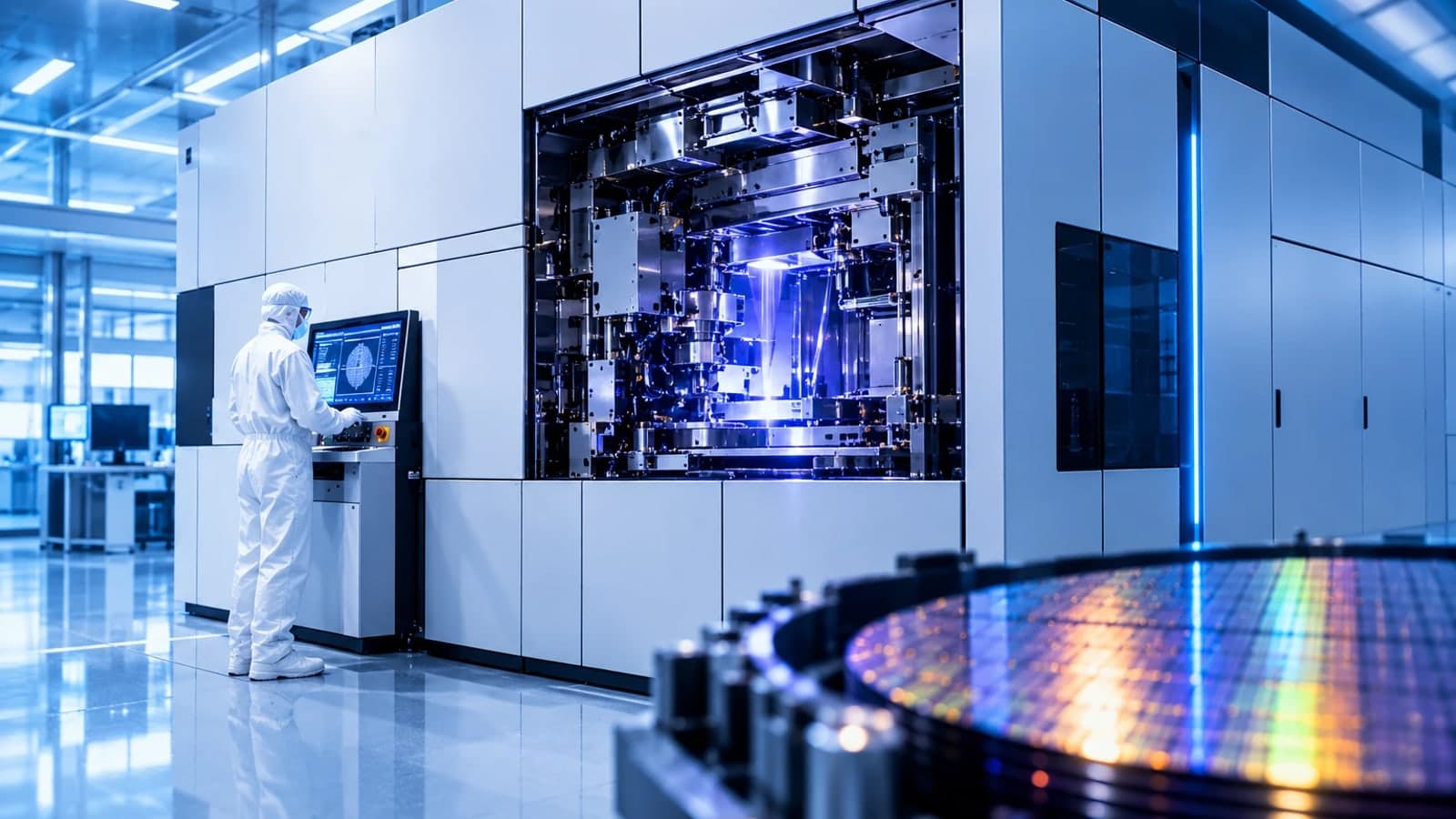
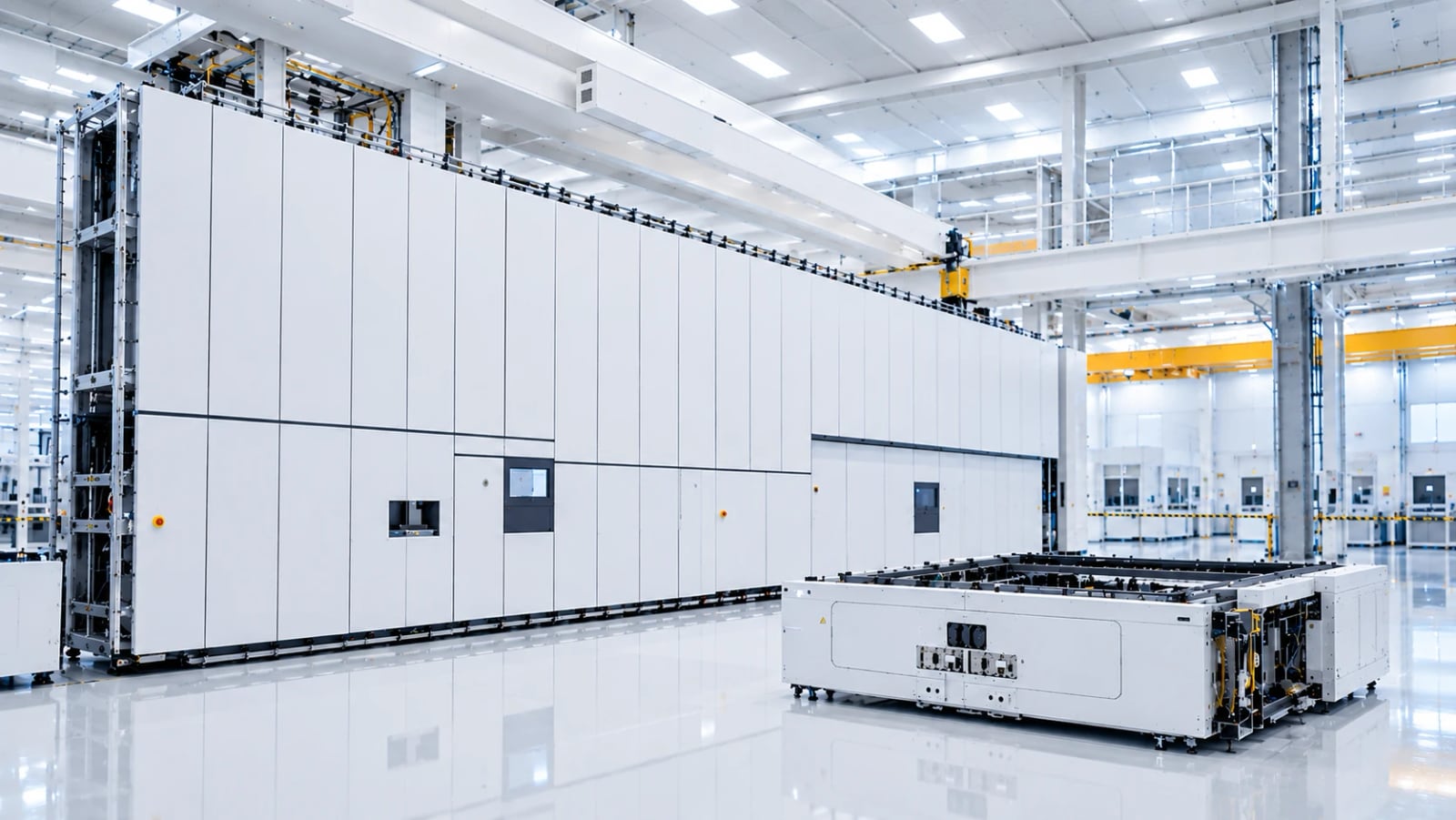 Illustration generated with artificial intelligence: a lithography machine in a chip factory. Not a photograph of a real ASML machine.
The second leg is the installed base. Every machine sold stays in a factory for years and needs servicing, spare parts and upgrades that raise its productivity. ASML calls it Installed Base Management, and it is the most stable part of revenue: in the third quarter of 2026 it brought in €3.3bn out of €11.7bn, more than one euro in four.
High-NA is the bet on the next decade: larger mirrors that make it possible to print even smaller details. Intel was the first to use it to produce chips for sale, on some layers of its processors; according to Reuters in October 2026, Samsung and SK Hynix plan to follow in 2028, TSMC in 2030. And while High-NA is only just entering factories, engineers at ASML and Zeiss have already published, in October 2026, a study on the one after it, dubbed Hyper-NA, which could be ready in about ten years. ASML has started development but has not committed to building it.
China, the United States and a company in the middle
No EUV machine has ever reached China. In 2019 China's SMIC ordered one, but after pressure from the Trump administration the Dutch government did not renew the export licence. Since then EUV has been banned for China, and so have the most advanced DUV machines. In June 2026 ASML had to state publicly once again that it had never shipped to China either an EUV machine or components developed for EUV.
Less advanced DUV machines, on the other hand, can be sold, and Chinese customers bought them in bulk: in 2025 China accounted for 33% of ASML's revenue, its biggest market by far. For 2026 the company expects that to fall to around 20%. But the third quarter went the other way: according to the South China Morning Post, sales to China more than doubled from the previous quarter, rising to 23% of machine sales.
In the background is the MATCH Act, a bipartisan bill introduced in the US Congress in April 2026 and not yet passed. If it passed as it stands, it would ban exports to China of immersion DUV machines too and, above all, servicing of those already installed, giving the Netherlands and Japan 150 days to fall into line before Washington acts alone. Dutch prime minister Rob Jetten has said he is confident of reaching an agreement with the United States. The game is still open.
The numbers
2025 closed with €32.7bn of revenue and €9.6bn of net income, both records. In January ASML expected 2026 revenue of between €34bn and €39bn. Then it raised the forecast three times.
On October 14th 2026 it published third-quarter results: €11.7bn of revenue, 55% more than in the same quarter of 2025, and €5bn of net income, more than double. Gross margin, what is left of revenue after production costs, rose to 57.5%. For the fourth quarter the company expects between €14.2bn and €15.2bn, and for the whole of 2026 between €44bn and €45bn, about a third more than the year before.
The most interesting comparison is with the future ASML had drawn for itself. In November 2024 it set out a 2030 revenue scenario of between €44bn and €60bn. The updated forecast for 2026 already reaches that floor, four years early.
And there is the sentence that matters more than any figure. Chief executive Christophe Fouquet said that the production capacity planned for 2027 and 2028 will not be enough to meet customer demand. Yet the plan was already aggressive: in July ASML announced it intended to raise its production capacity for standard-generation EUV machines, about 65 units a year in 2026, by 30% in 2027, and was considering another 30% for 2028.
At the same time, in January the company announced about 1,700 job cuts, mainly managerial roles in the Netherlands, to slim down an organisation it described as too layered. In March more than a thousand employees walked out in protest in front of the Veldhoven headquarters.
The stock
ASML is listed in Amsterdam under the code ASML and on the Nasdaq under the same ticker. At the close on October 22nd 2026 in Amsterdam the share was worth €1,419.60, down almost 5% in a single session, for a market value of around €547bn. The fall came on a bad day for the whole sector: the evening before, America's Lam Research, another maker of chip equipment, had flagged supply-chain constraints, and the sector's stocks fell together.
Over the past 52 weeks the stock has ranged between €822.20 and €1,741: it is up about 70% from the low, but still well below the high.
Source: Yahoo Finance, weekly closing prices. Data as of 23 October 2026.
The doubts worth keeping in mind
The first is political. With the MATCH Act on the table, the risk concerns not only future sales in China but also servicing of machines already installed, part of the most stable business.
The second is visibility. Since 2026 ASML no longer publishes quarterly orders received: the last figure, at the end of 2025, showed an order backlog of €38.8bn. The company argues that the quarterly figures were too irregular to be useful, but for investors it means having to rely more on what management says.
The third is the cycle. Today demand outstrips supply because the big chipmakers are building factories for artificial intelligence. If that spending slowed, ASML would find itself with production capacity just raised by 30%.
The fourth is execution. Producing more of a 100,000-component machine depends on suppliers that are often the only ones in the world for their part, starting with Zeiss. A bottleneck at any one of them becomes a bottleneck for the whole industry.
ASML is one of the rare companies in the world with no competitor for its most important product. It is a position built on forty years of bets that could have gone wrong, and one that now puts it at the centre of a contest between superpowers.
What do you make of this technological supremacy?
Latest resultsThird quarter 2026 (July-September) · published 14 October 2026
- Revenue
- €11.7bn+55%
- vs the same quarter a year earlier
- Net income
- €5.0bn
- Gross margin
- 57,5%
Company outlook
Fourth-quarter revenue between €14.2bn and €15.2bn; 2026 revenue between €44bn and €45bn
Source: ASML official press release
Figures reported by the company. Items marked as adjusted exclude certain one-off components according to the company's own definitions. We do not report analyst estimates.
This article is for information and editorial purposes. It is not investment advice: consider your own circumstances or consult a licensed adviser before making any investment decision. The financial figures reported come from the company's official communications; sales shares by region are reported by press sources. Data is current as of October 22nd 2026 and can change quickly. The author holds no positions in the securities mentioned.
Image credits
- Cover: illustration generated with artificial intelligence, cropped to 16:9.
- In the text: diagram "Come funziona una macchina EUV" (How an EUV machine works), Bellwether infographic.
- In the text: illustration generated with artificial intelligence.
Sources
- ASML — "ASML reports €11.7 billion total net sales and €5.0 billion net income in Q3 2026", press release, October 14th 2026. investor.asml.com
- ASML — "ASML reports €32.7 billion total net sales and €9.6 billion net income in 2025", press release, January 28th 2026. asml.com
- ASML — "ASML reports €9.3 billion total net sales and €2.9 billion net income in Q2 2026", press release, July 2026. investor.asml.com
- ASML — press release on Investor Day 2024 with the 2030 scenarios (Form 6-K, SEC), November 14th 2024. sec.gov
- ASML — corporate pages on the company's history, the founding of the joint venture and how the EUV source works. asml.com, asml.com, asml.com
- ASML — "Samsung joins ASML's Customer Co-Investment Program for Innovation" (Form 6-K, SEC), August 27th 2012. sec.gov
- ASML — Annual Report 2014 (Form 20-F, SEC), note on the Cymer acquisition. sec.gov
- ASML and ZEISS — "ZEISS and ASML strengthen partnership for next generation of EUV lithography", November 3rd 2016. asml.com
- South China Morning Post — "ASML's chip equipment sales to China soar 109% despite US export curb push", October 14th 2026. scmp.com
- Reuters, via Yahoo Finance — "US targets Chinese chipmaking with proposed export restrictions on ASML and others", April 3rd 2026. finance.yahoo.com
- semiconductors
- lithography
- EUV
- Netherlands
- China
- chips
- Euronext Amsterdam
- Nasdaq