In mid-September 2026 Broadcom is worth about $1.65trn, down from the record high it set a few weeks earlier. It is still one of the ten most valuable companies in the world, ahead of Tesla and Walmart. Yet almost nobody outside the technology industry could say what it actually makes. It does not build GPUs like Nvidia, and it sells neither phones nor computers. It does something more hidden and just as central: it designs custom chips that the AI giants are wiring into their own compute infrastructure, sitting alongside Nvidia's GPUs rather than replacing them. Which is why Broadcom is, in our view, one of the most important AI stocks that gets talked about least.
Origins: from a forgotten HP division to a semiconductor giant
Broadcom's story begins a long way from where it stands today. Its roots go back to 1961, as the semiconductor division of Hewlett-Packard. In 1999 HP spun that division out, along with others, into a new company called Agilent Technologies. In 2005 the private equity firms KKR and Silver Lake bought the Agilent Semiconductor Products Group for $2.66bn and renamed it Avago Technologies. Avago listed in 2009, and in 2015 made the move that changed its fate: it acquired the original Broadcom Corporation, the networking chip company founded by Henry Samueli and Henry Nicholas, for $37bn. Avago kept its own ticker, AVGO, but took the better-known name on the market: Broadcom.
Behind almost every move in this story stands the same person: Hock Tan, born in Penang, Malaysia, with a mechanical engineering degree from MIT and an MBA from Harvard. Before semiconductors he held finance roles at General Motors and PepsiCo, then co-founded a venture fund in Singapore. In 1994 he joined Integrated Circuit Systems, a Pennsylvania chipmaker, becoming chief executive in 1999; under him the company was bought by a group of investors including Bain Capital. It was that record as an operating chief executive, rather than a purely financial background, that won him the call in 2005 to lead the newly created Avago. From then on his method has never changed: buy technology companies with solid products and loyal customers, cut costs, squeeze margins, and plough the cash generated into the next acquisition. CA Technologies in 2018 for $18.9bn. Symantec's enterprise division in 2019 for $10.7bn. And above all VMware, announced in 2022 and completed in November 2023 for roughly $61bn in cash and stock plus $8bn of assumed debt, for a total deal value of about $69bn.
Two companies in one: chips and software
Broadcom today stands on two legs. The first, the historic one, is semiconductors — which Broadcom designs but does not manufacture itself: like almost every large fabless player, it relies on outside foundries such as TSMC for physical production. This covers networking chips for data centres, RF and connectivity chips for smartphones, with Apple at the front of the queue, and components for telecoms infrastructure. The second leg, built through acquisitions, is enterprise software: VMware for virtualisation, alongside CA Technologies and Symantec for management and security software. In fiscal 2025, closed in early November, total revenue was roughly $63.9bn, split between $36.9bn of semiconductors (58%) and $27bn of infrastructure software (42%).
One detail on the Apple front is worth watching. For some months Apple has begun bringing in-house certain functions it used to buy from Broadcom, starting with the N1 Wi-Fi and Bluetooth chip introduced with the iPhone 17, which replaces the Broadcom part in that specific role. In July 2026, however, the two companies extended the rest of their collaboration — on RF chips and other custom semiconductors — through to 2031. Apple remains an important customer, just a slightly less exclusive one on individual components.
The real engine now: custom AI chips for the tech giants
What is pulling everything along, though, is a third thing, sitting inside the semiconductor segment: custom AI chips, or XPUs, designed to order for a single customer. Unlike Nvidia's GPUs, built to be generic and flexible, Broadcom's XPUs are optimised for one specific workload. And, contrary to what is often written, they are not only for inference, meaning running an already-trained model: Broadcom itself describes its platform as designed for training the most advanced models too. The economic advantage lies less in a lower cost per chip — designing an ASIC is hugely expensive up front — than in the performance-per-watt ratio and in the total cost amortised across enormous volumes, a trade-off only the large hyperscalers can afford.
Google has used TPU chips designed with Broadcom for years; Meta does the same with its MTIA accelerators, under an agreement extended in 2026 through to 2029. Anthropic, for its part, has no direct contract with Broadcom: it signed an agreement with Google for several gigawatts of next-generation TPU capacity, manufactured and supplied through the Google-Broadcom partnership, while continuing to use Nvidia GPUs and Amazon's Trainium accelerators alongside them. It is not abandoning its other suppliers. The most recent and most discussed case is OpenAI: on October 13th 2025 the two companies announced a collaboration to co-develop and deploy 10 gigawatts of accelerators designed by OpenAI itself, with Broadcom supplying both hardware and the Ethernet connectivity that links the systems. In June 2026 the first chip from that partnership was shown, optimised for inference; deployment at real scale is planned from the second half of 2026 through to 2029. So it is more accurate to say that OpenAI is starting to integrate custom accelerators developed with Broadcom, not that it already "uses" them to train its models, nor that it has replaced Nvidia.
The numbers: growth close to vertical
In the third fiscal quarter of 2026, closed in early August and reported on September 2nd, Broadcom booked revenue of $29.6bn, up 86% year on year. The semiconductor segment reached $20.8bn, up 127%, pulled along by AI chips: $16.7bn of AI revenue in the quarter, up 221% year on year and 54% on the previous quarter. Net income was $13.1bn, with free cash flow of $13.7bn, equal to 46% of revenue. For the fourth fiscal quarter the company guided to revenue of roughly $34.8bn, up 93% year on year, with AI revenue expected at $21.7bn, up 236%.
On the longer view, this is no longer a matter of outside estimates alone. After the September quarter Broadcom itself pointed to a target of roughly $115bn in AI revenue for fiscal 2027 and about $230bn for 2028 — figures that, if they hold, would radically change the proportions of a company that until a few years ago was seen mainly as a supplier of chips for phones and networks.
The shares have traced a steep arc: from a 52-week low around $290 to a high of $495 in the summer, then a retreat in mid-September — driven partly by broader fears of a slowdown in AI spending across the sector — to about $345, for a market value of roughly $1.65trn. Analyst consensus, 49 of them at the most recent count, remains "Strong Buy", with an average price target around $530 in mid-September. That number is worth taking as an order of magnitude rather than an exact figure: it moves constantly, and different sources report it tens of dollars apart.
The contested part: what happened with VMware
Not everything in Broadcom's recent history has landed well with the market. The VMware acquisition brought with it an aggressive restructuring of the licensing model: the programmes with long-standing OEM partners were scrapped, and perpetual licences gave way to subscription contracts, often bundled compulsorily with other VMware products. Several enterprise customers have documented cost increases of several times their previous contracts — depending on the case and configuration, figures from 150% to more than 500% have been reported — with widespread frustration and part of the market starting to look seriously at alternatives to VMware virtualisation. The episode also drew the attention of European antitrust authorities, which received complaints about how the licences were changed.
The risks worth keeping in mind
The first is customer concentration. Broadcom does not publish a detailed breakdown of AI revenue by customer, but it is known that a very small number of hyperscalers — with Google by far the most important on the XPU side, followed by Meta and the others — accounts for most of that business. If even one of them slowed its investment, or decided to design more in-house, the impact on the numbers would be immediate.
The second is competition, and it became more concrete only in recent weeks: on August 19th 2026 Marvell Technology announced an agreement with Google to develop custom AI chips, including an option for Google to acquire up to $12.2bn in Marvell stock — a clear signal that even Broadcom's most important customer is diversifying its custom silicon suppliers.
The third is the cyclicality typical of semiconductors. The history of this industry — as seen in the Micron story too — teaches that phases where demand outstrips supply do not last forever, and investment in new capacity always arrives, sooner or later, to flip the balance. The mid-September fall in the shares, triggered by general fears of a slowdown in AI spending, is a first taste of how nervous the market remains on this point.
The fourth is reputational, and it concerns VMware directly: an enterprise customer who feels squeezed today is a customer who, within a few contract renewals, may decide to switch supplier, taking with it a meaningful slice of the 42% of revenue that comes from software.
Broadcom is the proof that, in the race to artificial intelligence, the winners are not only the companies everyone knows. From a forgotten division of a Californian instruments maker to a key supplier of the custom chips on which the biggest names in AI are building part of their infrastructure, Broadcom's path is that of a company grown through acquisitions and margin discipline, which found itself in exactly the right place — custom silicon — at the moment the rest of the technology world began looking for a partial alternative to a single GPU supplier.
This article is for information and editorial purposes. It is not investment advice: consider your own circumstances or consult a licensed adviser before making any investment decision. The market data and the per-customer revenue percentages cited are partly estimates from outside analysts rather than official figures released by Broadcom; share data is current as of September 14th 2026 and can change quickly.
Image credits
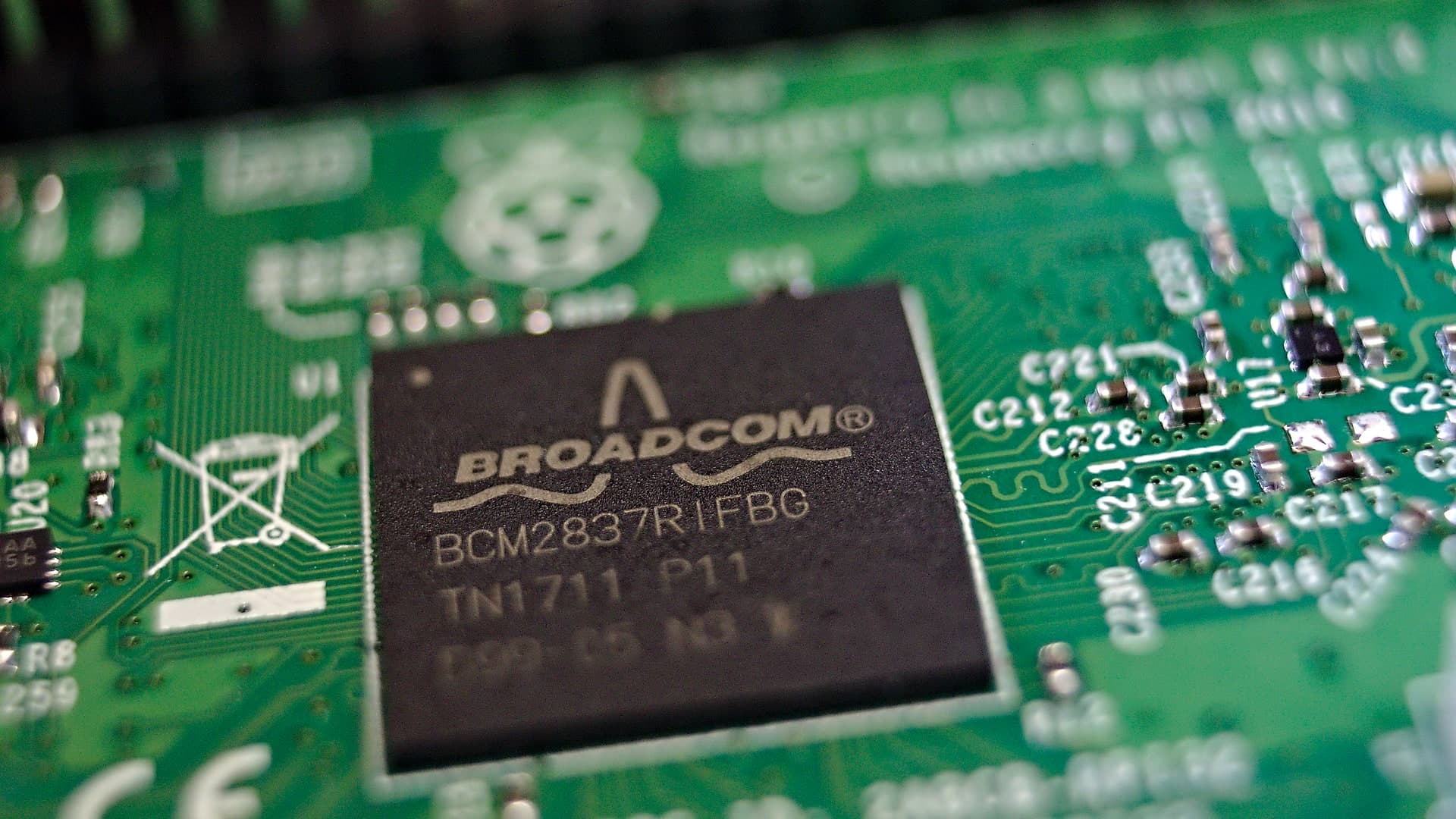
Photo: "Raspberry Pi 3 Broadcom BCM2837 Main Processor – SOC" by Florian Knodt, licensed CC BY 2.0, via Wikimedia Commons. Resized and tonally adjusted.
- semiconductors
- artificial intelligence
- custom silicon
- data centres
- enterprise software