Genoa, 1921. Ansaldo is one of the largest industrial groups in Italy: between 1914 and 1918 its value rose from 30 to 500 million lire, it employs 80,000 workers and it builds ships, guns, aircraft and locomotives. It is run by the brothers Pio and Mario Perrone, who also hold a significant stake in the Banca Italiana di Sconto, the bank that was Ansaldo's main lender during the war. Then the war ends, military orders stop and the house of cards collapses: the Banca di Sconto, worn down by its loans to Ansaldo and by failed attempts to take over the Banca Commerciale, suffers a run by savers and is put into liquidation. The Perrones leave the stage and, to stop the crash from dragging half of Italian industry down with it, a rescue consortium led by the Bank of Italy steps in. From that moment on, in one form or another, the state has never loosened its grip on that company. Today that company is called Leonardo. Why has the state never let it go?
From a bank failure to a state holding company
The story begins with another banker. In 1852 Cavour, who wants a national industry capable of building locomotives for the railways of the Kingdom of Sardinia, persuades the engineer Giovanni Ansaldo to take over the Taylor & Prandi works in Sampierdarena, which had gone into liquidation. In 1853 Gio. Ansaldo & C. is born, founded with Raffaele Rubattino, Giacomo Filippo Penco and Carlo Bombrini. Bombrini is the detail that closes the circle: he ran the Banca Nazionale degli Stati Sardi, the institution from which the Bank of Italy would emerge decades later, and much of the initial capital came through that bank. The forerunner of the Bank of Italy helped to create Ansaldo; sixty-eight years later, the Bank of Italy had to rescue it.
For half a century the company grows on locomotives, boilers and ships, until Ferdinando Maria Perrone becomes its sole owner in 1904. Under him and then his sons, Ansaldo becomes a vertically integrated giant: steel, shipyards, weapons, all under the same roof. The First World War is the perfect multiplier for this model, until it stops being one.
After the 1921 rescue Ansaldo enters the public sphere and in 1933 ends up in IRI, the agency created by the Fascist regime to take over the industrial holdings of banks in crisis. In 1948 IRI groups its engineering companies, Ansaldo included, into a holding company called Finmeccanica. For decades Finmeccanica grows by accumulation, absorbing pieces of state industry: in 1989 the electronics businesses Selenia and Elsag arrive from Stet, and in the early 1990s, with the liquidation of another state agency, EFIM, come Agusta, Oto Melara and Breda.
The detour on two wheels
Here is a detail almost nobody connects with defence: that Agusta is the same family as MV Agusta, the motorcycle maker. In 1945, with the war drawing to a close and an Allied embargo preventing Italy from building aircraft, Domenico Agusta has to find a way to keep the Cascina Costa factory, near Samarate, going. The answer is Meccanica Verghera: motorcycles instead of aircraft. That fallback choice gives rise to one of the most successful dynasties in motorcycle racing, with 75 world titles according to MV Agusta's own figures, 13 of them won by Giacomo Agostini.
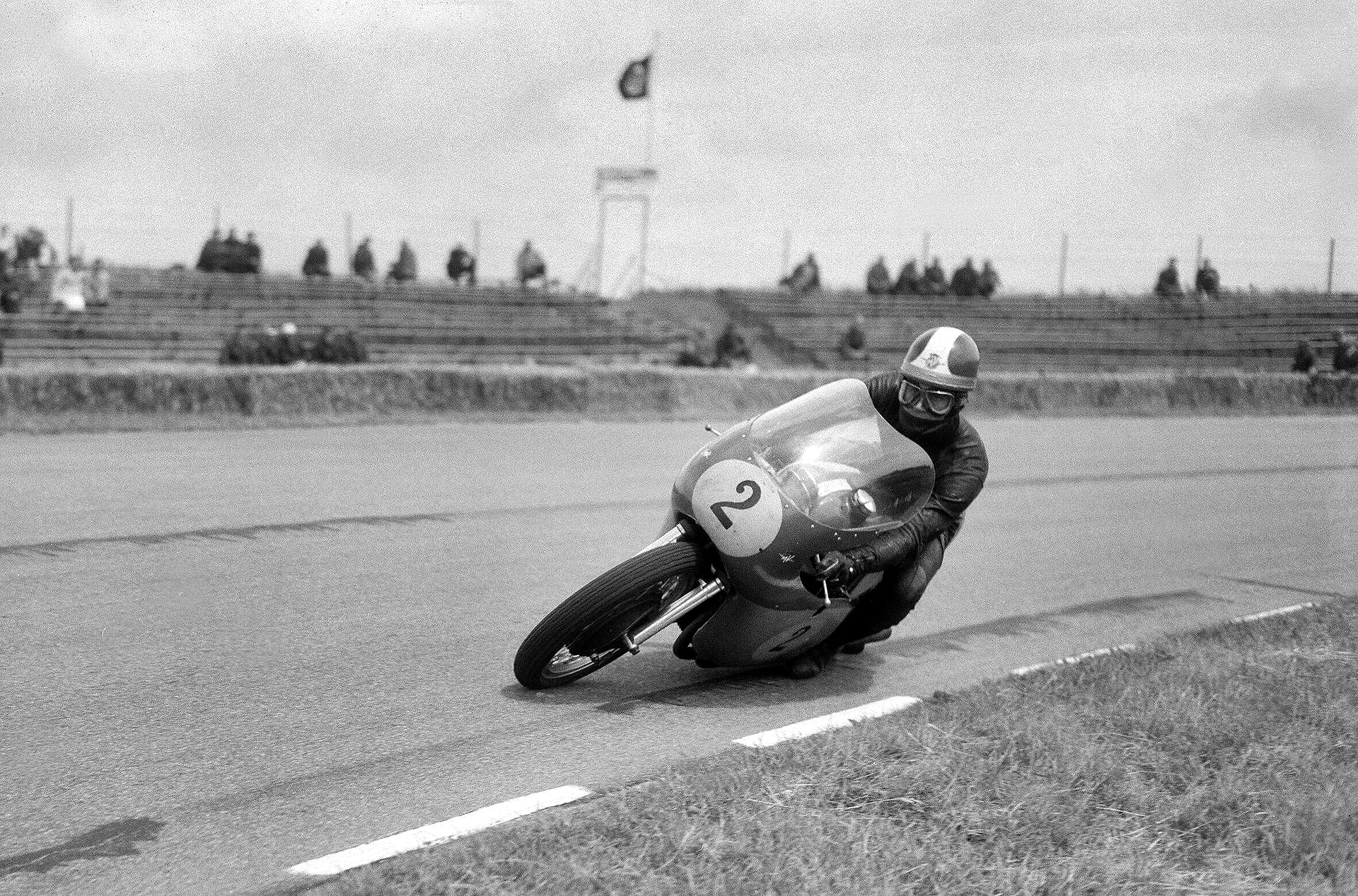 Giacomo Agostini on the MV Agusta 500 during practice for the TT at Assen, in the Netherlands, in 1965.
But Domenico never stopped thinking about the sky. On 11 August 1952 he signs a licence with the American company Bell to build, repair and sell helicopters, and in 1954 the first AB 47 produced at Cascina Costa takes to the air. It is the direct origin of Leonardo's Helicopters division, which still has one of its sites at that same factory today.
From Finmeccanica to Leonardo
From 2002, under Pier Francesco Guarguaglini, the group commits firmly to aerospace and defence: Telespazio and Aermacchi arrive, and between 2004 and 2005 Finmeccanica takes full control of AgustaWestland, born from the merger of the Agusta helicopters with Britain's Westland. In 2008 it buys the American company DRS Technologies for around 3.4 billion euros, the move that opens the Pentagon's doors to it.
From 1 January 2016 the main subsidiaries are merged into the parent company, which becomes a single company organised in divisions. The name changes in two stages: Leonardo-Finmeccanica from April 2016, then simply Leonardo from 1 January 2017, in homage to Leonardo da Vinci. The Ministry of Economy remains the largest shareholder with 30.2%. It is not literally the same stake as in 1921: public control passed from the Bank of Italy consortium to IRI and finally to the Ministry. But it has never lapsed, through a world war, Fascism and dozens of governments of the Republic.
A company that does not just sell weapons
Here the register changes, because the Leonardo of 2026 needs to be understood even by those who have not a single euro invested in the stock market: it is one of the few Italian companies with real weight in decisions that concern the security of all of Europe. In 2025 it had revenue of 19.5 billion euros with around 62,800 employees, and 71% of revenue came from defence.
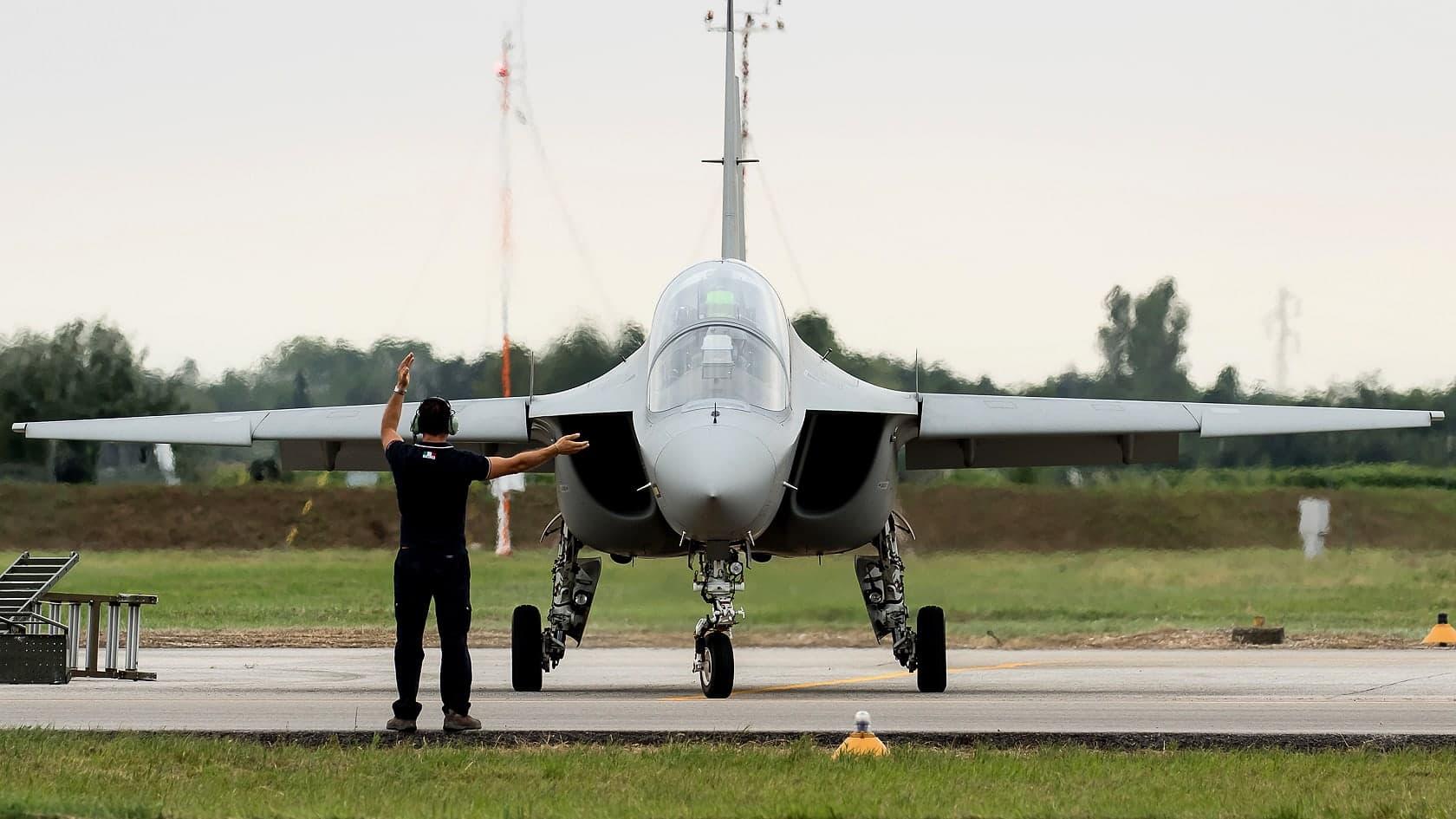
The group covers almost every domain of modern defence. There are helicopters, the direct legacy of Agusta, with models such as the AW139 that are also used for rescue, policing and civil protection. There is aeronautics, from the M-346 trainer to Italy's share in the Eurofighter, the F-35 and the future sixth-generation GCAP fighter. There is defence electronics, meaning radar, command and control systems and cybersecurity: the least visible part, but the one that lets different systems "talk" to each other on the same battlefield. There is space, with control of Telespazio and a 33% stake in Thales Alenia Space. And since March 2026 there are also land vehicles, after the 1.6-billion-euro acquisition of Iveco's defence business, with the IDV and Astra brands: around 2,000 people and 1.37 billion in revenue in 2025.
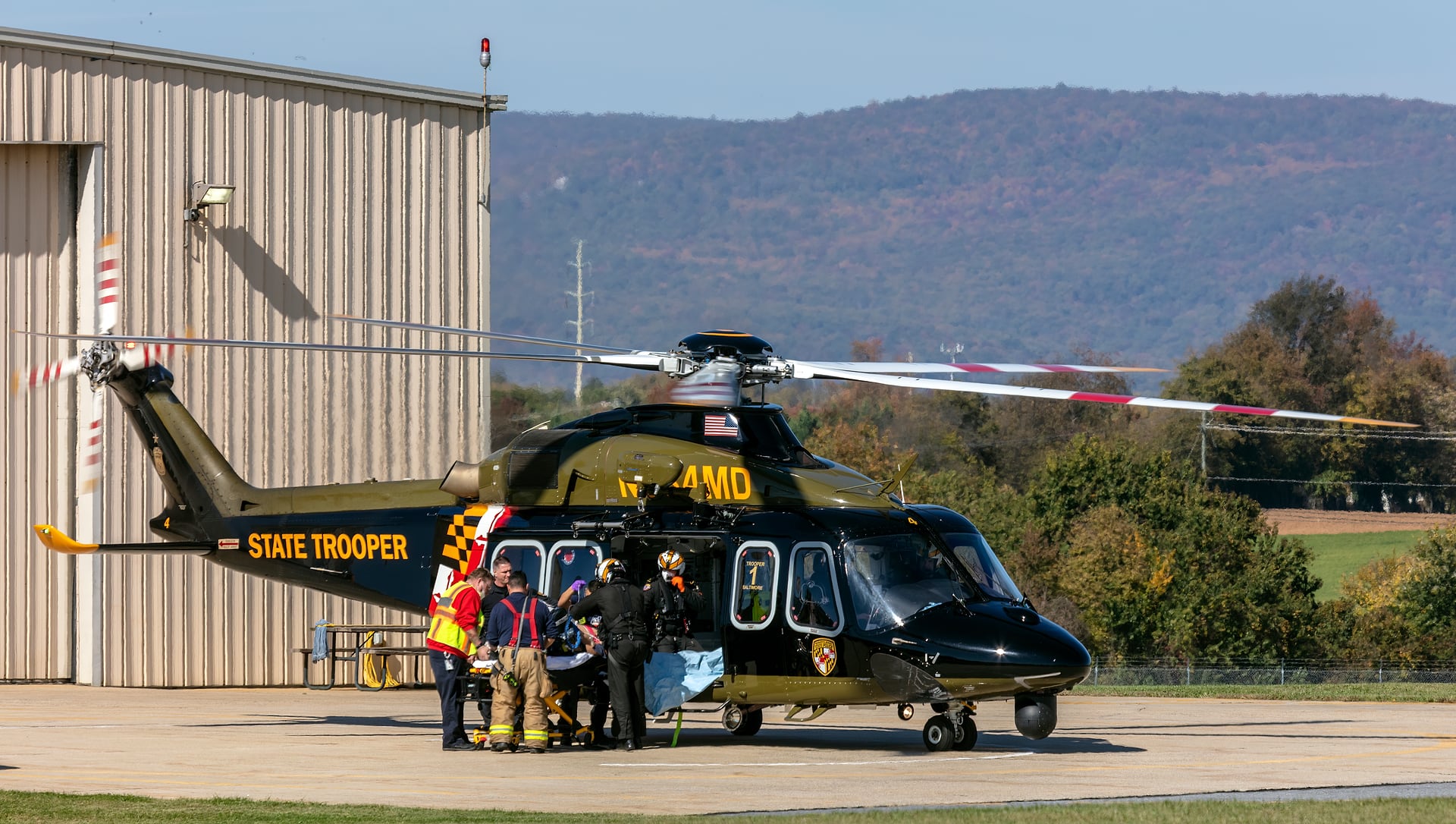 A Maryland State Police AW139, in the United States, loads a patient at Frederick airport: the helicopter born at Cascina Costa also flies for rescue services and police forces.
Why a "sixth-generation" fighter needs more electronics than metal — technical deep dive, open if you're interested
GCAP is not simply a faster aircraft than its predecessors. What really determines its military value is its ability to collect data from radar, sensors and satellites, fuse it in real time and hand it to the pilot (or to a connected autonomous system) in a usable form within a fraction of a second.
That is why on 10 September 2026 Edgewing, the joint company of Leonardo, BAE Systems and Japan's JAIEC that runs the programme, awarded a consortium called G2E an 18-month contract to develop exactly these integrated sensor and communications systems. The consortium includes Leonardo, its subsidiary Leonardo UK, Italy's ELT Group and Japan's Mitsubishi Electric. It confirms that, in a modern fighter, the electronics weigh as much as the airframe, if not more.
The picture is completed by the joint ventures: MBDA (25% Leonardo, with Airbus and BAE Systems) for missiles, ATR (50-50 with Airbus) for regional aircraft, and the youngest, LBA Systems, an equal partnership with Turkey's Baykar, the maker of Bayraktar drones. LBA Systems became fully operational in July 2026 and has already started production of the first batch of Astore Levante, the European version of the Bayraktar TB3 drone with Leonardo systems, with delivery to an Italian customer expected by the end of 2026. It is a piece created to close, quickly, a gap that the war in Ukraine has made obvious to the entire European defence industry.
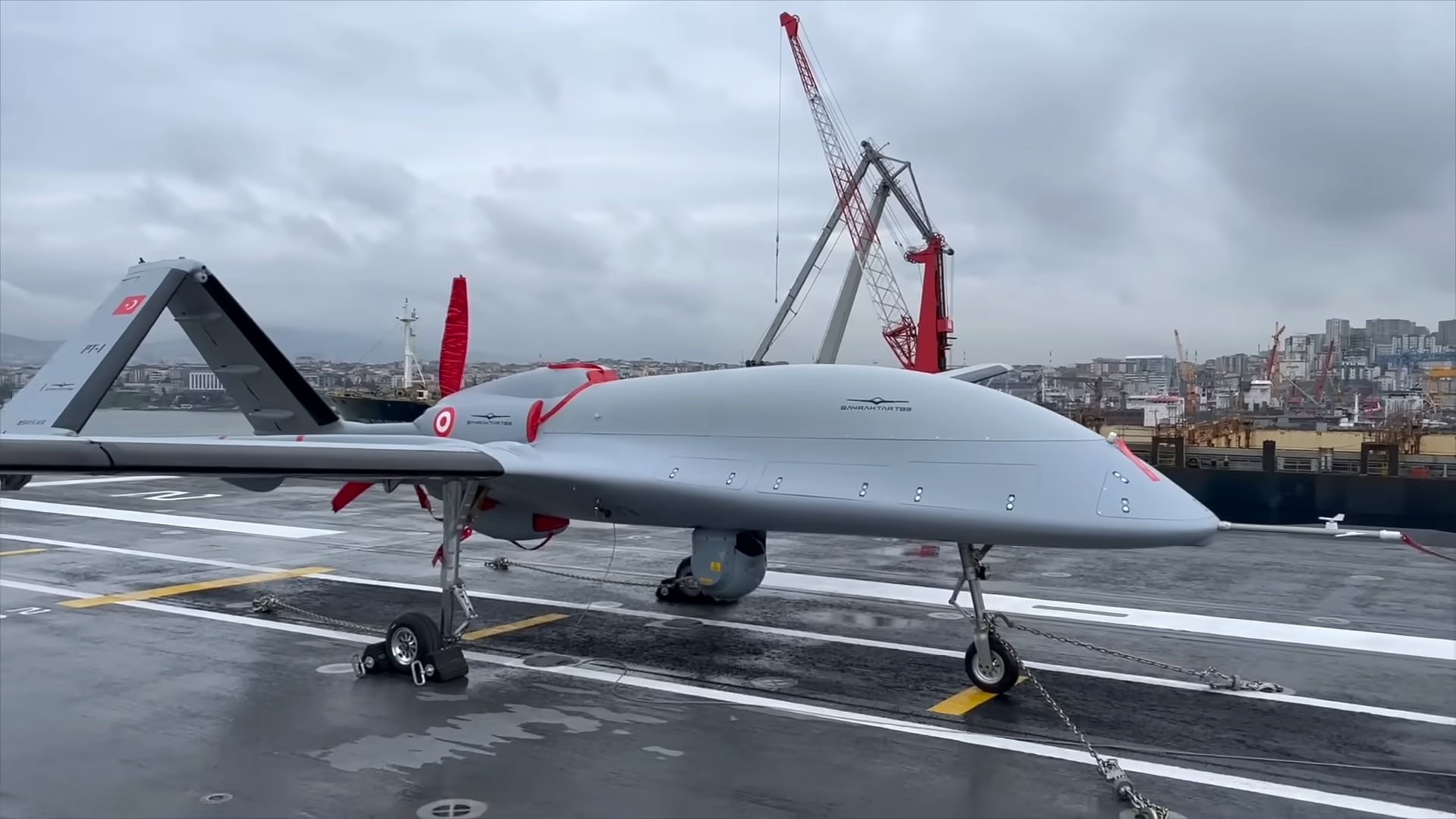 A Bayraktar TB3, the Baykar drone on which LBA Systems' Astore Levante is based, on the deck of a ship in 2023.
Then there is a part of Leonardo that surprises almost everyone outside the industry: Leonardo DRS, the heir to the DRS bought in 2008. Since November 2022, after its merger with Israel's RADA, it has been listed on both Nasdaq and the Tel Aviv Stock Exchange, and Leonardo controls around 71% of it. According to its own accounts, 80% of its revenue comes from the US government. Put simply: a group almost one-third controlled by the Italian state owns the majority of a Wall Street company that sells military technology to the United States.
Who runs Leonardo today, and the 2026 numbers
In spring 2026 everything changed at the top. In April the Ministry of Economy nominated Lorenzo Mariani as the new chief executive in place of Roberto Cingolani, and the shareholders' meeting of 7 May completed the handover: Mariani as chief executive and general manager, Francesco Macrì as chairman in place of Stefano Pontecorvo. Mariani is an electronic engineer with a brief past as an officer in the Italian Navy and a career split between Leonardo and MBDA, where until his appointment he ran the Italian subsidiary.
The new leadership inherits numbers that are growing fast. In the first half of 2026 Leonardo had revenue of 10 billion euros (+12.2%), with EBITA of 780 million (+34.3%): this is the measure of operating profitability Leonardo uses, which excludes amortisation linked to acquisitions, restructuring and one-off items. Adjusted net profit rose to 476 million (+74.4%). The most important figure is orders: 16.3 billion in the half, +44.6%, with the total order book rising to around 59 billion, equal to more than two and a half years of production. On the back of these results the company raised its 2026 guidance: orders expected at 28.2 billion, EBITA at 2.21 billion. The flip side is cash: in the half, free operating cash flow (FOCF) was negative by 249 million and net debt rose to 3.2 billion, mainly because of the purchase of IDV.
The reason these numbers are growing so fast has been the same for two years. Since 2025 the European Union has set in motion a rearmament plan that aims to mobilise up to 800 billion euros of total investment, 150 billion of it as loans to member states through the common SAFE instrument. On the research side, Leonardo submitted 18 proposals to the European Defence Fund 2025 and had 15 selected, out of 57 projects funded in total: more than any other Italian company.
The Michelangelo bet
The project that best captures this ambition is the Michelangelo Dome, announced by Cingolani at the end of November 2025 and placed at the heart of the 2026-2030 industrial plan presented in March. It is a multi-domain shield (air, land, sea, space and cyber) that would use artificial intelligence to fuse data from different sensors and neutralise threats of every kind, from drone swarms to cruise missiles and even hypersonic ones, instead of leaving each European country to buy systems that are not connected to each other.
In September Mariani told Il Sole 24 Ore that in the final part of 2026 a testing phase will begin directly in Ukraine, focused on defence against drone attacks, with the aim of making the system operational from 1 January 2028, provided the procedural process is streamlined. Leonardo estimates a commercial opportunity of around 21 billion euros over ten years, 6 billion of it by 2030: a figure to treat with caution, because it is a company projection on a project that has yet to be tested, not an order in hand.
The risks to keep in view
It is not all straightforward. Orders are running much faster than revenue, but cash for the half remains negative, and turning an order book of almost 60 billion into real profits takes years, not quarters. The company depends on political decisions (defence budgets, alliances, government priorities) that an election or a peace deal can change quickly. The sector remains fragmented among European national champions that often compete instead of consolidating, and large multinational programmes such as GCAP always have to reckon with tensions between countries over the division of work. Then there is the question of price: after the stock's long run that began with the war in Ukraine, much of this growth is already priced into market expectations.
In 1921 the Italian state stepped into a bankrupt industry because letting it fail would have cost more. A century later, the public presence born of that rescue, and not of an industrial plan, finds itself governing one of the companies that matter most for the security of an entire continent. The question for anyone looking at Leonardo today, as an investor or simply as a European citizen, is whether this history of rescues and forced conversions, from the collapsed bank to racing motorcycles to drones, proves that the state knows how to choose the right moments to step in, or is only a sign of how rarely, in a century, Italy has had any other choice.
The information contained here does not constitute financial advice: before making any investment decision, consider your own personal situation or consult a qualified adviser. The financial data and company news reported come from Leonardo's official announcements and from specialist press sources; the historical accounts of Ansaldo and MV Agusta are attributed to their respective external sources and are not figures certified by the company. The data are up to date as of the end of September 2026 and may change quickly.
Image credits
- Cover: "Alenia Aermacchi T-346A Master CSX55152 - M346 with marshal (22064959376).jpg" by Gian Marco Anzellotti, via Flickr and Wikimedia Commons, licensed under CC BY 2.0. Cropped and tone-adjusted.
- In the text: "G Agostini Training TT 1965 croppedandrestored.jpg" by Joop van Bilsen / Anefo, from the Dutch National Archives via Wikimedia Commons, public domain (CC0). Resized and tone-adjusted.
- In the text: "MSP Trooper 1 AW139 N384MD MD2.jpg" by Acroterion, via Wikimedia Commons, licensed under CC BY-SA 4.0. Resized; the modified version is distributed under the same licence.
- In the text: "Baykar Bayraktar TB3.png" by tolgaozbekcom, a still from a video published on YouTube, via Wikimedia Commons, licensed under CC BY 3.0. Converted to JPG and tone-adjusted.
Sources
- Leonardo S.p.A. — first-half 2026 results announcement, 30 July 2026, and Integrated Annual Report 2025.
- Leonardo S.p.A. — announcement on the closing of the acquisition of Iveco's defence business, 18 March 2026.
- Leonardo S.p.A. — announcements on LBA Systems (21 July 2026) and on GCAP Electronics Evolution (10 September 2026).
- Leonardo DRS — Form 10-K for fiscal year 2025, filed with the SEC.
- Fondazione Ansaldo — "Giovanni Ansaldo, imprenditore del futuro".
- Wikipedia — "Ansaldo" (Italian). it.wikipedia.org
- Wikipedia — "Banca Italiana di Sconto" (Italian). it.wikipedia.org
- Museo Agusta — "L'azienda dalle origini agli anni '70".
- MV Agusta — "MV Agusta Celebrates Its 80th Anniversary".
- Formiche.net — "Chi è Lorenzo Mariani, il nuovo amministratore delegato di Leonardo", April 2026.
- Il Sole 24 Ore — "Leonardo unveils new plan: expected 142 billion orders by 2030", March 2026.
- Euronews — "Leonardo annuncia i primi test dello scudo multidominio Michelangelo Dome in Ucraina", September 2026.
- defence
- aerospace
- helicopters
- Finmeccanica
- Ansaldo
- GCAP
- Michelangelo Dome
- state ownership