November 1910. Six men arrive separately at a New Jersey railway station, in the evening, to avoid being seen together. They board a private carriage with the blinds drawn. Among them are a United States senator, a Harvard professor, the senator's private secretary, the president of what is now Citibank, a German-American banker from Kuhn, Loeb & Co. and a partner at J.P. Morgan. The train staff are told to address them by first name only — Nelson, Harry, Frank, Paul, Piatt, Arthur — so that nobody learns their surnames. The official cover story is a duck hunt on an exclusive island off Georgia, the Jekyll Island Club, one of the least accessible places in the world for anyone not already extremely rich. None of the six ever picks up a gun. For more than a week they stay shut inside the club writing, line by line, the blueprint for what would become the central bank of the United States. The meeting would remain secret for twenty years.
How did an agreement written in secret by six men become the institution that today sets the cost of money for the entire world?
The problem America had been carrying for a century
The United States reached 1910 with an unusual distinction: it was the only major economic power in the world without a central bank, and not by oversight. A first central bank, the First Bank of the United States, created at Alexander Hamilton's urging in 1791, saw its charter lapse in 1811 because Congress did not renew it. A second, the Second Bank, founded in 1816, was deliberately destroyed by President Andrew Jackson in the 1830s, who regarded it as a dangerous concentration of power in the hands of a few bankers. For the next thirty years the United States lived through what historians call the "free banking" era: every state bank printed its own notes, with a value that changed from state to state and often from bank to bank, a chaos Congress tried to tidy up with the National Banking System during the Civil War. It half worked: there was finally a national currency, but nobody to act as a safety net when confidence collapsed — and sure enough banking crises returned on schedule in 1873, in 1893 and, more severely, in 1907.
Here is the underlying contradiction that explains everything that follows: Americans desperately wanted something to stop banking crises from overwhelming the economy, while at the same time deeply distrusting any institution powerful enough to do it.
In 1907 the system fell apart again. A failed attempt to corner the shares of a copper company set off a panic at one New York bank, then another, then across the whole system, in what we would now call a generalised bank run. What stopped it, literally, was a private citizen: J.P. Morgan, who locked the city's most important bankers in his personal library until they agreed to pool the funds needed to save the system. It worked. But the fact that the financial stability of an entire country had depended on the goodwill of a single man — however powerful — convinced even the sceptics that what was needed was an institutional mechanism, not the occasional availability of a billionaire.
Congress duly created a commission led by the Republican senator Nelson Aldrich, who spent three years touring Europe studying the central banks of Germany, France and England. Back home, he organised the Jekyll Island meeting to put a concrete plan on paper together with the bankers who knew the system better than anyone.
From the bankers' plan to the government's law
The plan that came out of Jekyll Island — the so-called Aldrich Plan — was exactly what you would expect from a blueprint written by bankers: a central bank controlled by the banks themselves, with minimal public influence. Politically it was suicide. The American public, already suspicious of Wall Street, would never have accepted a handful of New York bankers running the country's money, and the 1912 elections put a Democrat, Woodrow Wilson, in the White House with a Democratic majority in Congress hostile to the Republican plan.
Here comes the compromise that still defines the Fed's DNA. Wilson did not throw away the technical work done at Jekyll Island — Senator Carter Glass, who actually wrote the law, consulted Paul Warburg, one of the Jekyll Island six, directly on the technical detail. But Wilson imposed one non-negotiable principle: the system had to have public oversight, not just banking oversight. What emerged was a decentralised structure, deliberately awkward for anyone to control — twelve regional banks, so as not to concentrate power in New York or Washington, topped by a presidentially appointed board. In other words: the Federal Reserve was born precisely out of fear of the power it now wields.
On December 23rd 1913 Wilson signed the Federal Reserve Act.
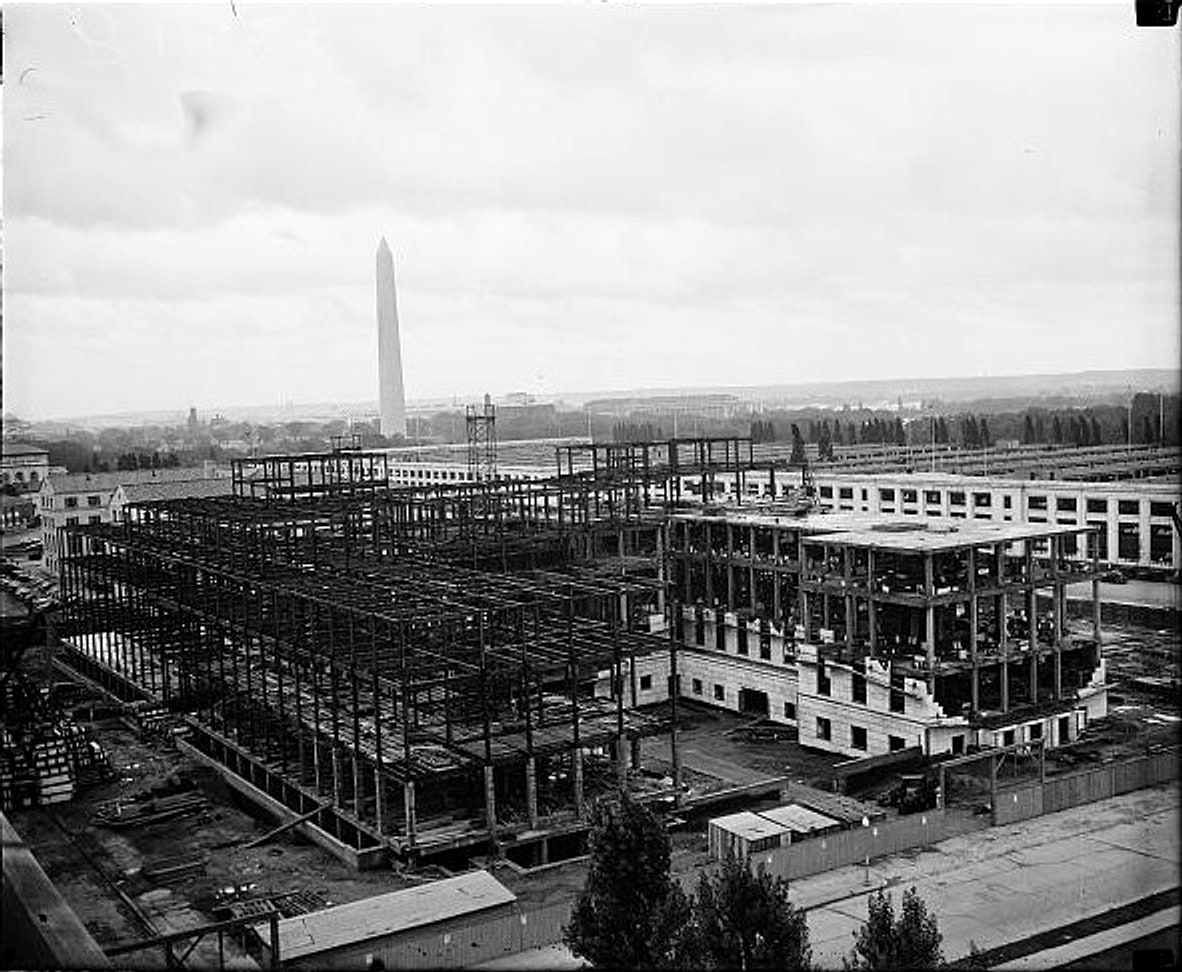 The Fed Board's headquarters under construction in Washington, October 1st 1936: twenty-three years after the Federal Reserve Act was signed.
"The Fed" is not one bank
When a newspaper writes that "the Fed has raised rates" it is simplifying a great deal, and it is worth clearing up because it helps explain how power actually works in there. The system today rests on three distinct pieces. The twelve regional Federal Reserve Banks (New York, Chicago, San Francisco and the rest) are technically capitalised by the commercial banks in their area — a direct leftover of the 1913 compromise. The Board of Governors in Washington, seven members appointed by the president and confirmed by the Senate on staggered fourteen-year terms, is to all intents and purposes a federal agency. And monetary policy decisions — the ones on rates — are not taken by one person but by the Federal Open Market Committee (FOMC): twelve voting members, the seven governors plus the president of the New York Fed plus four regional presidents on rotation, though all twelve regional presidents take part in the discussions regardless. Whoever chairs the committee — today Kevin Warsh — runs the meetings and speaks at the press conference, but the decision remains collective: it is never "the Fed chair" deciding alone.
And who owns this machine, literally? Nobody, in the sense in which one owns a private company. Commercial banks hold stock in the Reserve Bank of their region, but without the economic rights of a normal shareholder — they do not collect the system's profits, which go almost entirely to the US Treasury each year. It is a hybrid structure, public in substance, belonging to no single private actor nor to any one branch of government.
How a rate set in Washington ends up inside your mortgage
The mechanism is worth understanding, because it is simpler than it looks. The FOMC does not directly set the rate on your mortgage, the yield on a US Treasury bond or the price of a share. It sets something more technical and further upstream: the federal funds rate, the rate at which banks lend reserves to one another overnight. From there a transmission chain begins: that rate influences general financial conditions, which influence the cost of credit for households and businesses, which influences how much they consume and invest, which in turn pushes inflation and employment up or down.
It is a chain, not a switch, and that is why the right question is not "is the Fed raising or cutting rates?" but what happens when its two objectives — maximum employment and price stability, the so-called dual mandate written into law — pull in opposite directions. Raising rates to cool inflation that has run too hot risks cooling hiring and investment too. And to complicate things, the effects of a decision taken today show up in the real economy months or years later: whoever runs the Fed has, in a sense, to steer by where the car will be when today's braking takes effect, not just the stretch of road in front of the windscreen right now. The Fed, in short, does not control the economy: it tries to influence it, with indirect tools and on a delay.
Independent from government, but not outside it
Here we reach the heart of the matter, the thing that makes the Fed different from an ordinary government department. The underlying idea, written into the DNA of the 1913 law and reinforced over the following decades, is that monetary policy works better when kept at arm's length from the electoral cycle: a politician facing re-election in two years has an almost automatic incentive to want low rates now, even if the bill, in the form of inflation, arrives later.
That is why the Fed has specific protections: governors on fourteen-year terms, removable only "for cause", and funding that does not depend on the congressional budget — the Fed funds itself from the interest on the securities it holds and the fees on services to banks, and hands the surplus to the Treasury each year. But "independent" does not mean "outside government": the Fed chair is appointed by the White House and confirmed by the Senate, reports regularly to Congress, and the law governing all of it can be changed by Congress at any time. It is an independence built inside the democratic system, not against it.
That this is not textbook theory is shown by a very concrete episode from the 1970s. Ahead of the 1972 re-election, Nixon put direct and documented pressure — the White House tapes prove it — on the Fed chair of the day, Arthur Burns, to keep rates low even though inflation was already rising. Burns gave way, Nixon won the election, and the United States found itself in one of the harshest inflationary decades in its history — the Great Inflation. It was not the only cause, the oil shocks mattered too, but it has become the case study taught every time the subject comes up of why keeping the central bank away from short-term politics is not an institutional whim but a lesson paid for dearly.
The bank that lends when nobody else will
There is another Fed role rooted directly in 1907, that of "lender of last resort": in a crisis, when even a sound bank can suddenly find itself without liquidity because everyone else stops lending to each other, the Fed can step in through tools such as the discount window, its facility for lending directly to banks in difficulty. It is exactly the role J.P. Morgan played as a private citizen in 1907, institutionalised.
But this safety net carries a contradiction economists call moral hazard: if a bank knows somebody will step in to save it anyway, it has less incentive to be prudent about the risks it takes. It is one of the great unresolved questions of modern central banking — system stability against incentives to behave — and it has no simple answer.
2008: when the Fed changed jobs
Until the global financial crisis, the general public associated the Fed almost exclusively with interest rates. After 2008 words such as quantitative easing, the Fed's balance sheet and mortgage-backed securities entered common vocabulary: under the then chair Ben Bernanke, the Fed began buying government bonds and other securities on a massive scale to inject liquidity into the system when interest rates, already close to zero, were no longer enough. Its balance sheet — a sort of real-time snapshot of how much it is intervening — went from less than $900bn before the crisis to several trillion within a few years. The Fed was no longer just the bank that sets the cost of money: it also became the stabiliser of last resort for the entire financial system.
In 2020, with the pandemic, the script repeated itself but faster and on a larger scale still: under Jerome Powell, the Fed's balance sheet came close to $9trn in early 2022, nearly double the pre-pandemic level. One common misconception is worth clearing up here: saying that "the Fed prints money" is not quite accurate. Physical banknotes are printed by the US Treasury, not the Fed; what the Fed does, by buying securities, is create reserves electronically in the banking system — a real operation with real consequences, but different from running a mint's presses.
2026: the most serious test in half a century
This tension between independence and political power, far from being merely history, erupted again over the past year. In August 2025 Donald Trump tried to remove a Fed governor, Lisa Cook, on a pretext involving mortgage documents — an attempt many observers read as a way around the "for cause" protections, to put someone on the board more aligned with his demands for lower rates. The case, Trump v. Cook, reached the Supreme Court, which on June 29th 2026 blocked the removal by five votes to four: the president cannot remove a Fed governor simply because he would prefer someone "more in tune" with his own views. It was described as an important but not definitive victory for central bank independence, because the ruling leaves several questions open about how far that protection extends.
Meanwhile Jerome Powell's term as Fed chair expired in May 2026, after years in which Trump had publicly attacked him demanding rate cuts. Kevin Warsh took his place. It is precisely the scenario for which the 1913 law provided staggered terms and protections against arbitrary removal: a president who changes, an institution that is meant to stay stable regardless of who runs it at any given moment.
The Fed's real power
There is one last thing that makes the Fed different from any other economic institution, and it is perhaps the most interesting: much of its strength comes not from what it actually does but from what people believe it will do. If households, banks and firms believe the Fed will bring inflation back under control, they start behaving accordingly today — negotiating wages, setting prices, making investment decisions as though that promise had already been kept. The Fed does not only move money. It moves expectations about the future of money.
This is where the circle opened on that train bound for Georgia more than a century ago closes. The Fed does not decide what a house, a share or a loan costs: it decides something further upstream, what the money used to buy those things costs. And it is powerful not because it can command the American economy at will, but because it can shift the incentives of millions of people and firms at once — with the same indirect, watched and contested tools that a group of men meeting in secret on an island off Georgia first put in writing in 1910.
Image credits
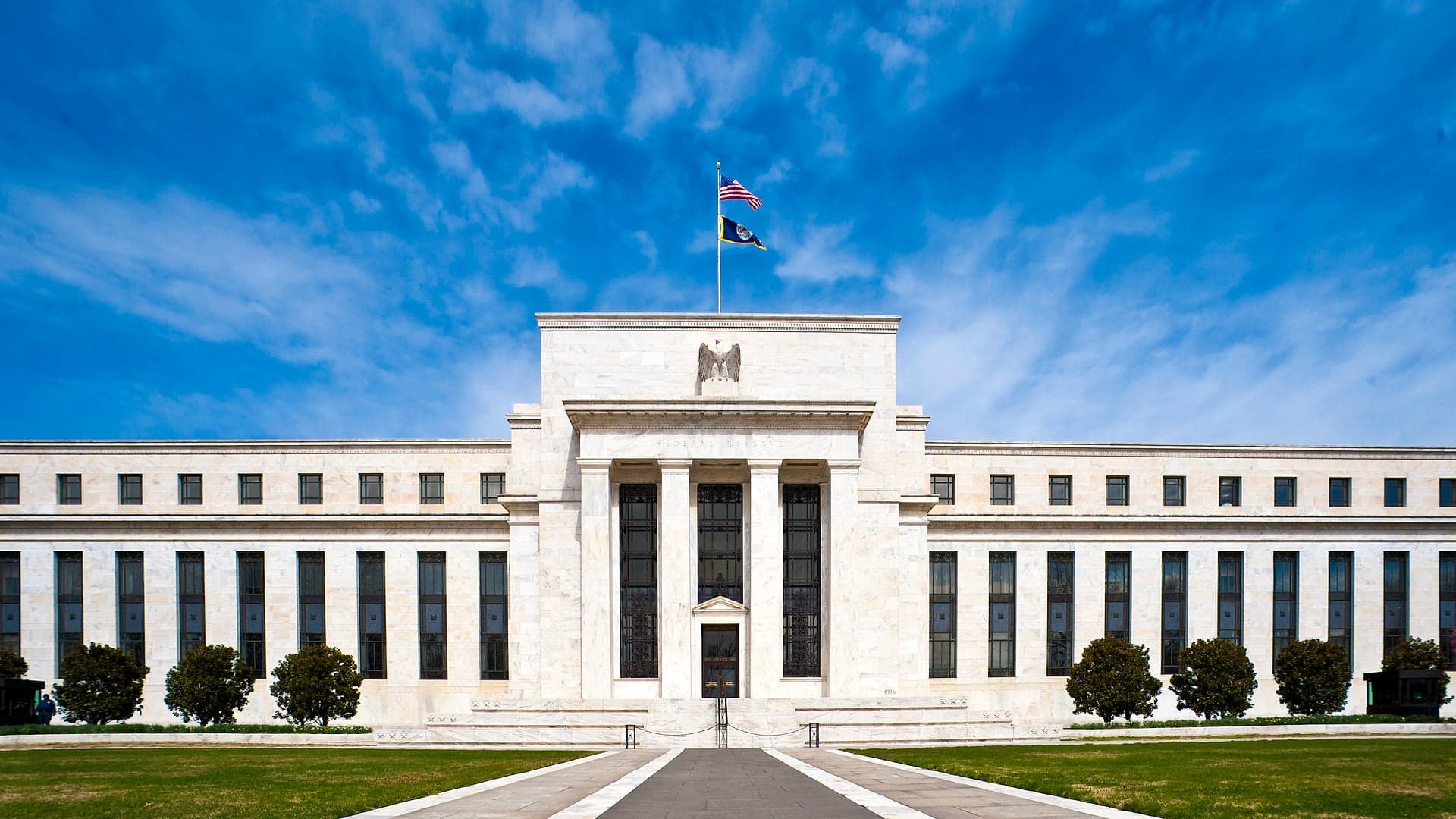
Cover: "Eccles Building", Federal Reserve, via Flickr and Wikimedia Commons, public domain. Cropped and tonally adjusted.
In the text: "Eccles Board building construction, 1936", photo by Harris & Ewing for the Federal Reserve, via Wikimedia Commons, public domain. Enlarged and tonally adjusted.
Sources
- Federal Reserve History — "The Meeting at Jekyll Island" and "Federal Reserve Act Signed into Law".
- Federal Reserve Bank of Minneapolis — "Born of a Panic".
- Federal Reserve Bank of Richmond — "The Fed Is Shrinking Its Balance Sheet".
- Brookings — "Fed independence after Trump v. Cook".
- Federal Reserve Board — the release on Powell as chair pro tempore, May 2026.
- American Economic Association — "How Richard Nixon Pressured Arthur Burns".
- financial history
- central banks
- Federal Reserve
- monetary policy
- United States