You can come along for the ride, or you can not. Either way, we are going to dominate.
— Alex Karp, chief executive of Palantir
In 2004 Palantir came knocking at Sequoia Capital, the fund that had already bet on PayPal, looking for an investor. It left empty-handed. No major Silicon Valley firm wanted to finance a data-analysis start-up built for the intelligence community, founded by an odd mix of established names — Peter Thiel and Alex Karp were both past 35 — and young engineers out of the PayPal orbit. The rescue came, of all places, from the strategic investment fund of the CIA. That start-up is now worth roughly $400bn on the stock market and has joined the S&P 500. Which leaves one question: how do you go from being turned down across Silicon Valley to becoming one of the most talked-about, most contested and most valuable names in American software?
Origins: built for the war on terror
Palantir was founded in Palo Alto in 2003 by Thiel, a PayPal co-founder, alongside Karp, Stephen Cohen, Joe Lonsdale and Nathan Gettings. The premise was narrow: take the anti-fraud technology built for PayPal and repurpose it so American intelligence agencies could connect data points. The September 11th attacks had exposed how badly they struggled to do exactly that. Thiel funded almost the entire launch himself, some $30m of his own capital. Founders Fund, the vehicle that would later define his reputation as an investor, was not created until 2005, by which point Palantir was already running.
The first outside believer was In-Q-Tel, the CIA's strategic investment fund. It put in about $2m and opened the agency's doors. From 2005 the CIA became both the main customer and the testing ground. For three years agency analysts and engineers worked alongside Palantir's team to refine what became Gotham, the company's first product.
The name was not an accident. Thiel, a Tolkien enthusiast, took it from the palantíri of The Lord of the Rings: seeing-stones that show events distant in space and time. As branding for a surveillance and data-analysis business, it was not subtle.
Karp joined in 2004 and became chief executive in 2005. He had met Thiel at Stanford Law School. He holds a Stanford law degree and a doctorate in social theory from Goethe University in Frankfurt, an unusual résumé for a technology chief executive. He has spent two decades behaving like one. He talks in philosophical terms, states political positions without hedging, and appears to enjoy the controversy that follows.
Palantir stayed private for 17 years, an eternity by Valley standards. No quarterly earnings, no public-market pressure, just slow product work. It listed on the New York Stock Exchange on September 30th 2020 through a direct listing rather than a conventional IPO, opening at $10 a share. It had never turned an annual profit, and roughly a third of revenue came from three customers. It joined the S&P 500 in 2024.
How Palantir makes money: the three products
The model is standard enterprise software: no advertising, no hardware, just licences and subscriptions sold to governments and large companies and wired into their operations. But the valuation only makes sense if you understand what the three products actually do, not merely who buys them.
Gotham. The original product, built for the CIA. Its job is to take entirely different data streams — satellite imagery, drone footage, intercepted communications, field reports, sensor data — and fuse them into a single shared operational picture. It does not just display the data. It links it, surfaces patterns that would take human analysts weeks to cross-reference, and in a military setting can help identify potential targets and present options to commanders. Palantir's stated principle is that a human always makes the final call: Gotham proposes, it does not pull the trigger. It is nonetheless the software that turns raw data into an operational decision. The same tool, in different configurations, is used by the CIA, the FBI, the US Department of Defense and allied governments.
Foundry. The same fusion and processing logic, aimed at the commercial market. A bank uses it to cross-reference fraud data. A hospital uses it to manage patient and resource flows. An airline or a manufacturer uses it to run a complex supply chain. Foundry opened the non-government market to Palantir and now underpins its fastest-growing business.
AIP, the Artificial Intelligence Platform. The newest layer, built to plug generative AI models into the data infrastructure already assembled by Gotham and Foundry. It lets a user — a manager or a military commander — ask questions in plain language and get traceable operational answers, instead of querying databases and dashboards by hand. Commercially it produced "boot camps" that demonstrate results in days rather than months, compressing the sales cycle sharply. On the military side, according to several press accounts, it has cut analysis times from days to minutes in live operations.
Revenue is split almost evenly between the public and private sectors, but the balance is shifting fast. In the most recent reported quarter, US commercial revenue grew 149% year on year, nearly double the pace of US government work at 90%. For the first time in the company's history, the commercial side is the engine.
The government relationship
This is what separates Palantir from every other listed software company, and it is worth understanding before looking at a single line of the accounts.
Palantir has never been merely a technology vendor to governments. Its architecture is now embedded in the operational processes of key customers. Those customers include the CIA, the FBI, the US Department of Defense, Britain's Ministry of Defence, the Ukrainian army and the Israeli defence forces. In July 2025 the US Army signed a ten-year framework agreement worth up to $10bn — a ceiling, not money already spent — the largest in the company's history. It folds 75 separate contracts into one and strips out much of the military procurement process. Two months earlier, in May 2025, the Pentagon had raised the ceiling on another contract to roughly $1.3bn: Maven, the AI system the armed forces use to analyse satellite and drone imagery.
Then there is the contested front: Immigration and Customs Enforcement. Palantir has run ICE's case management system since 2014. In 2025 it signed a $30m contract to build "ImmigrationOS", a platform designed to link information held across government systems in order to identify, prioritise and manage deportation proceedings. Subsequent reporting suggested tax, social-security and passport records were among the possible sources, though the contract has never been published in full. The deal triggered lawsuits from civil-liberties groups and criticism from legislators, and drew scrutiny of the financial ties between Palantir and figures close to the administration setting immigration policy.
Palantir does not run from the reputation. Karp defends the defence and law-enforcement work publicly and frames it as the founding mission. That is a deliberate position, and for anyone holding the stock it is not colour. Dependence on government contracts is simultaneously the company's strongest competitive moat — multi-year deals, painful to replace, with very high barriers to entry — and its largest source of political and regulatory risk. Each change of administration, or of public sentiment about data, can put billions of dollars of contracts back in play.
Why Palantir matters in war
Ukraine shows most clearly what Gotham means on a battlefield. After Karp visited Kyiv in 2022, Palantir began fusing satellite imagery, drone video, intercepted communications and civilian reports gathered through apps into a single operational map shared with Ukrainian commanders. According to military sources and later reporting, that integration compressed the targeting cycle from days to minutes. By September 2022 Ukraine had struck more than 400 Russian targets with HIMARS launchers alone. How much of that is attributable to Palantir's software specifically, rather than the wider Western intelligence chain, cannot be established publicly. Karp has claimed a central role, but that is an interested party talking, and it is not verifiable from outside. The company also works in Ukraine on less cinematic ground: in 2023 it signed an agreement with the Prosecutor General's Office to catalogue and analyse data on more than 78,000 recorded war crimes, alongside demining work ahead of reconstruction.
The same technology sits at the centre of a January 2024 agreement with Israel's defence ministry, supplying analysis and decision-support tools during the Gaza conflict. Bloomberg confirmed the deal and the company has never denied it. It became one of the most contested partnerships in Palantir's history, drawing international criticism including from a United Nations special rapporteur, along with public protests and a handful of staff resignations. Karp has not retreated an inch, defending the Israeli work in blunt terms. Britain took a slower route. In September 2025 Palantir and the Ministry of Defence announced a non-binding strategic partnership with a promised investment of up to £1.5bn. The actual contract followed only in December 2025: £240.6m over three years, awarded without competitive tender.
The thread linking Ukraine, Israel and Britain is that the same product is read in radically different ways. A country using it to repel an invasion is cast as a resistance hero. A country using it in a more contested conflict is accused of complicity. The underlying technology draws no such distinction. It takes raw data and converts it into targets and operational decisions, faster than a team of human analysts could. For anyone looking at Palantir as an investment this is not an ethical footnote. It is where the value of these contracts comes from.
What the latest numbers say
The second quarter of 2026, closed on June 30th and reported on August 3rd, was the company's best ever by percentage growth. Revenue reached $1.94bn, up 93% year on year, against analyst expectations of $1.80bn. Net income passed $1bn, with GAAP earnings of 41 cents a share against a consensus of 35 cents.
Palantir raised full-year guidance for the second time in 2026, lifting the revenue range to between $8.15bn and $8.16bn from an original $7.65bn to $7.66bn. The shares jumped as much as 12% the following session.
One point deserves to be stated plainly, because it is where analysts disagree most sharply. Palantir trades on some of the highest valuation multiples in the American equity market, far above the historical average for software. The market is pricing in years of growth at current rates. Analysts are split between those who still see room to run and those who think the price has already outstripped the fundamentals. That kind of open split is rare on a stock this size.
Palantir is no longer the secretive start-up wiring data together for the CIA. It is a core supplier to American defence and to a growing list of large companies, carrying a valuation that assumes this dual identity keeps compounding at double digits for years. It is not America's largest software company — Microsoft and Oracle remain far bigger — but it is one of the few at this market value that is still half technology firm, half state infrastructure. The question for anyone holding the stock is not whether Palantir is good at what it does. It is whether that dual identity is a durable structural advantage, or a balance that a single political turn could break.
This article is for information and editorial purposes. It is not investment advice: consider your own circumstances or consult a licensed adviser before making any investment decision.
Image credits
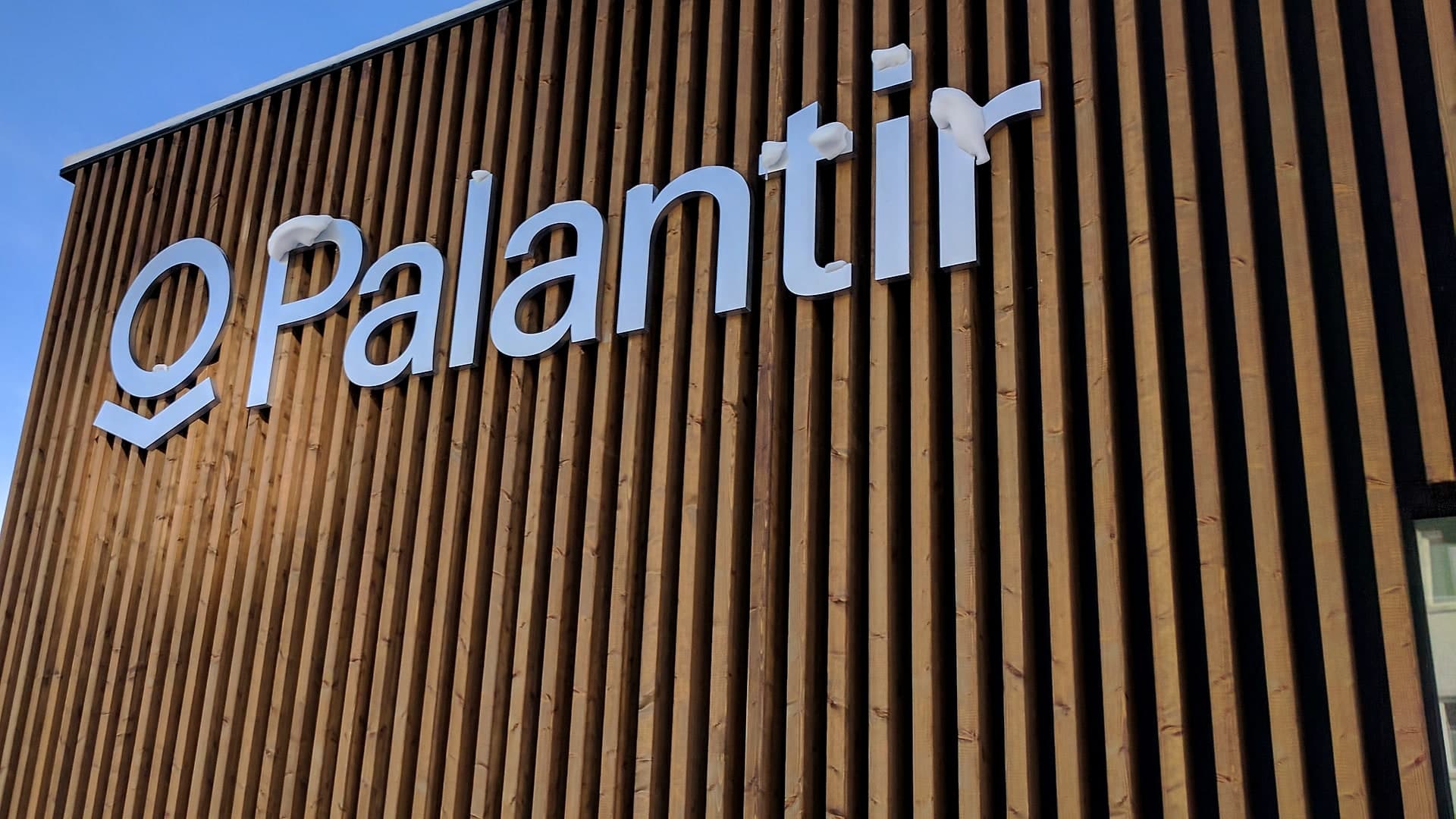
Photo: Palantir pavilion, World Economic Forum, Davos, Switzerland, by Cory Doctorow, 17 January 2017, via Flickr, licensed CC BY-SA 2.0. Cropped and tonally adjusted; the modified version is distributed under the same licence.
- software
- defence
- intelligence
- Peter Thiel
- data
Newsletter
Was this analysis useful?
We publish one a week: a company taken apart piece by piece, or a story that changed the markets. It arrives by email, without the noise.