 Bellwether
Why bonds exist
In the thirteenth century Venice was a sea power, and the wars to defend its trade routes cost more than taxes could raise. When money was needed in a hurry, the Republic asked its richest citizens for it, in proportion to their wealth. These were neither gifts nor taxes: they were compulsory loans, which the state promised to repay.
In 1262 Venice did something new. It gathered all these debts into a single fund, the Monte, and promised those who had financed it a fixed interest of 5% a year, guaranteed by the revenue from certain taxes on consumption.
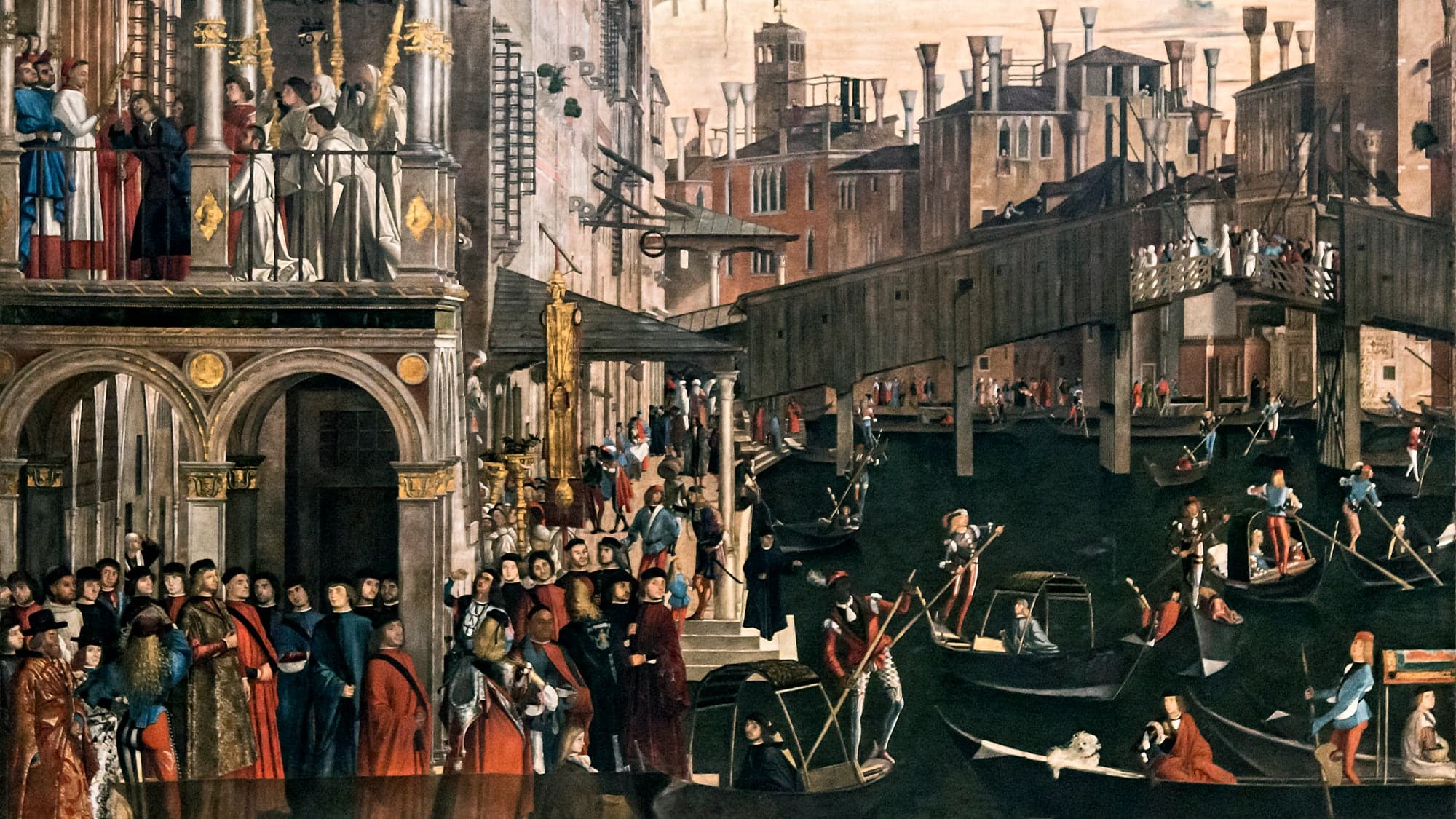
The real invention, though, was something else: those claims could be sold. Anyone who needed their money did not have to wait for the state to repay it. They went to Rialto and sold their claim to a banker or a merchant. The price changed with the news: when Venice was strong it was worth more, when a war went badly it was worth less, because the fear of not being paid grew. During the long war against the Turks, between 1463 and 1479, the shares fell below a third of their face value.
Everything a modern bond does is already there: a loan divided into shares, a fixed interest, a price that moves with confidence in the debtor. And its weak point is already there too. For more than a century Venice paid on time. Then the wars got the better of it: interest was skipped during the War of Chioggia, between 1378 and 1381, again during the war against the Turks and once more in 1480, and in the fifteenth century the rate was cut to 4%. In 1482 the Republic had to open a new debt, the Monte Nuovo, backed by new taxes. Even the soundest state in the Mediterranean, when the money ran short, postponed or skipped its payments.
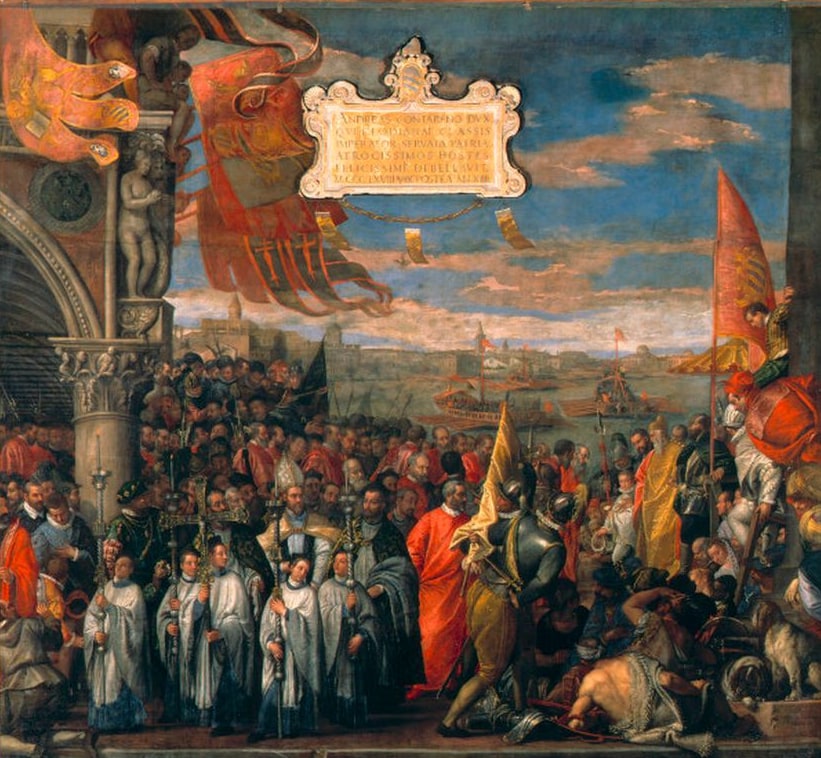 Doge Andrea Contarini returns to Venice after victory in the War of Chioggia, in a painting by Paolo Veronese. It was during that very war that Venice stopped paying interest on the Monte.
What you really buy
When you buy a bond you lend money to someone. You do not become a partner in anything: you become a creditor. In return you receive interest and the promise of getting your money back on a set date.
There are four things to look at in a bond:
- Who issues it. It can be a state, such as Italy with its BOTs and BTPs or the United States with Treasuries, or a company. In the second case they are called corporate bonds.
- The face value. This is the sum you will be repaid at the end. By convention prices are read as a percentage of that value: a bond quoted at 97 costs 97% of what it will repay.
- The coupon. This is the interest. It is usually fixed: a 4% coupon on 10,000 euros of face value means 400 euros a year before tax. It can also be floating, that is, linked to a market rate, or missing altogether. Italy's BOTs, for example, pay no coupon: you buy them below 100, at maturity you get 100 back and your gain is the difference.
- The maturity. This is the day the debtor repays you the face value and the loan ends. It can be a few months away or thirty years away.
Let's put it all together. You buy 10,000 euros of a 4% bond maturing in five years: you collect 400 euros before tax every year and at the end you get your 10,000 euros back.
In the guide to shares we saw the difference between a partner and a creditor. The partner makes money if the company does well and, if it does badly, is paid last. The creditor is the opposite. If the company triples its profits your coupon stays the same: you do not rise with it. In exchange, with ordinary bonds the coupon is not a decision taken each year like the dividend: it is an obligation written into the contract. If the debtor does not pay it, it is insolvent, and if it goes bust, bondholders are paid before shareholders.
To judge how reliable a debtor is there are rating agencies, such as S&P, Moody's and Fitch. They give a grade that runs from triple A, the highest, downwards. Below BBB- (Baa3 on Moody's scale) bonds are called speculative, or high yield. The name says it all: whoever is less reliable has to pay higher interest to find someone willing to lend to them. It is the same principle as with shares: more risk, more reward.
Bonds are also bought and sold on the stock exchange, through a brokerage account at a bank or a broker. In Italy the main market is Borsa Italiana's MOT. You do not have to hold them to maturity: you can sell them earlier, as the Venetians did at Rialto. But at that day's price, which is not necessarily the one you paid.
How you make money
With a bond, too, you make money in two ways.
The coupon. This is the predictable part: you know in advance how much you will collect and when. That is why bonds appeal to people who want a regular income.
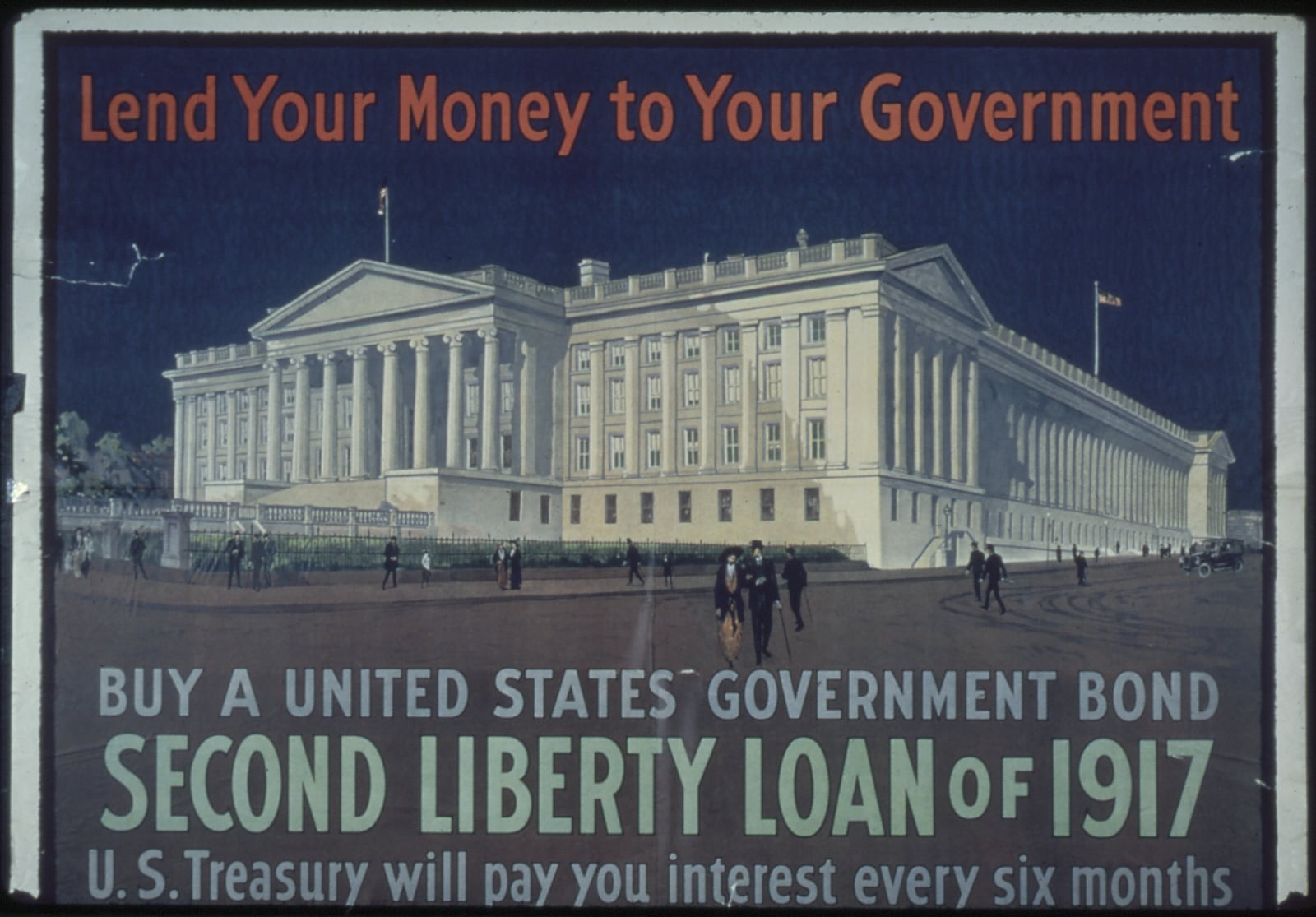 A US Treasury poster for the second Liberty Loan, the war loan of 1917: "Lend your money to your government". At the bottom, the coupon's promise: interest paid every six months.
The price. Between the day a bond is born and the day it matures, its price moves. If you buy at 95 a bond that will repay 100 at maturity, on top of the coupons you also gain those 5 points of difference.
But why does the price move? The main reason is interest rates. Say you hold a bond with a 2% coupon, bought at 100. A year later rates rise and new bonds pay 4%. Nobody will give you 100 for yours any more: with the same money they can buy one that pays twice as much. To sell it you have to lower the price, until it is as attractive to the buyer as the new ones.
It works the other way too. If rates fall, your 2% bond becomes more valuable than the new ones, and its price rises. There is only one rule to remember: when rates rise, bond prices fall; when rates fall, they rise. And the further away the maturity, the stronger the effect, because you are stuck with that coupon for more years.
From this comes the most important number of a bond, and it is not the coupon. It is the yield to maturity: how much you earn each year if you buy it today at that price and hold it to the end, counting both the coupons and the difference between what you pay and what you will be repaid, provided the debtor pays everything it promised. It is a calculation, not a guarantee. Two bonds with the same coupon can have very different yields. When you compare, compare this.
Historically, in the big markets and over the long term, bonds as a whole have returned less than shares and moved much less. It is the age-old trade-off: less risk, less reward. But it holds for the category, not for every single bond, and less risk does not mean no risk.
How you lose money
With a bond you can lose money even if the debtor pays everything, down to the last cent.
Rates rise and you have to sell. In 2020 Austria, one of the most reliable debtors in Europe, issued a bond maturing in 2120, with a 0.85% coupon. In December 2020 it was quoted at 139. By mid-June 2022, with rates rising all over the world, it was worth little more than 40, and in October it was back at the same levels: it had lost more than two thirds of its value. In October 2026 it trades at around 31. Austria had not missed a single payment. Rates had changed, and on a hundred-year maturity the effect is enormous. If you hold a bond to the end you still get the face value. But if you need the money sooner, you sell at that day's price. "Safe" refers to the debtor, not to the price.
Inflation. A bond gives you back the same euros you lent, but they will not necessarily be worth as much as before. In 2022 prices in Italy rose by 8.1% on average. Anyone who got 10,000 euros back at the end of the year could buy with them what had cost about 9,250 twelve months earlier. If the coupon was lower than inflation, the gain on paper was a loss in reality. There are inflation-linked bonds, such as Italy's BTP Italia, but ordinary ones do not protect you.
The debtor doesn't pay. This is the real risk. In December 2003 Parmalat, the dairy group from Collecchio, near Parma, was declared insolvent. In the weeks that followed, behind falsified accounts, a hole of about 14 billion euros emerged, and about 10 billion had been raised by issuing bonds. Tens of thousands of small savers had bought them thinking they had chosen the prudent path, and they recovered only part of their money, years later. The risk applies to states too: Venice in the fifteenth century, Argentina in 2001, with many Italian savers caught up in it.
Being a creditor puts you in the queue ahead of shareholders, but the queue does not end there. Some bonds, called subordinated, are repaid only after all the others. That is exactly why they pay more.
The currency. If you buy a bond in dollars, coupons and repayment arrive in dollars. If in the meantime the dollar loses value against the euro, you lose too, even if the debtor has paid everything.
The same reasoning as with shares applies to bonds: risk is spread. Lending all your savings to a single debtor, however famous, is the choice that ruined those who held only Parmalat bonds.
Taxes vary from country to country
As with shares, every country has its own rates, but the types of levy are similar almost everywhere. For the figures we again use Italy as an example. You can find your own country's rules on the national tax authority's website or by asking your broker.
The tax on interest and gains. Almost every country taxes coupons and capital gains. Some, like Italy, tax public debt less: on Italian government bonds and those of countries on the so-called white list the rate is 12.5%, on corporate bonds 26%. The difference shows. On 10,000 euros with a 4% coupon you collect 400 euros before tax: with a BTP you keep 350, with a corporate bond 296. It is one of the reasons why comparing two bonds by their coupon alone leads you astray.
Losses can't always be recovered. In Italy a loss on the price of a bond can be used, until the fourth following year, to pay less tax on future capital gains, that is, on gains from selling shares, bonds and other securities. But not against coupons and dividends, nor against gains on most ETFs. And a loss on a government bond counts for less than half, 48.08%, precisely because those bonds are taxed less.
Foreign interest. If you buy bonds from another country, that country may withhold part of the interest before paying it to you, and then your own country taxes what is left. It depends on the country and on its tax treaties with yours: some withhold, others don't. It is worth knowing before you buy, not after.
Taxes on the account. Italy's 0.2% annual stamp duty on the brokerage account also applies to bonds, government bonds included. It is charged on the value of the securities, not on the gain: with a bond yielding 3% and capital that stays more or less the same, the 0.2% is worth about a fifteenth of the gross gain, every year.
What you don't see
On top of taxes come costs, the same as with shares: broker commissions, the spread, currency exchange. With bonds the spread often weighs more, because many of them, corporate bonds above all, trade rarely. The fewer people buying and selling, the wider the gap between the price you buy at and the price you could sell at.
Then there is a trap that belongs to bonds alone: the price above 100. Say you buy at 108 a corporate bond with a 5% coupon maturing in four years. You spend 10,800 euros for 10,000 of face value. Over four years you collect 2,000 euros in coupons, which after 26% tax become 1,480. At maturity you get 10,000 euros back, that is, 800 less than you paid. The real gain is 680 euros over four years: about 1.6% a year, before stamp duty and commissions and without counting any tax recovery on the loss. The coupon said 5%.
And it gets worse. In Italy you paid tax on the whole coupon, but the 800 euros lost at repayment cannot be offset against the coupons. You can only use them against capital gains realised in the following four years. If you have none, that loss remains a loss for the taxman too. And even if you do, you recover at most 26% of those 800 euros, that is, 208.
Taken one at a time, each of these items seems negligible. But with bonds the margin is tighter than with shares: when an investment yields 3%, half a point of costs is not a detail, it is a sixth of the gain.
The good news is that these costs, too, can be seen, measured and compared. You just need to know where to look.
The information in this article does not constitute financial advice: before making any investment decision, assess your personal situation or consult a licensed adviser.
Image credits
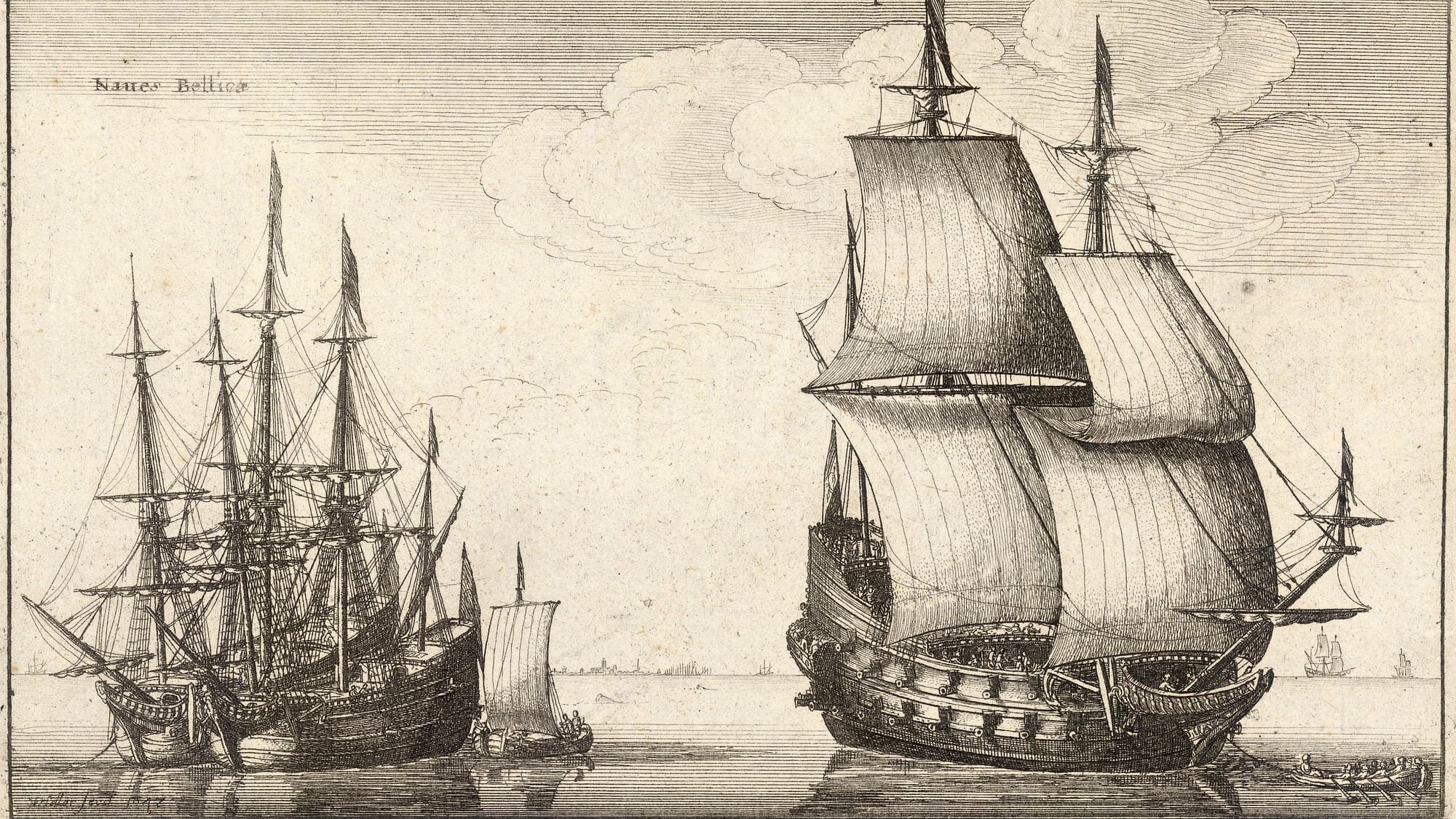
- Cover: "Accademia - Miracle of the Holy Cross at Rialto by Vittore Carpaccio.jpg", painting by Vittore Carpaccio, around 1496, Gallerie dell'Accademia, Venice, photo by Didier Descouens, via Wikimedia Commons, public domain. Cropped to 16:9 (removing the roofs and sky at the top) and resized.
- In the text: "The Doge Andrea Contarini Returning Victorious from Chioggia.JPG", painting by Paolo Veronese, via Wikimedia Commons, public domain.
- In the text: "Lend Your Money To Your Government. Buy a United States Government Bond. Second Liberty Loan of 1917 (NARA 512625)", US Treasury poster, unknown author, U.S. National Archives and Records Administration, via Wikimedia Commons, public domain. Resized.
Sources
- John Munro, University of Toronto — "Usury and Medieval Public Finance", 2012: the consolidation of 1262, the 5% paid from consumption-tax revenue, the negotiable claims, the arrears from 1432 and the Monte Nuovo in 1482. economics.utoronto.ca
- Bryan Taylor — "Birds, Boats, and Bonds in Venice", The Big Picture, December 2013, on data from Sidney Homer: interest skipped during the War of Chioggia, the war against the Turks and in 1480, the rate cut to 4%, shares falling below 30.
- The Tontine Coffee-House — "Venice's Fiscal Restructurings", May 2020: interest paid for more than a hundred years, then the missed payments of the fifteenth century.
- Investireoggi — "Bond a 100 anni, cedola effettiva salita sopra il 2%", June 22nd 2022: the price of 40.60 on June 21st 2022. investireoggi.it
- Investireoggi — "Bond Austria a 100 anni, +25% in un mese con la corsa ai safe asset", July 15th 2022: the high of 139 in December 2020. investireoggi.it
- Investireoggi — "Super bond a 100 anni a sconto del 50%", December 17th 2022: the October 2022 low of 40.33. investireoggi.it
- Teleborsa — "Austria Tf 0,85% Gn2120": reference price of 31.14 on October 21st 2026.
- Istat — "Prezzi al consumo, dicembre 2022": average 2022 inflation of 8.1%. istat.it
- DairyReporter — "Parmalat debt reaches €14 billion", January 27th 2004: the net debt of 14.3 billion calculated by the auditors after the insolvency. dairyreporter.com
- AGI — "Ascesa e rovinosa caduta di Calisto Tanzi, l'uomo che inventò la Parmalat", January 1st 2022: liabilities of 14 billion, about 10 from bonds. agi.it
- Il Fatto Quotidiano — "Crac Parmalat, oggi la sentenza di primo grado per l'ex patron Tanzi", December 9th 2010: the insolvency declared in December 2003. ilfattoquotidiano.it
- il Resto del Carlino — "Btp, conviene? Quanto rendono": the 12.5% and 26% rates, the example on 10,000 euros at 4%. ilrestodelcarlino.it
- Money.it — "Tutti i casi in cui paghi solo il 12,5% di tasse sui tuoi investimenti", April 29th 2026. money.it
- Fiscoinvestimenti — "Imposta di bollo sul dossier titoli: 0,2%", updated October 8th 2026.
- guides
- bonds
- government bonds
- BTP
- interest rates
- taxes
- investing