In June 2024 half the internet carried the same story: the petrodollar agreement, signed by the United States with Saudi Arabia in June 1974 and valid for exactly fifty years, had just expired. Riyadh would no longer sell oil in dollars. This was the beginning of the end of American monetary hegemony.
No treaty with a fifty-year expiry ever existed. Several fact-checkers established as much, PolitiFact among the first, and what was signed in June 1974 was a joint commission on economic cooperation: a diplomatic container, not a contract obliging Saudi Arabia to invoice in any particular currency. But the genuinely interesting part is something else. Even if that agreement had existed, even if it had expired on schedule, almost nothing would have changed. Because the reason the world needs dollars stops having anything to do with oil about a second after the oil has been paid for.
If crude were sold tomorrow in yuan, in euros and in rupees, would the dollar really lose its place?
What actually happened, between 1945 and 1974
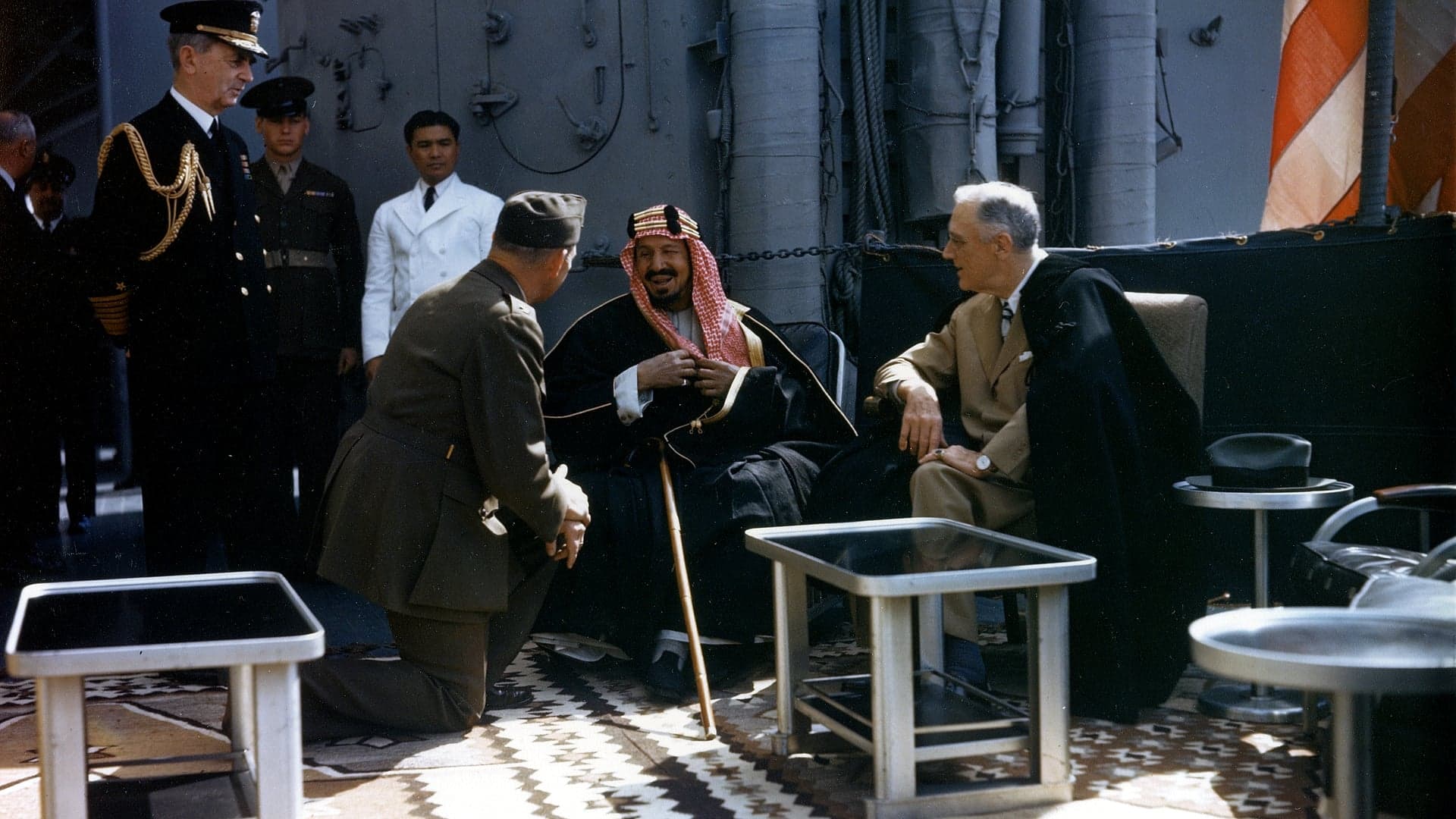
The real story begins on February 14th 1945, aboard the cruiser USS Quincy, in the Great Bitter Lake along the Suez Canal. Franklin Delano Roosevelt is on his way back from Yalta, where he has just redrawn post-war Europe. Waiting for him is Ibn Saud, the Bedouin who unified by force of arms the kingdom that bears his name and who has never set foot on a ship in his life. Roosevelt gives up cigarettes and cocktails for the occasion, out of respect for the king's faith. They argue about Palestine. But they come away with an unwritten understanding worth more than any communiqué: American security in exchange for access to Saudi oil.
The dollar, by that point, was already deeply embedded in the Saudi oil trade, for a prosaic reason: the kingdom's oil industry had been built by American companies, which priced and collected in dollars. No pact was needed to establish it.
What changes in 1971 is the anchor. On August 15th Richard Nixon unilaterally closes the "gold window": the dollar stops being convertible into metal at the fixed price of $35 an ounce set at Bretton Woods, and stands on nothing but confidence in its issuer. Two years later, in October 1973, the Arab countries of OAPEC impose the oil embargo during the Yom Kippur War, while OPEC's decisions on prices and production help quadruple the price of crude within months.
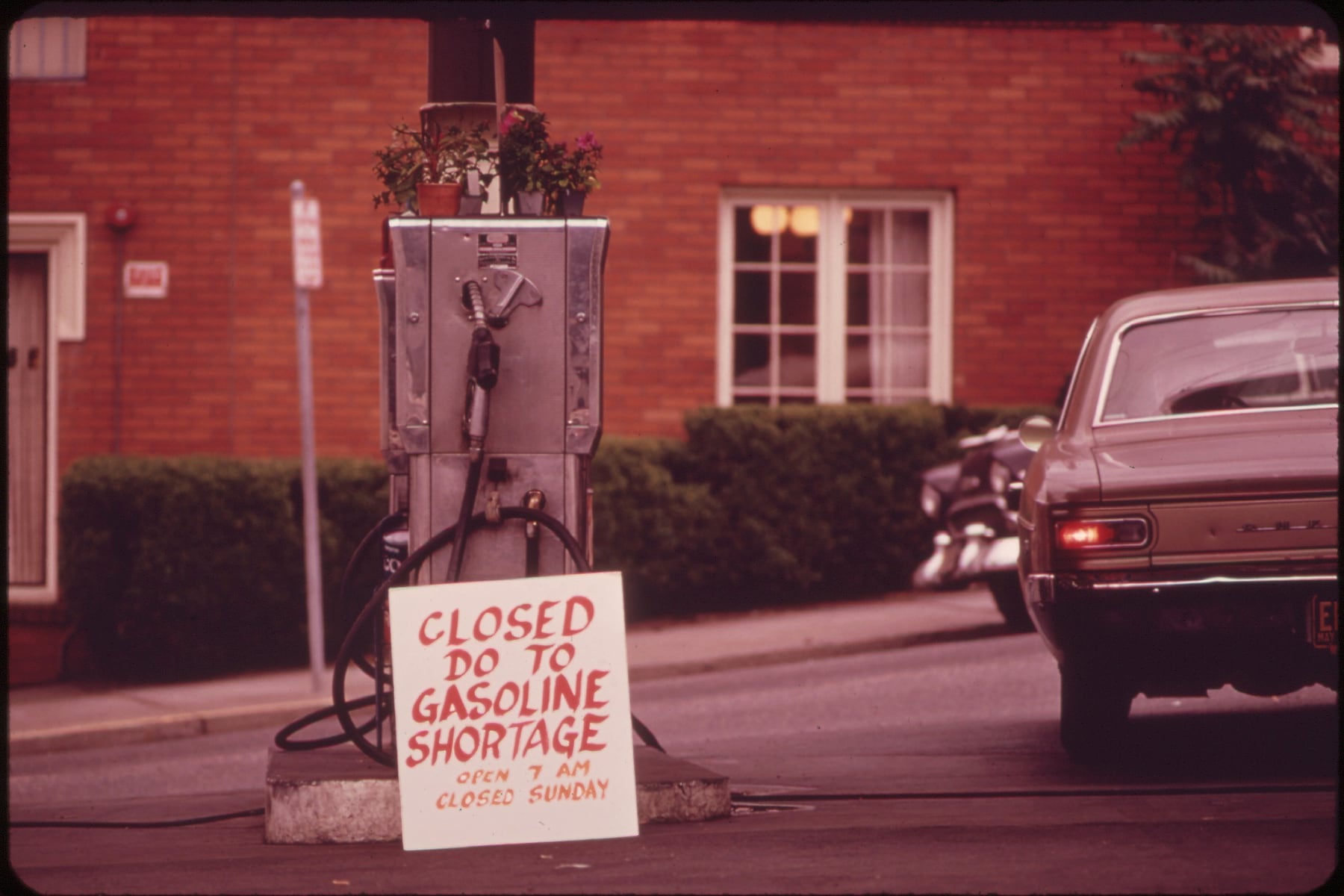 June 1973: a filling station closed for lack of petrol. The Arab embargo would follow in October.
It is in that context that the system we now call the petrodollar was born, and it is worth being precise about what it actually was. In June 1974 the United States and Saudi Arabia set up a joint commission on economic cooperation, a diplomatic container. The following month the new Treasury secretary William Simon flew to Jeddah for four days, officially on a tour of economic diplomacy, and closed an understanding of an entirely different kind: the kingdom would invest its oil proceeds in US Treasury securities, with Washington providing military aid and equipment. King Faisal set one condition, that Saudi holdings of Treasuries remain strictly confidential, and that confidentiality lasted forty-one years: the episode was only reconstructed in 2016 by Bloomberg, on the basis of diplomatic cables retrieved from the National Archives, while the size of those holdings was made public by the Treasury in the same year.
Note what is missing from all this: no formal commitment on the currency in which oil would be sold. The 1974 pact was not about how invoices were denominated, which was already settled practice. It was about where the dollars went afterwards.
The first movement of the money, and all the ones after
Here is the point that headlines about the "end of the petrodollar" systematically skip. The currency a transaction is denominated in concerns the first movement of the money. Monetary hegemony concerns every movement after that.
Take an example. A producer sells crude for $100bn. Those $100bn can sit in a bank, go into American government bonds, buy shares, finance investment abroad, be converted into other currencies, be spent on imports or end up inside a sovereign wealth fund. Only the first of those choices concerns the denomination of the sale. All the others concern a different question: where do you park the money once you have it?
The measured answer is striking. According to the final results of the US Treasury's annual survey, published on April 30th 2026, foreign investors held $35.349trn of American securities as of June 30th 2025. These are not Treasuries: the largest share, $19.86trn, is in American equities, against $13.84trn of long-term debt. Twelve months earlier the total was $30.881trn.
It is worth slowing down over how to read that difference of roughly $4.47trn, because it is where it is easy to go badly wrong. The survey measures market values, so it contains both new purchases and revaluations: the growth in the equity portion reflects above all the rise of Wall Street, not a wave of foreign buyers. On debt, by contrast, the flows were real and substantial, with $880bn of long-term securities bought over twelve months, $530bn of it in Treasuries and federal agencies. The overall result is that foreign investors own 21.2% of all American securities outstanding, a share that has stayed broadly stable over the past decade.
Public debt is only one piece of the picture, but it is the most visible: in December 2025 foreign investors held roughly $9.2trn of it, equal to 31% of all American debt held by the public.
This is the real product of dollar hegemony. Not the dollar itself, but the ecosystem of dollar-denominated financial assets the world has built to absorb it.
Buying dollars means buying a machine, not a currency
There is a second reason oil matters less than it seems, and it is purely infrastructural.
In April 2025 the global foreign exchange market traded an average of $9.6trn a day, according to the triennial survey by the Bank for International Settlements, the most complete there is. Within that mass of trading, the dollar was on one side of 89% of all transactions, up from 88% in 2022. The euro, second, stood at 28.9%. The percentages add to more than a hundred because every trade involves two currencies, and that is precisely the point: to convert one minor currency into another minor currency, you very often go through the dollar. Not because anyone imposes it, but because that is where the deepest market is and therefore the lowest cost.
The same holds for payments. In June 2026, according to SWIFT data, the dollar accounted for 59.1% of the value of international payments, against 13.9% for the euro.
An international currency does not win because somebody decides to use it. It wins when there exists an ecosystem you can enter, trade in, borrow in, invest in and exit from at low cost and in enormous size: banks, foreign exchange markets, clearing, futures, trade finance, bond markets, derivatives, accounting standards. When a country accumulates dollars it is not buying green pieces of paper, it is buying access to that machine. It is the difference between choosing a language and discovering that everybody else already speaks it: at first you have to persuade someone to use it, after that it feeds itself.
What is actually changing
That said, it would be wrong to conclude that nothing is happening. Something is — it just looks very little like the story going around.
The dollar's share of the official foreign exchange reserves of all the world's central banks — the figure the IMF publishes each quarter in its COFER report — was 57.13% in the first quarter of 2026, out of $13.1trn of reserves in total. In the early 2000s it was above 70%: the long-run decline is real and documented. In the latest available quarter, however, that share rose rather than fell, and about half of the increase is explained simply by the dollar's appreciation against other currencies. The yuan, in the same quarter, was at 1.99%. The euro at 20.03%.
The bigger movement is not towards another currency: it is towards gold. According to the ECB's report on the international role of the euro published on June 2nd 2026, at the end of 2025 gold accounted for 27% of global official reserves, ahead of US Treasury securities at 22% and the euro at 15%. The ECB itself specifies that the crossover reflects above all the price effect, not a sale of Treasuries to buy bullion: after three years above a thousand tonnes, central bank purchases in 2025 fell to roughly 850. Be careful not to confuse these numbers with COFER: the 57% is the dollar's share of foreign exchange reserves alone, while gold's 27% is calculated on a total that includes gold. They are two different pies, and half the apocalyptic headlines are born of that confusion.
On alternative infrastructure, the most-cited project is mBridge, the cross-border settlement system built on the central bank digital currencies of China, Hong Kong, Thailand, the United Arab Emirates and, since June 2024, Saudi Arabia. It began under the coordination of the Bank for International Settlements, which withdrew in October 2024 once the project reached minimum viable product stage, leaving governance to the participants. It has processed roughly $55.5bn across more than 4,000 transactions since it began, with the digital yuan covering over 95% of them. That cumulative volume over four years corresponds to less than ten minutes of trading on the global foreign exchange market. It is real infrastructure, growing, and it offers an alternative to traditional correspondent banking on certain payment corridors: it does not replace dollar clearing, and it is not yet an alternative at scale.
The yuan, too, tells a less linear story than expected. Oil futures denominated in yuan have existed on the Shanghai exchange since March 2018 and the People's Bank has signed a currency swap with the Saudi central bank. But according to a Peterson Institute analysis from September 2026, yuan volumes on SWIFT in January 2026 had fallen 24% from their July 2024 peak, while China's own CIPS payment system was hitting record highs. Part of the 2023-24 push, tied to the reorganisation of Russian flows after sanctions, has run its course.
There is one signal, though, worth more than all the others, and it concerns Saudi Arabia itself. The country that in 1974 recycled its oil surplus into American Treasuries now borrows: the borrowing plan approved for 2026 sets out requirements of 217bn riyals, roughly $58bn, of which 165bn to cover the budget deficit and 52bn to repay maturing debt, to be raised across bonds, sukuk and loans on the domestic and international markets. According to estimates from economists at Emirates NBD, between $14bn and $18bn will come from international issuance. Between Vision 2030, Neom and cheaper crude, Riyadh spends more than it takes in.
The result looks like the inverse of the 1970s: the country that recycled its own oil surpluses into American debt now has to finance its own, and to do so goes asking the same markets for money. Not because of a geopolitical decision: because of budget arithmetic.
The other side of the coin: the privilege is also a trap
There is one last piece almost nobody tells, and it concerns the United States.
If the world wants dollars and safe dollar-denominated financial assets, somebody has to issue them. And to supply assets you have to issue liabilities: American federal debt passed $40trn in September 2026, with interest spending running above a trillion a year. The more the rest of the world demands American assets, the more the American system is structurally incentivised to supply them.
The Belgian economist Robert Triffin set it out before Congress as early as 1960, in a different context but with the same logic: the country supplying the world's reserve currency must accept growing imbalances to satisfy foreign demand for that currency, and those imbalances sooner or later undermine confidence in the currency itself. It is the Triffin dilemma, and it has never had a clean solution. What in 1965 the French finance minister Valéry Giscard d'Estaing called, with a note of irritation, the "exorbitant privilege" is also, for whoever exercises it, a constraint.
De-dollarisation does not mean the end of the dollar
It is worth keeping two things apart that are continually confused.
A country can reduce the share of dollars in its reserves, increase bilateral trade in local currency, use more yuan, build alternative payment systems, buy gold. All of this is called de-dollarisation and it is measurable. It does not mean the dollar stops being the system's central currency, which is a qualitative question, a question of regime: where reserves are held, where international debt is financed, which currency is used as collateral, where the most liquid market exists for parking capital in enormous size.
You can perfectly well have a world in which oil is no longer denominated exclusively in dollars and the dollar remains the centre of the global financial system. Indeed, that is the most likely scenario. And the plausible future is not "a new king replaces the old king", but a more fragmented realm: a lower dollar share, a euro and a yuan more present regionally, more gold in reserves, more parallel payment corridors, and no currency able to offer on its own what the dollar offers today.
2025 already showed how separate the two planes are: the dollar index lost around 11% in the first half, its worst start to a year since 1973, and in 2026 it climbed back to a thirteen-month high following expectations for the Fed's interest rates. The price of a currency and its role in the system move on different horizons, and confusing the first for the second is the error that makes yet another announcement of collapse credible every six months.
The story of the petrodollar begins with an unwritten handshake on a cruiser in 1945 and an informal pact with Kissinger in 1974. Its current chapter is not being played out over the currency Saudi Arabia writes its invoices in, but over how long the rest of the world will keep finding it convenient to park its savings inside the American financial machine.
How multipolar can a monetary system become without ceasing to be dominated by a single currency?
This article is for information and editorial purposes. It is not investment advice: consider your own circumstances or consult a licensed adviser before making any investment decision. The data reported here comes from official sources (IMF, BIS, US Treasury, ECB, SWIFT) and is current as of mid-September 2026; the market shares and volumes cited can change quickly.
Image credits
Cover: President Franklin D. Roosevelt meets King Ibn Saud aboard the cruiser USS Quincy in the Great Bitter Lake, Egypt, on February 14th 1945. The king is speaking to the interpreter, Colonel William A. Eddy. Photo by the U.S. Army Signal Corps (USA-C-545), via Wikimedia Commons, public domain. Cropped and tonally adjusted.
In the text: "Gasoline shortage", June 1973, photo by David Falconer for the DOCUMERICA project, U.S. National Archives and Records Administration, via Wikimedia Commons, public domain. Resized and tonally adjusted.
Sources
- International Monetary Fund — "IMF Data Brief: Currency Composition of Official Foreign Exchange Reserves", first quarter 2026, July 1st 2026. data.imf.org
- Bank for International Settlements — "Triennial Central Bank Survey", September 30th 2025. bis.org
- U.S. Department of the Treasury — "Report on Foreign Portfolio Holdings of U.S. Securities at End-June 2025", final results, April 30th 2026. home.treasury.gov
- U.S. Treasury Fiscal Data — "Debt to the Penny" (fiscaldata.treasury.gov) and Congressional Research Service — "Foreign Holdings of Federal Debt" (congress.gov).
- European Central Bank — "The international role of the euro", June 2nd 2026.
- SWIFT — "Global Currency Tracker", June 2026. swift.com
- Peterson Institute for International Economics — "Has the Chinese yuan's rise in global usage hit a wall?", September 2026. piie.com
- Forbes — "After mBridge and Agorá, multilateral CBDC interoperability is dead", May 12th 2026. forbes.com
- Gulf News — "Saudi Arabia approves SR217 billion 2026 borrowing plan", with National Debt Management Center data (gulfnews.com) and The National — "Saudi Arabia signals easing in bond sales", January 5th 2026, with Emirates NBD estimates (thenationalnews.com).
- Andrea Wong — "The Untold Story Behind Saudi Arabia's 41-Year U.S. Debt Secret", Bloomberg, May 30th 2016: the reconstruction of Simon's July 1974 mission and of the confidentiality around Saudi Treasury holdings (bloomberg.com), and PolitiFact, fact-check on the alleged "fifty-year" agreement, June 2024.
- financial history
- the dollar
- oil
- Saudi Arabia
- monetary system