 Bellwether
In the 1420s the Rome branch of the Medici Bank, the one that worked alongside the papal court, held deposits for a sum far larger than the capital of the entire bank, all branches included.
That figure is worth pausing on, because the whole story is inside it. The bank that financed popes, kings and the Florentine Renaissance worked mostly with other people's money, and a huge share of that money passed through Rome. As long as clients paid and managers were supervised, the machine was enormously profitable. When the controls slackened and the most powerful clients stopped repaying, it was all over within thirty years.
What happened to one of the most powerful banks in European history?
Giovanni, the money changer of Rome
The story begins with a man who did not come from a rich family. Giovanni di Bicci de' Medici was born around 1360 into an unlucky branch of the Medici: his father Averardo, known as Bicci, had not been a great businessman. What made the difference was a distant relative, Vieri di Cambio de' Medici, one of the most prominent bankers in Florence. Vieri took Giovanni on and promoted him to partner in the Rome branch, which he came to manage in 1385.
After Vieri's death his bank was split into three separate firms. Giovanni and a partner took over the Rome one. On October 1st 1397 he founded a bank of his own in Florence, with about ten thousand florins raised with another partner, who left soon afterwards. The timing was good, because the great Florentine banks of the previous century had collapsed and left a gap. In 1402 he opened a branch in Venice. According to historians' estimates, in that year about seventeen people worked for him in all, and only five at the Florence headquarters.
The leap came from Rome. Giovanni attached himself to Baldassarre Cossa, an ambitious cardinal who in 1410 became pope as John XXIII, partly thanks to Giovanni's support, and who made the bank his trusted banker. Five years later, at the Council of Constance, Cossa was deposed, and for a bank that lived off its relationship with the pope that could have been the end. Instead the Medici stayed on their feet and won over the new pope, Martin V, too.
In 1422 the manager of the Rome branch was appointed depositary of the Apostolic Camera, the papal treasury, and the Medici would hold that post for twenty-two years in a row. They collected the Church's revenues from all over Christendom, kept them and moved them where needed, in return for a commission. In the first decades of the fifteenth century the Rome branch produced more than half the profits of the whole group.
In 1427 Florence introduced the catasto, a tax based on wealth. Giovanni had more than one reservation, not least because it served to fund the war against Milan, and became the second most heavily taxed citizen in the city. He died in February 1429, leaving about 180,000 florins. All his life he had avoided flaunting political ambitions, a caution his eldest son, Cosimo, would not share.
How to make money when interest is a sin
The Church condemned usury, charging interest on a loan, so a Christian banker could not write in a contract "I lend you a hundred and you pay me back a hundred and ten". The bank had found its way through currency exchange.
A Florentine merchant who had to pay for wool in Bruges did not send coins on a cart, at the risk of being robbed. He paid florins into the bank in Florence, and the Bruges branch paid the seller in local currency, with a bill of exchange. The profit lay in the difference between the exchange rates in the two places and in the timing of the payment. In the theologians' eyes that fee was legitimate, because the risk of rates moving was real. In practice it was interest hidden inside the exchange.
There was also a variant, the dry exchange, in which the currency swap was fictitious and served only to disguise a loan. Deposits worked in a similar way: the client entrusted the money and the bank undertook to return it, but any reward was at the bank's discretion, and so formally a gift.
The Medici's real stroke of genius, though, was organisation. Each branch was an autonomous company, with its own capital, its own books and a manager who often held a stake. The Medici normally put up at least half the capital, to keep control. The manager received a share of the profits larger than his share of the capital, so he had every interest in running his branch well.
The advantage was clear: by law, London's debts did not fall on Venice. The branches remained linked by common business, but the legal separation was real. In 1455 a Milanese merchant sued Tommaso Portinari, who worked at the Bruges branch, over bales of spoiled wool bought from the London branch. Portinari argued that the two branches were separate firms, and the judge agreed: the merchant could seek redress only from the London manager.
The books were kept in double entry, a method the Medici used systematically, as a fragment of the Bruges ledgers that has survived shows. At the bank's peak (1435-1455) the branches were in Rome, Venice, Milan, Pisa, Geneva and later Lyon, Avignon, Bruges and London, and the whole group employed just a few dozen people.
Cosimo, exile and return
Cosimo was born in 1389 and in 1420, when his father retired, took over the bank with his brother Lorenzo. Florence was formally a republic, with magistrates who rotated every few months, and the Medici had no title to rule. But Cosimo understood that wealth is a form of power, and he began to use it.
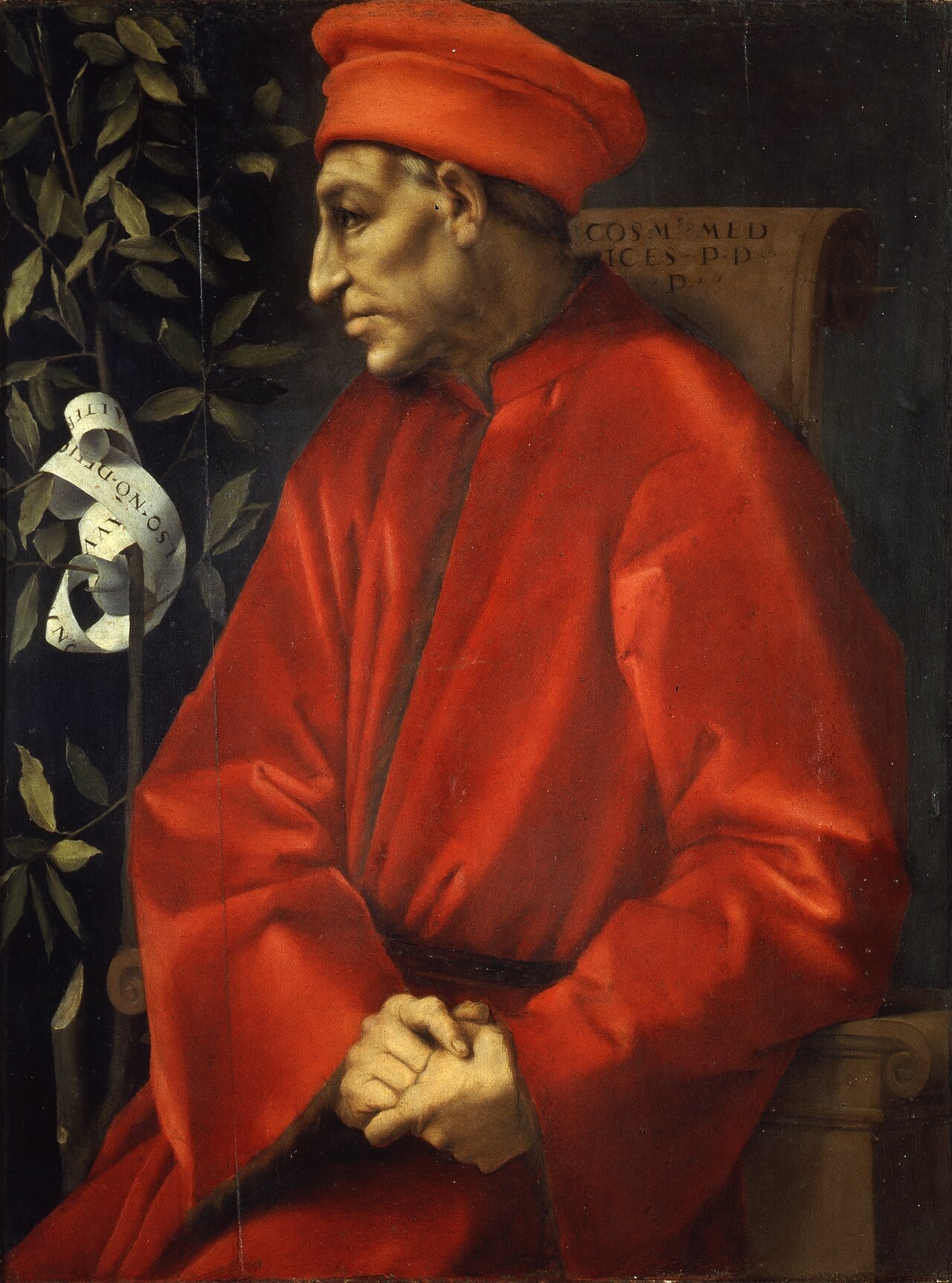 Cosimo de' Medici, known as the Elder, in the portrait painted by Pontormo around 1518-1520, more than fifty years after his death. The laurel branch is a Medici emblem.
In 1433 the opposing faction, led by Rinaldo degli Albizzi, controlled the city's government, which was coming out of a badly lost war against Lucca and Milan. In September Cosimo was summoned to the Palazzo della Signoria and arrested. He was accused of treason and sentenced to exile: first to Padua, then to Venice.
It did not last. The following year the wind changed and a new Signoria, favourable to the Medici, overturned the sentence. Cosimo returned to Florence in October 1434. This time it was the Albizzi who were sent away, along with other rival families such as the Strozzi. From then until his death in 1464 Cosimo ran the city without holding any title as head of state. He lent money, did favours and weighed on who could hold public office. The mechanism was simple: the bank funded political power, and political power protected the bank.
Business boomed. Between 1435 and 1450 the bank earned an average of about 19,400 florins a year. In 1439 the Bruges branch was officially opened, in the great trading hub of Flanders, where English wool and northern cloth arrived. In 1461 rich deposits of alum were discovered at Tolfa, in the Papal States. Alum was used to fix dyes in textiles, and Florence lived on textiles. The Medici won the management of the mines.
When Cosimo died, on August 1st 1464, the Medici Bank was the largest and most respected bank in Europe.
After Cosimo, nobody checks the books
The system's flaw was that it worked only if someone at the top was supervising the branch managers. Cosimo did. His successors far less.
Piero, his son, nicknamed the Gouty for the illness that tormented him, had a humanist education and delegated more and more of the management to the general manager. When he tried to put the accounts in order by calling in many old loans, several merchants went bust and became enemies of the Medici.
In 1469 Piero died and the bank passed to his son Lorenzo, who was twenty and would be called the Magnificent. Machiavelli and Guicciardini agreed on one thing: in business Lorenzo had no luck and kept away from it, leaving the work to his men. In 1522 one of Lorenzo's nephews, Alessandro de' Pazzi, in a speech to Cardinal Giulio de' Medici, listed three causes of the bank's failure: poor business ability, an interest in politics and the household's enormous spending.
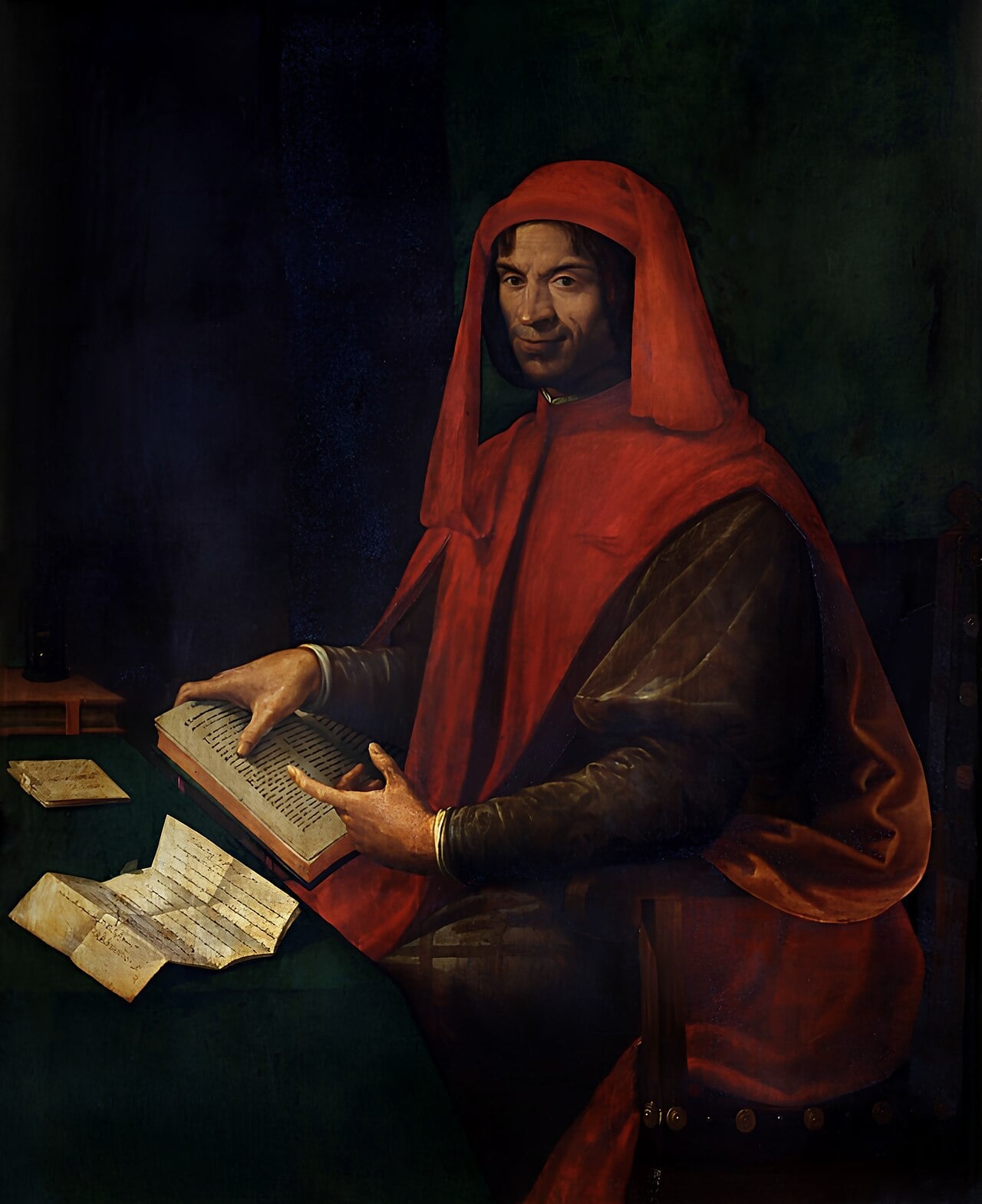 Lorenzo de' Medici, known as the Magnificent, in a sixteenth-century portrait by Girolamo Macchietti.
The man who held everything together was the general manager Francesco Sassetti, who ran the bank for most of Lorenzo's years. The Lyon branch nearly failed because of its manager, who was abusing his position. Sassetti managed to save it, but historians fault him for not growing suspicious sooner of the excessively high profits that branch was reporting.
The worst case was Bruges. Tommaso Portinari, the same man from the 1455 lawsuit, had arrived in the city around 1440 and from about 1465 ran its branch. He lived in grand style and had himself and his wife painted by Hans Memling. He made risky, unsecured loans to Charles the Bold, Duke of Burgundy. A prudent partner, Angelo Tani, objected. Sassetti consistently overruled him and removed even the last limits on loans to rulers.
Charles the Bold died in battle at Nancy in January 1477, and his debts became his creditors' problem. In London the situation was similar, with loans to King Edward IV, and in 1477 the branch was closed: its assets and liabilities passed to Bruges, which emerged even more burdened. Between 1478 and 1480 the Medici decided to wind up Bruges as well and forced Portinari to take it over, with huge losses. Around 1479 Lorenzo wrote that he had lost more money in a Portuguese expedition along the African coast financed by Portinari, and forbade him to invest any more. On April 21st 1488, in a single day, seventeen letters went out about the Lyon branch's difficulties, addressed to foreign creditors.
Why are loans to kings so risky? A merchant who does not pay can be taken to court and his goods seized. A duke or a king cannot. The danger had long been known: the Bardi and the Peruzzi, the Florentine giants of the previous century, had collapsed partly from lending too much.
The Pazzi conspiracy
Meanwhile something serious had happened on the Roman front. Pope Sixtus IV wanted to buy Imola for one of his nephews and asked the Medici bank for a loan. Imola lay on the road between Florence and Venice, and Lorenzo feared having a papal state on his borders. He refused.
The response was revenge. Sixtus took the Apostolic Camera's accounts away from the Medici and gave them to the Pazzi, their old rivals. It was the Pazzi who financed the purchase of Imola. For the Medici it was like losing the client that had made their fortune.
On Sunday April 26th 1478, during high mass in Florence Cathedral, the conspirators attacked Lorenzo and his brother Giuliano. Giuliano was stabbed to death. Lorenzo, wounded in the neck, saved himself by taking refuge in the sacristy. Among the organisers was Francesco de' Pazzi, manager of the Rome branch of his family's bank. Between April and October eighty people were put to death. The pope placed Florence under interdict, and a war followed.
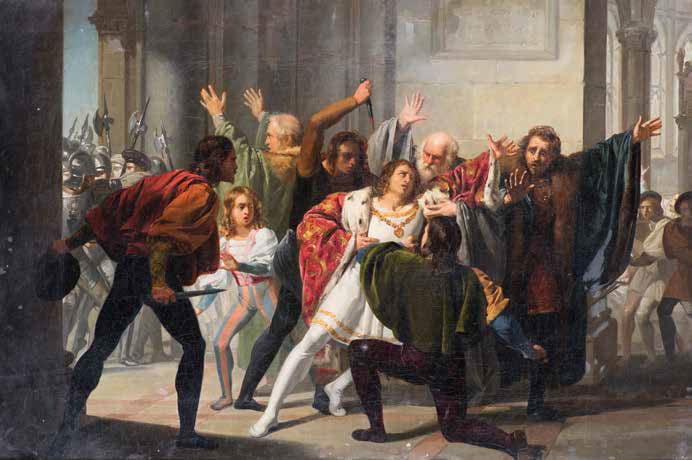 The Pazzi conspiracy and the murder of Giuliano de' Medici in Florence Cathedral, in a nineteenth-century painting by Stefano Ussi.
Lorenzo came out of it stronger as lord of the city, but the bank was weaker than before. To hold the accounts together, according to historians, he also used public money. The bank's men now knew they were working for a family that governed the city, and that they could no longer say no to the powerful.
November 1494
Lorenzo died on April 8th 1492, aged 43. His son Piero, who was twenty, inherited a political and financial legacy more fragile than it looked. He would be called the Unfortunate.
In 1494 King Charles VIII of France marched into Italy with an army to conquer Naples, invited by Ludovico Sforza of Milan. Piero met the king and handed him the main fortresses of Tuscany. In Florence the move was judged a surrender. The preacher Girolamo Savonarola, who had foretold a divine scourge falling on Italy, saw his prophecies confirmed, and the city rose up. On November 9th Piero fled.
The Medici palace was looted. Among those inside were French soldiers and a nobleman from the king's retinue, who set about plundering on the grounds that the Lyon branch owed him a large sum. The Signoria sent guards to protect the palace. Then it seized what remained at the bank's Florence headquarters, and that was the end.
There was not much left to seize. In the preceding years Lorenzo had moved resources to Rome and Lyon and channelled them into other companies. When the bank was wound up, the liquidators found little in Florence. According to some historians, even without the French invasion the bank would have ended in a financial collapse of the first order.
Piero would drown in December 1503 while crossing the Garigliano river with the French army. The Medici returned to Florence in 1512 and never went back to banking: they became popes, with Leo X, another of Lorenzo's sons, in 1513, and then dukes, with Alessandro in 1532.
Someone else always pays the bill
The story of the Medici Bank is often told as that of a family of geniuses who invented modern finance. Most of the tools already existed. The merit of Giovanni and Cosimo was to use them with discipline: separate branches, motivated managers, controls from the centre.
The bank ended when that discipline slackened and the bank became the wallet of a family that ran the city. The pope had given it its wealth, and the pope took it away when it really mattered. The kings and dukes it had lent to felt no obligation to repay. Cosimo had built a system in which politics protected the bank. Lorenzo turned it upside down, and it was the bank that had to protect politics.
When politics gets into a bank's books, who really pays the price?
Image credits
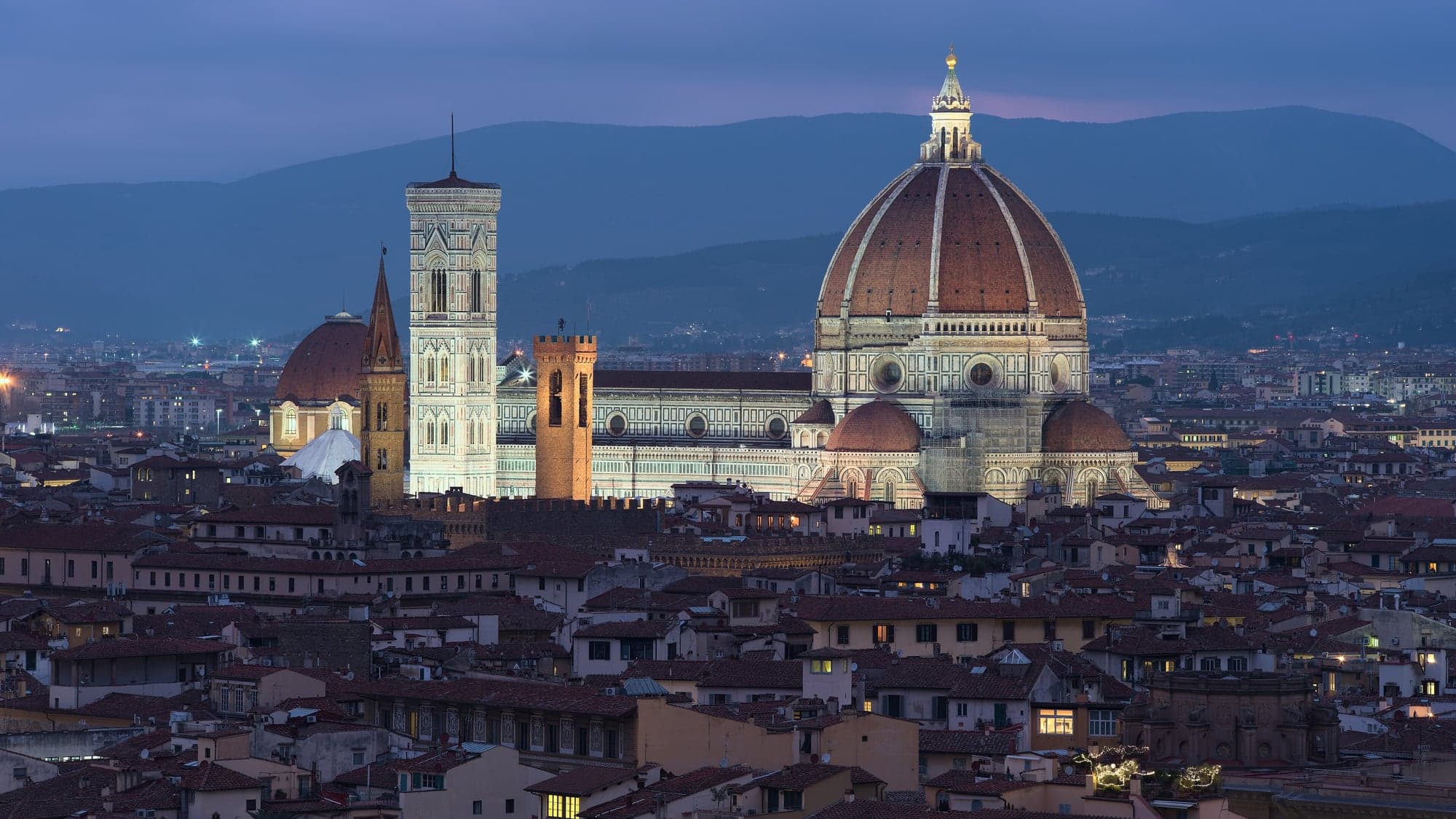
- Cover: "Florence Cathedral seen from Piazzale Michelangelo night dllu.jpg", photo by Dllu, February 17th 2023, via Wikimedia Commons, licensed CC BY-SA 4.0. Cropped to 16:9 and resized; the modified version is distributed under the same licence.
- In the text: "Pontormo - Ritratto di Cosimo il Vecchio - Google Art Project.jpg", painting by Pontormo, around 1518-1520, via Wikimedia Commons, public domain.
- In the text: "Ritratto di Lorenzo de' Medici detto il Magnifico - Macchietti Girolamo.jpg", painting by Girolamo Macchietti, 16th century, via Wikimedia Commons, public domain.
- In the text: "Stefano Ussi La Congiura dei Pazzi.jpg", painting by Stefano Ussi, 19th century, via Wikimedia Commons, public domain.
Sources
- Raymond de Roover, The Rise and Decline of the Medici Bank, 1397-1494, Harvard University Press, 1963.
- Raymond de Roover, The Medici Bank: Its Organization, Management, Operations and Decline, New York University Press, 1948.
- Florence Edler de Roover, "Francesco Sassetti and the Downfall of the Medici Banking House", Bulletin of the Business Historical Society, 17 (4), 1943.
- Tim Parks, Medici Money: Banking, Metaphysics, and Art in Fifteenth-Century Florence, Profile Books, 2005.
- Lauro Martines, April Blood: Florence and the Plot Against the Medici, Oxford University Press, 2003.
- Pierluigi Terenzi, "Medici, Giovanni de'", Dizionario Biografico degli Italiani, Istituto della Enciclopedia Italiana (Treccani).
- Paul Strathern, Death in Florence: The Medici, Savonarola, and the Battle for the Soul of a Renaissance City, Pegasus Books, 2015.
- Medici
- Florence
- banking
- Renaissance
- bills of exchange
- history