 Bellwether
On 5 June 1947, in Cambridge, Massachusetts, thousands of people attended the Harvard commencement ceremony. Among the twelve guests receiving an honorary degree were the poet T. S. Eliot and Robert Oppenheimer, the physicist who two years earlier had led the building of the atomic bomb. Last on the list was the American Secretary of State, General George Marshall. In the afternoon, in front of the alumni, he spoke for about ten minutes, from a text of around 1,200 words, reading in a low voice with his eyes on the page. Journalists were told it was an ordinary end-of-year speech. It was in fact the start of the most famous aid programme in history. People remember that programme's name and its figure, but much less how it worked and where the money really went.
What does it cost to save a continent from hunger, and why did the greatest power in the world decide to pay?
A continent without dollars
The winter of 1946-47 was the harshest in living memory. Snow blocked the railways and coal supplies, and the harvest was poor. The cold, though, was only the visible part. The real problem was money.
Restarting required grain, coal, cotton and machinery, and in 1947 the only supplier able to sell them in quantity was America, which wanted to be paid in dollars. Europe did not have them. Its factories were destroyed or idle, so it exported little, and its reserves had been used up during the war. It bought more than it sold and had nothing with which to cover the difference. Economists called this the "dollar gap". Marshall did not hide the American interest: the consequences for the United States economy of a Europe in crisis, he said, should be apparent to all.
Marshall explained it with an example that takes up a central passage of the speech. The farmer produces food to exchange it for what comes from the city, and this division of labour, he said, is the basis of modern civilisation. But if the city lacks goods to buy and the currency is worth nothing, selling the harvest does not pay, and the farmer keeps it for himself. The cities go without food, governments spend their last reserves on importing it and the factories produce even less.
In September 1947 a confidential State Department memorandum reported that, according to the French government, by 15 October France would have exhausted its means and would be forced to suspend even imports of food and coal for lack of dollars.
The United States was already helping Europe. Between 1945 and 1947 it had paid out sums that, calculated per year, exceeded even those of the Marshall Plan. But these were separate programmes competing with one another, and Congress was starting to doubt that they worked. This too was why the Plan was born: to put that aid under a single direction and tie it to a political strategy.
Ten minutes at Harvard
Marshall had been Secretary of State since January. Returning from the Moscow conference on the future of Germany, which had ended without results after a private meeting with Stalin, he said: "The patient is sinking while the doctors deliberate." He asked the State Department's policy planning office to prepare a proposal and gave it a single instruction: "avoid trivia".
That the speech was given at Harvard was almost chance: Marshall had also been invited by the University of Wisconsin and by Amherst. The Under Secretary of State advised him against that venue, because commencement speeches, he said, are a ritual to be endured without listening. Marshall was not persuaded.
The Harvard speech was written with contributions from several officials, and Marshall was still correcting it the day before. President Truman did not receive a final version. The text contained no figure and no name for the project, and it never mentioned the communist threat. It did contain a condition: the initiative had to come from Europe, which would have to present a common programme. And it contained a line that was to last: American policy, he said, was directed "against hunger, poverty, desperation and chaos".
He had opened with words of humility, calling himself "profoundly grateful" and "overwhelmed" by the honour he had received. At the bottom of the text he added two paragraphs by hand: from a distance it was almost impossible to grasp the real scale of the situation, and the future of the world depended on a correct judgement. At the end the applause was very loud.
Marshall had arranged for the BBC to be alerted, so that the first response would come from Europe. That same evening, at 10:30 pm, the British Foreign Secretary Ernest Bevin heard extracts of the speech on the radio and at first thought it was live. The next morning he telephoned his French counterpart. Years later he recalled: "I grabbed them with both hands." He called the speech "a lifeline to sinking men". The American press was cooler: the next day the New York Times ran the headline "Marshall Pleads for European Unity". The speech had no title, and the Harvard alumni bulletin called it "The Marshall Doctrine". Even the president of Harvard admitted in his memoirs that he had not understood the importance of that speech.
The door Stalin closed
Bevin and his French counterpart also invited the Soviets to Paris, and at first Stalin did not refuse: he sent his Foreign Minister Molotov, who arrived on 27 June. On 2 July he left: in his view a common plan violated the sovereignty of countries and divided Europe into two blocs. Bevin replied by warning the other governments that, for ideological or other reasons, it was disastrous to waste the bridge the United States was building between East and West. On 12 July sixteen countries met in Paris. Those of Eastern Europe were missing.
The Czechoslovak government had accepted the invitation on 4 July, with the unanimous vote of the parties. On 9 July a Czechoslovak delegation was received in Moscow by Stalin, who according to the record said he was surprised by their decision and told them to refuse. The next day the Prague government withdrew its acceptance. Poland too, which had shown interest, stepped aside. The Plan was applied only to Western Europe.
In Washington, meanwhile, people joked that the plan was a flying saucer: nobody knew what it looked like, how big it was, where it was going or whether it really existed. In December Truman presented the first official version of the programme to Congress.
Where the money really went
In 1948 the agency charged with managing the aid, the Economic Cooperation Administration (ECA), was set up in Washington, and in Paris the organisation of the European countries receiving it, the OEEC. Each country had to present a four-year recovery programme, with more detail on the first year, and the other countries examined it together. This was to stop each of them building its own steelworks: with scarce resources, steel had to be rebuilt where a base already existed. The overall request then went to the ECA, which decided how much to grant.
The least known part is the payment mechanism. Imagine Fiat, which needs new sheet-metal presses because the old ones are worn out or destroyed. The Italian government asked the ECA to pay for them, and the ECA checked that the purchase fell within the programme approved in Paris. Fiat found an American manufacturer, which was paid in dollars while it worked, through a bank that was then reimbursed by the United States Treasury. Not a single dollar crossed the Atlantic. The presses arrived in Italy and the state resold them to Fiat in lire. Those lire went into a fund, known as the counterpart fund. It worked the same way for coal, for cotton and for grain: the bread Italians bought fed the fund, because bakers paid the state in lire for the imported grain.
Five per cent of the fund went to the Americans for the expenses of their missions. The rest was spent by the government, but only with Washington's approval, and much of it had to go towards reducing the public deficit. In this way the state did not print new money to cover it, and inflation fell.
The effect was twofold. Europe received food, fuel and machinery it could not otherwise have paid for, while American farmers and industries collected dollars from their own Treasury. The State Department's Office of the Historian writes that the Plan was also a stimulus for the American economy, because it opened markets to its products.
In the end the United States spent about 13.3 billion dollars, against the 17 planned, distributed to 17 countries: West Germany had joined the sixteen of Paris. Most of it was in grants: loans were deliberately kept low, so as not to repeat the problem of foreign-currency payments that had crushed Germany after the First World War. For the American budget it weighed between 1% and 2% of GDP a year. The United Kingdom received almost a quarter of the total, France a fifth, Italy 11%, West Germany 10%.
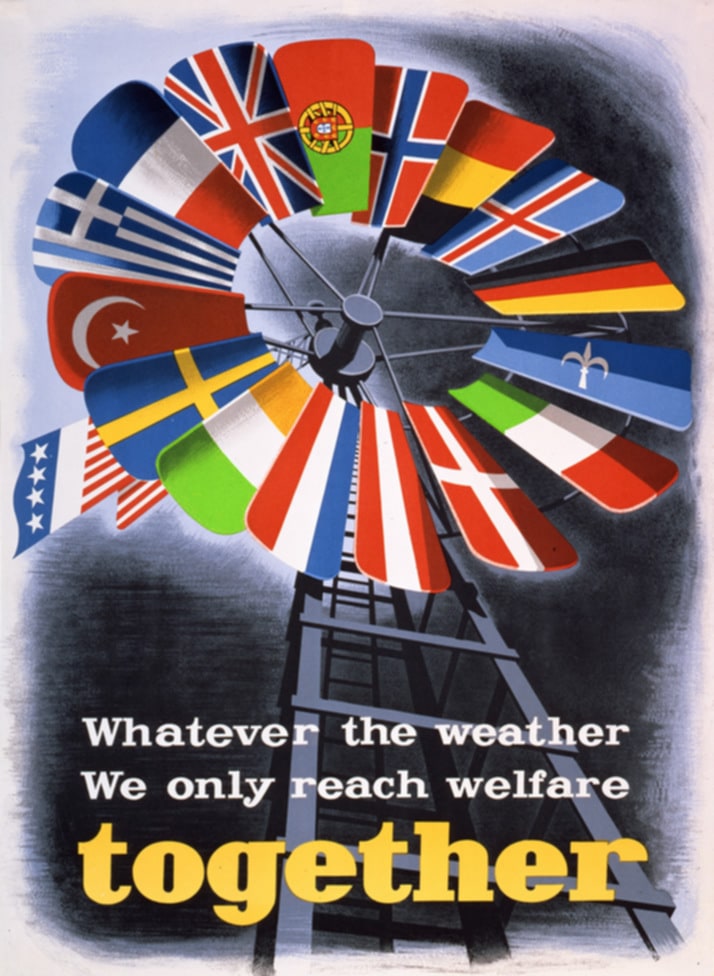 A 1950 poster by Ies Spreekmeester for the Economic Cooperation Administration: the flags of the countries receiving aid are the blades of a single windmill.
The Prague coup and the vote in Italy
Getting the Plan approved was not a foregone conclusion. The Truman Doctrine, set out in March 1947 with a request for 400 million dollars for Greece and Turkey, had surprised Congress, and some influential senators had taken it badly. The Democrats supported the aid but were in the minority, and the isolationist Republicans feared communism above all. In February 1948 the communist coup in Prague showed that the Soviet Union was ready to use force to take power in a country. It provided one more argument, especially in the House and when the time came to appropriate the funds. On 3 April 1948 Truman signed the law.
In Italy the vote came fifteen days later. De Gasperi had already been to Washington at the start of 1947 and had obtained a loan of 100 million dollars. In May of the same year he had removed the socialists and communists from the government, and the election campaign revolved around that choice of sides. Togliatti called the Plan political blackmail, and the Church mobilised civic committees to support the Christian Democrats. On 18 April 1948 the Christian Democrats took 48.5% of the vote and an absolute majority of seats, and the Popular Front of communists and socialists 35% of the vote. Italy went on to be the third-largest recipient of aid, about 1.5 billion dollars over four years.
How much it really mattered
In the four years of the Plan the participating countries restored industrial and agricultural production, stabilised their currencies and saw national product grow by between 15% and 25%. How much of this was due to the aid is something economists have been debating for decades.
The figure was large but limited: it did not exceed 2.5% of the income of the countries receiving it and covered less than 20% of investment in that period. One critical reading also argues that almost half the resources did not go to the most devastated areas, but served to win political support in Britain and France and to hold back the communists in various countries. A 1991 study by the National Bureau of Economic Research concluded that the aid was too small to speed up recovery by financing investment, repairing infrastructure or easing shortages of raw materials. The Plan mattered for another reason: the conditions it brought with it. To receive the funds governments had to stabilise prices, cut deficits and open up trade, and this pushed the European economies, mixed between state and market, towards more market and fewer controls.
A concrete result came in 1950 with the European Payments Union, which allowed European countries to offset their mutual debts without going through dollars each time and started a first liberalisation of trade. It was independent of the Plan, but supported with ECA funds.
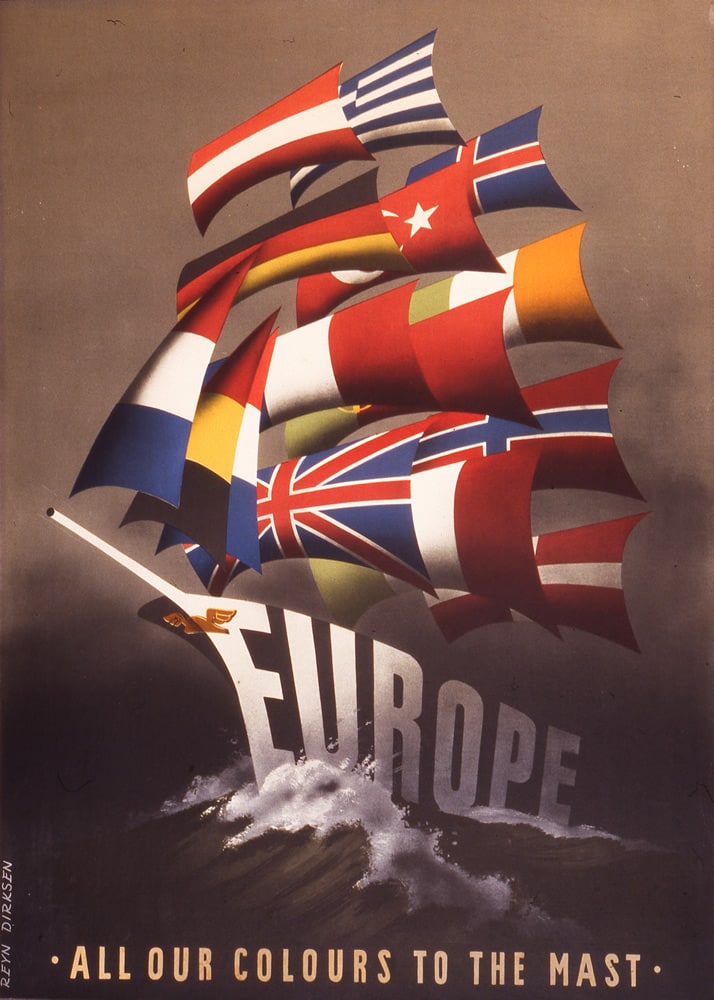 A 1950 poster by Reyn Dirksen for the Marshall Plan: the European flags become the sails of a single ship.
The verdict of contemporaries was less nuanced. Winston Churchill called it "the most unsordid act in history".
And today?
Every time a country emerges devastated from a war, Marshall's name returns to the debate. In the case of Ukraine the comparison is explicit, and the numbers help. The fifth joint assessment by the World Bank, the Ukrainian government, the European Commission and the UN, published on 23 February 2026, puts the direct damage from the Russian invasion at 195.1 billion dollars at the end of 2025 and reconstruction needs at 587.7 billion between 2026 and 2035, almost three times Ukraine's 2025 GDP. A World Bank study from October 2025 calculates that the Marshall Plan is worth about 190 billion 2025 dollars: rebuilding Ukraine would cost about three times as much.
For 2026 the Ukrainian government indicated priorities worth 15.25 billion, and at the time of the assessment about a third of this was covered between the state budget and partners. In December 2025 European Union leaders agreed a 90 billion euro loan for 2026-2027, financed with European debt on the markets and guaranteed by the Union budget, without using frozen Russian assets. Ukraine will repay it only when Russia pays reparations. The Russian assets remain blocked, and the Union reserves the right to use them to repay the loan, in line with European and international law. Compared with 1948, the form and the donor change: the Plan was mostly grants and came from a single country, whereas this is debt shared among many.
For Italy the closest comparison is the PNRR, the national recovery plan. It is worth 194.4 billion euros, of which 71.8 in grants and 122.6 in loans, and by June 2026 the European Union had paid out about 166 of them, or 85%. The roughly 1.5 billion dollars of the Marshall Plan, revalued, are a fraction of the grant part of the PNRR alone, and almost two thirds of the PNRR are loans to be repaid. One feature, though, is the same, and it is the one that mattered most to economists in 1948: the money arrives in instalments and only if agreed milestones and targets are met, meaning reforms and investments to be completed.
At the 1947 Harvard ceremony there were two men who would mark the same decade. One had built the bomb, the other proposed rebuilding the continent that war had destroyed. Marshall received the Nobel Peace Prize in 1953, the only general to receive it. The following year Oppenheimer lost his security clearance.
Was the Marshall Plan a gift, an investment or a Cold War weapon?
The information contained here is not financial advice: before any investment decision, consider your personal situation or consult a qualified adviser. The data comes from public sources (Harvard Magazine, U.S. Department of State, World Bank, European Council, Italian Chamber of Deputies) and is current as of early November 2026.
Image credits
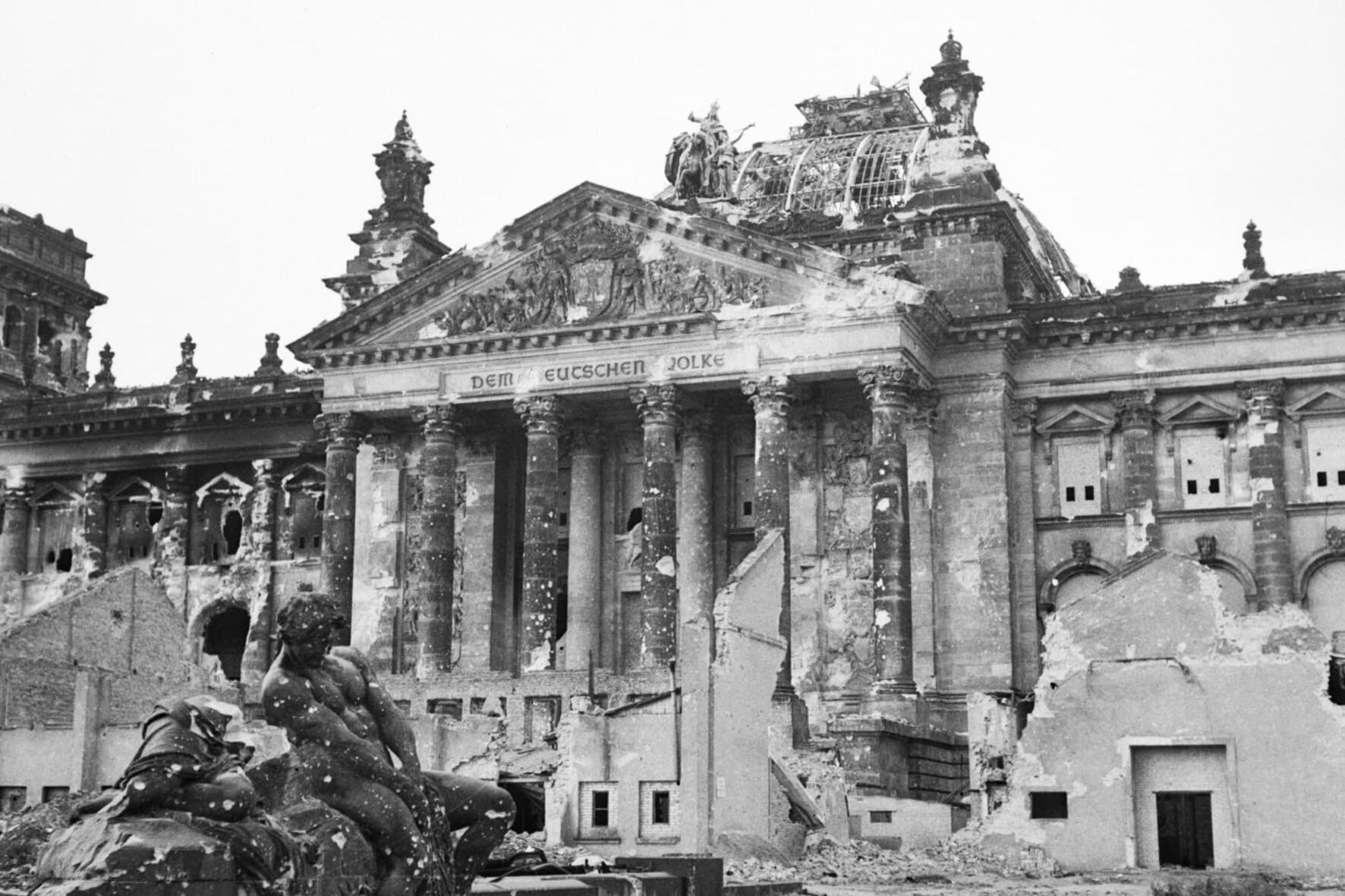
- Cover: "Ruins of the Reichstag in Berlin, 3 June 1945. BU8573.jpg", photo by Sgt Hewitt, No 5 Army Film & Photographic Unit, 3 June 1945, Imperial War Museum (BU 8573), via Wikimedia Commons, public domain. Cropped to 3:2.
- In the text: "Marshall Plan poster.JPG", poster by Ies Spreekmeester for the Economic Cooperation Administration, 1950, via Wikimedia Commons, public domain. Recompressed.
- In the text: "Europe Plan Marshall. Poster 1947.JPG", poster by Reyn Dirksen for the Economic Cooperation Administration, 1950, via Wikimedia Commons, public domain. Recompressed.
Sources
- Harvard Magazine, "The Ultimate Commencement Address" (1997), on the ceremony, the speech, Bevin, the 17 billion, Churchill, growth of 15-25%. harvardmagazine.com
- Harvard Magazine, "A Routine Commencement Speech", on the press coverage and the BBC broadcast. harvardmagazine.com
- Office of the Historian, U.S. Department of State, "Marshall Plan, 1948". history.state.gov
- Albrecht Ritschl, "The Marshall Plan, 1948-1951", EH.Net Encyclopedia (2008), on counterpart funds, loans, the size of the aid, the European Payments Union and the historical debate. eh.net
- National Security Archive, interview with Theodore Geiger (Cold War series), on the payment mechanism, counterpart funds and the Prague coup. nsarchive2.gwu.edu
- J. B. De Long and B. Eichengreen, "The Marshall Plan: History's Most Successful Structural Adjustment Program", NBER Working Paper 3899 (1991). nber.org
- George C. Marshall, Harvard speech, 5 June 1947 (text). nato.int
- The National Archives (UK), "Marshall on Marshall Plan", extracts from the speech. nationalarchives.gov.uk
- George C. Marshall Foundation, "Avoid trivia". marshallfoundation.org
- George C. Marshall Foundation, on the speech and the alert to the BBC. marshallfoundation.org
- Foreign Relations of the United States, 1947, vol. III, memorandum of 29 September 1947 "Immediate Need for Emergency Aid to Europe". search.library.wisc.edu
- Marshall Foundation, "Marshall Plan: A Blueprint for Recovery", on the winter of 1946-47. marshallfoundation.org
- HistorySkills, "Why did the Soviet Union reject Marshall Aid?", on Molotov and Czechoslovakia. historyskills.com
- Wilson Center Digital Archive, "Record of I.V. Stalin's Conversation with the Czechoslovak Government Delegation", 9 July 1947. digitalarchive.wilsoncenter.org
- Statista, "Distribution of Marshall Plan aid per country, 1948-1952". statista.com
- l'Unità, 18 November 1967, on the amount of aid to Italy (1,508.6 million dollars). archivio.unita.news
- Senato della Repubblica, "Introduzione alla I Legislatura", on the vote of 18 April 1948. senato.it
- Focus, "18 aprile 1948. Le prime elezioni in Italia". focus.it
- D. Kedrosky and J. Mokyr, "The Marshall Plan: Then and Now", World Bank Policy Research Working Paper 11230, October 2025 (13 billion equal to 190 billion 2025 dollars, 17 countries). documents1.worldbank.org
- World Bank, "Ukraine - Fifth Rapid Damage and Needs Assessment (RDNA5)", press release of 23 February 2026. worldbank.org
- Government of Ukraine, "RDNA5: Ukraine requires USD 15.25 billion for recovery in 2026", 23 February 2026. kmu.gov.ua
- European Council, conclusions of 18 December 2025 on Ukraine, 19 December 2025. consilium.europa.eu
- George C. Marshall Foundation, "The Marshall Plan in 10 Minutes" (the Harvard audience, length of the speech, total of 13.3 billion, 17 countries). marshallfoundation.org
- Camera dei deputati, "Il Piano Nazionale di Ripresa e Resilienza". temi.camera.it
- Marshall Plan
- George Marshall
- post-war
- dollar
- Cold War
- history