In 1899 Rheinmetall buys 1,040 hectares of heathland at Unterlüß, in Lower Saxony. It needs them for one thing only: a private range where it can fire its own guns in front of customers. On 27 August 2025, on that same ground, NATO Secretary General Mark Rutte, German Defence Minister Boris Pistorius and Vice-Chancellor Lars Klingbeil open the largest ammunition factory in Europe, built, according to the company, in just fifteen months of construction. In between come two world wars, two bans on making weapons, typewriters, refrigerators and car pistons. Then Russia's invasion of Ukraine, after which the share price rose to more than twenty times its earlier level. The company is Rheinmetall. Who cashes in when Europe is afraid?
The origins: the gun Germany didn't want
Rheinmetall is founded on 13 April 1889 in Düsseldorf with a very long name, Rheinische Metallwaaren- und Maschinenfabrik, and a precise goal: to make ammunition for the army of the German Empire. Its founder, the engineer Heinrich Ehrhardt, registers 128 patents. The most important comes in 1891: a method of pressing and drawing metal that makes it possible to produce seamless tubes and to make shells out of steel instead of cast iron.
The breakthrough, though, is brought by someone else. In 1895 Konrad Haussner, a former Krupp engineer, comes to Ehrhardt with a design of his own: a quick-firing gun that absorbs its recoil instead of jumping backwards with every shot. Ehrhardt believes in it, hires him in 1896, and Rheinmetall builds the prototype. The German army turns it down. The buyer, in 1900, is the British army, looking for a way to modernise its artillery. Norway, the United States, Austria-Hungary and eventually Germany follow. Within a decade, that rejected gun turns an ordinary ammunition maker into one of Europe's major arms manufacturers.
Two wars, two bans
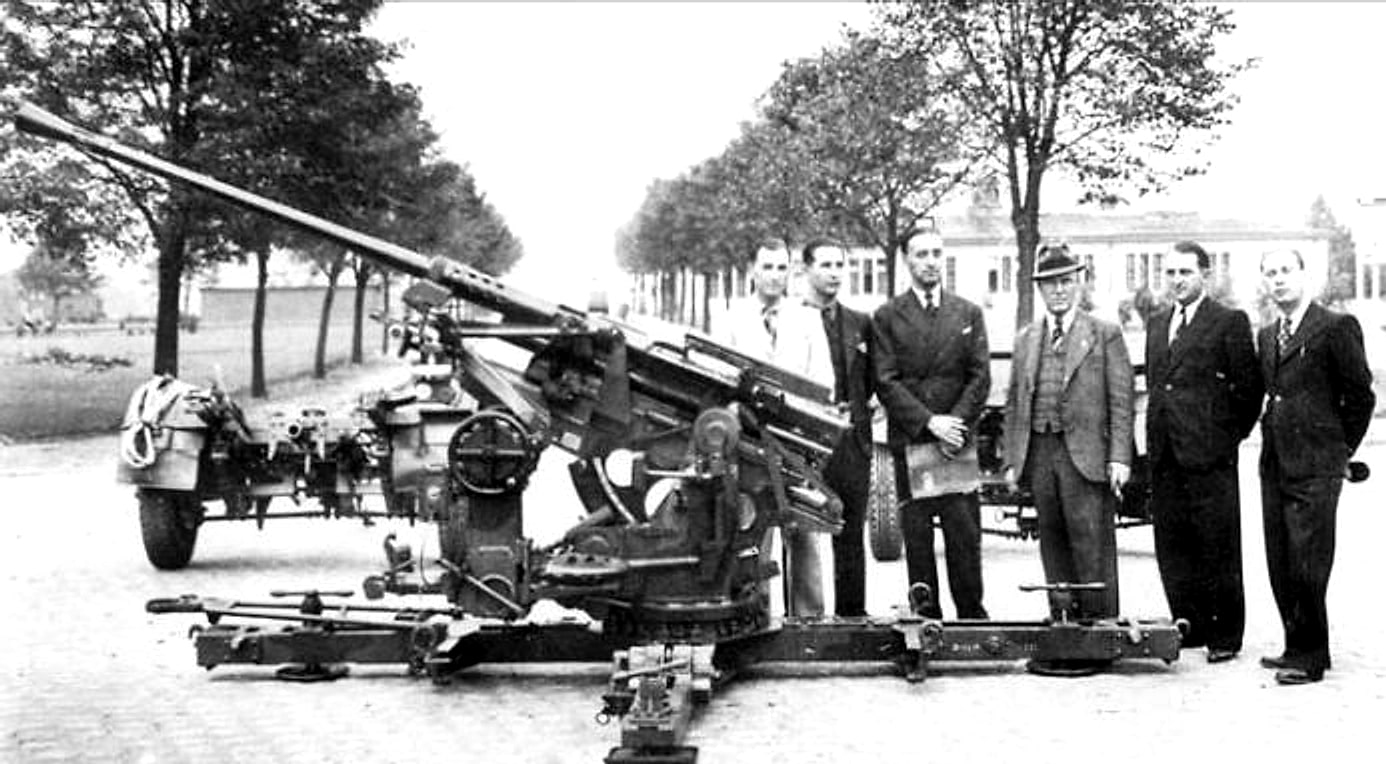 A Rheinmetall 37-millimetre anti-aircraft gun at the Astra factory in Brașov, Romania, where it was known as the Model 1939.
After the First World War the Treaty of Versailles bans Germany from large-calibre weapons, and Rheinmetall reinvents itself: locomotives, steam ploughs, typewriters and calculators. It does not last long. In 1925 the German state becomes the majority shareholder, in 1933 the company takes over Borsig, the historic Berlin locomotive builder then in liquidation, and with Nazi rearmament it ends up inside the Reichswerke Hermann Göring, the state industrial conglomerate created by the regime and named after the Nazi party's number two, to produce steel and weapons. It is also the darkest chapter in its history: at the Unterlüß plant alone, around 5,000 forced labourers and prisoners of war are put to work.
In 1945 weapons production stops again, by law. When the company restarts, in the early 1950s, it makes loading machinery, steam boilers and refrigerators. In 1956 the Röchling family, steel industrialists, buys the majority from the federal government; in the same period the Bundeswehr, Germany's new army, is created, and Rheinmetall goes back to making weapons. The first military product of the restart is the MG42 machine gun, the same one used by the Wehrmacht, from which the Bundeswehr's MG3 will later be derived.
Here comes the most surprising detail. In 1965 Rheinmetall resumes making gun barrels, and a team of engineers led by Raimund Germershausen begins developing a 120-millimetre smoothbore gun. The result is the Rh-120, fitted to the Leopard 2, the German tank first delivered in 1979. In the United States that barrel is produced under licence at the state-owned Watervliet Arsenal, in New York State, and mounted on an American carriage and recoil system: it is the M256, the gun of the M1 Abrams. Put simply: for decades the tank that symbolises the US Army fired through a barrel designed in Germany.
In 1986 Rheinmetall buys Pierburg, a maker of carburettors and engine components, and for forty years it stays split between defence and car parts. That chapter closes in June 2026, with the agreement to sell the civilian division, around 2 billion in revenue in 2025, to the Munich-based industrial group AEQUITA for a provisional price of 350 million euros, with completion expected by the end of the year. Once the deal is done, Rheinmetall will be a pure defence company.
What Rheinmetall does today
Since 2013 the chief executive has been Armin Papperger, an engineer who joined the company in 1990, with a contract renewed until 2030. Since 2026 the group has been organised into five divisions.
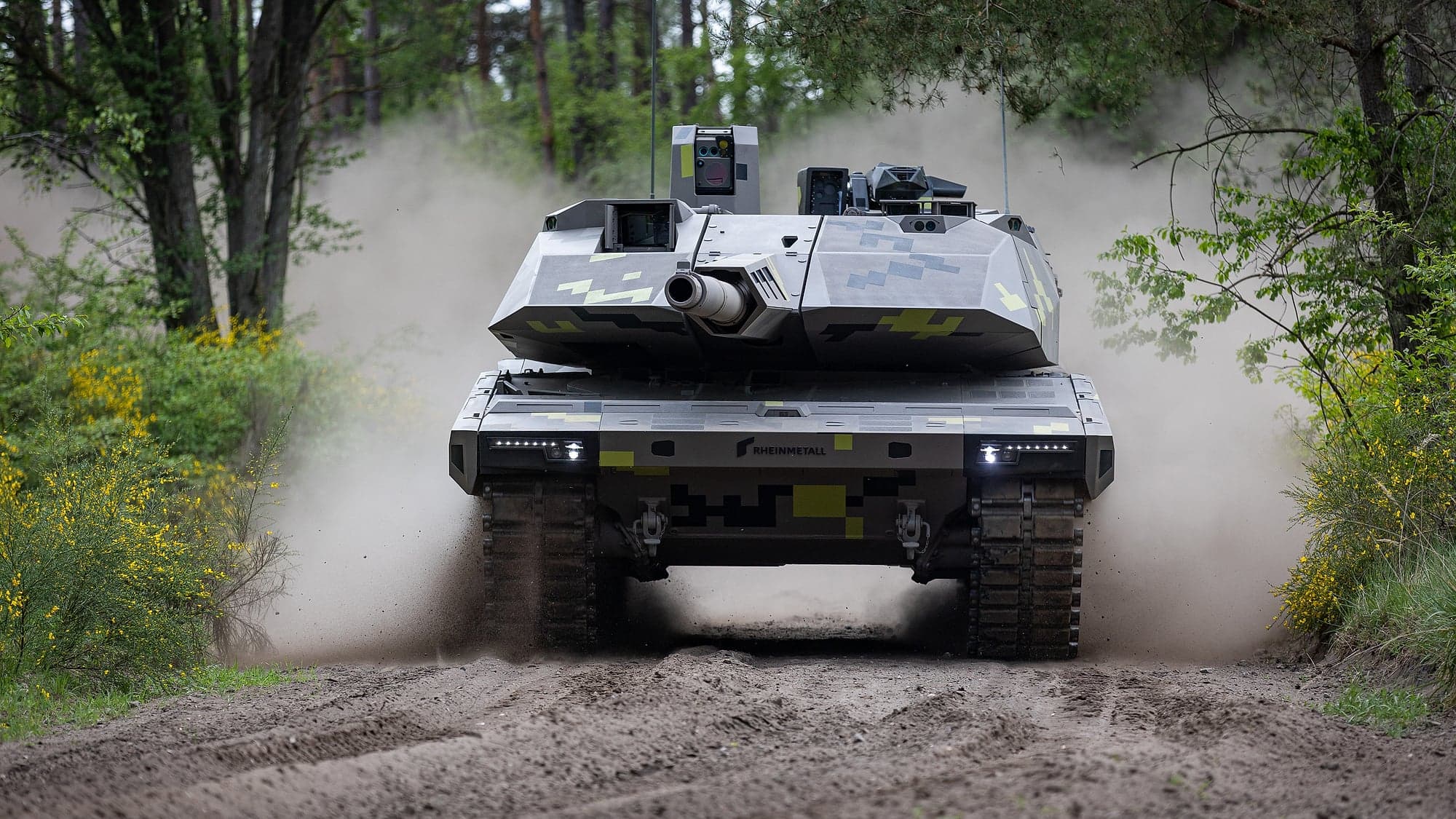
Vehicles. This is the largest division. It includes the Lynx, the infantry fighting vehicle chosen by Hungary, Ukraine, Italy and, in 2026, Romania with 298 vehicles; the Panther KF51 tank; and a share in German programmes such as the Puma.
Weapons and ammunition. Guns, mortars and above all 155-millimetre artillery shells, the kind the war in Ukraine consumes at a rate Europe had not seen for decades. Unterlüß alone aims for 350,000 shells a year from 2027; across all its plants, the group's target is around 1.5 million.
Air defence. Systems such as Skyranger and Skynex, short-range air defence based on automatic cannon and radar, designed above all against drones and low-flying threats. It is the fastest-growing division: +62% in the first half of 2026.
Digital systems. Communications, sensors and software that connect vehicles and soldiers in the field.
Naval. The youngest division, created with the purchase of NVL, the naval defence arm of the Lürssen shipbuilding group, completed in March 2026.
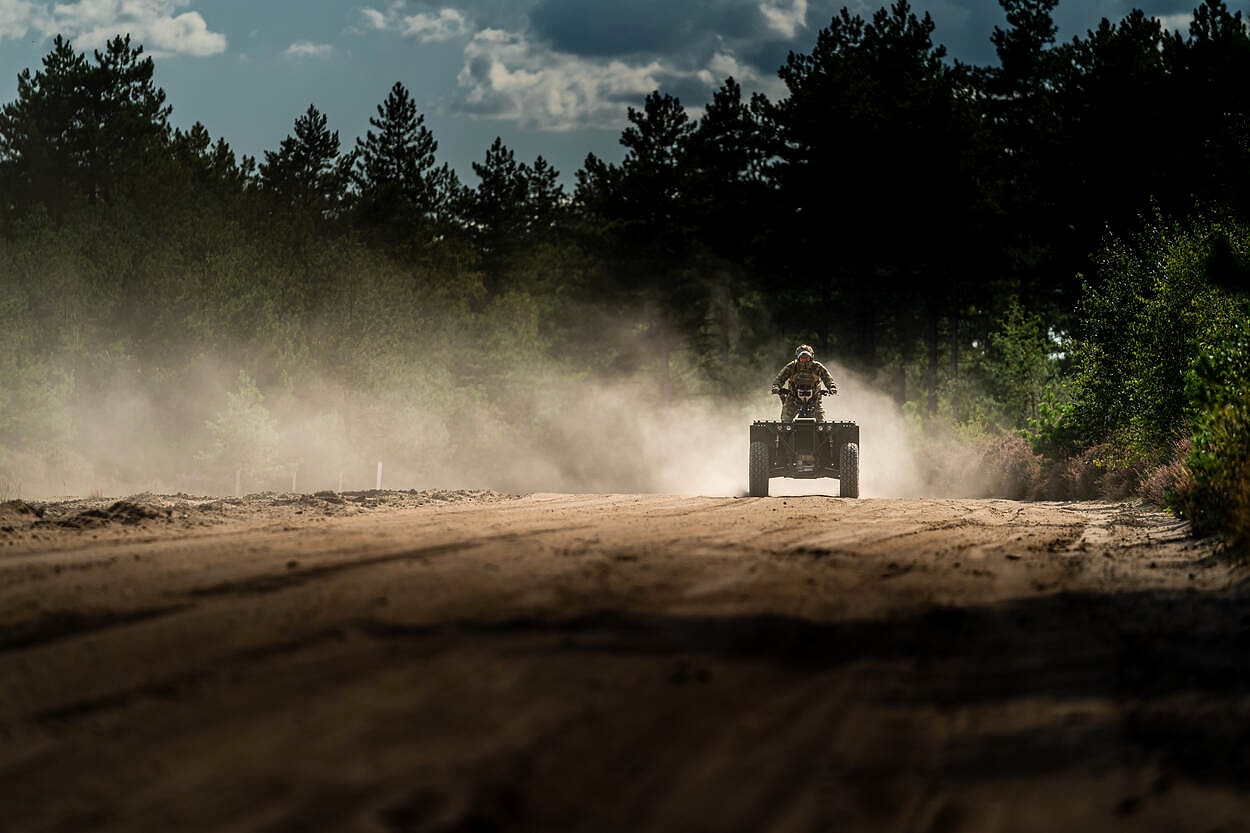 The hybrid military quad bike prototype tested by the Dutch armed forces at Leusden in 2019. It was developed by REEQ, the small Dutch company later taken over by Rheinmetall.
There is a reason ammunition matters more than its revenue suggests. In the first half of 2026 the vehicles division sold 2.4 billion euros' worth with an operating margin of 11.3%; weapons and ammunition sold 1.8 billion, but with a margin of 23.7%, more than double. A tank is sold once and stays in service for decades; a shell is fired, and has to be bought again.
Rheinmetall and Italy
In Rome there is Rheinmetall Italia, the former Oerlikon Contraves, which the group calls its "home of radar": it designs the surveillance and fire-control radars also used in air defence systems. In December 2025 Rheinmetall Italia delivered the first Skynex air defence system to the Italian Army, ordered for 73 million euros: Italy is the first NATO country to adopt it.
Then there is RWM Italia, headquartered in Ghedi, near Brescia, with an engineering centre in Turin and two plants in Sardinia, more than 600 employees in all. It makes underwater and mine-clearing systems, warheads and aircraft bombs, and since 2025 it has been mass-producing HERO loitering munitions at Musei and Domusnovas together with Israel's UVision, with orders worth more than 200 million euros from eight European countries. For years Domusnovas was at the centre of controversy over aircraft bombs exported to Saudi Arabia and the United Arab Emirates, until in 2019 the Italian government suspended the export licences and the site, according to Il Sole 24 Ore, lost 80% of its workforce within a year.
But the link that matters today is another one: Leonardo Rheinmetall Military Vehicles, the 50-50 joint venture with Leonardo set up in October 2024, headquartered in Rome with its operational base in La Spezia. Its job is to rebuild the Italian Army's armoured vehicles from scratch: 1,050 vehicles in the A2CS programme in 16 variants, based on the Lynx platform, and 132 new tanks based on Panther KF51 technology, plus 140 vehicles derived from the tank. According to Leonardo, the two programmes are worth more than 23 billion euros together, and around 60% of the work is planned in Italy.
The first steps have already been taken. The first contract, for 21 A2CS vehicles, arrived on 5 November 2025, and on 27 January 2026 the first four Lynx were delivered to the Army. For the tanks, however, there is no contract yet: on 21 September 2026 the land armaments directorate of the Ministry of Defence published the procedure for the new tank and derived vehicles, with a maximum value of 5.14 billion euros, and Leonardo aims to sign by the end of the year. Anyone who has read our article on Leonardo will recognise the mechanism: the money for European rearmament flows through national companies that, in order to build quickly, team up with those who already have the technology.
How it makes money, and how much
Rheinmetall sells almost exclusively to governments, on multi-year contracts: to understand where it is heading, the order book matters more than the latest quarter.
In 2025, excluding the civilian division being sold, it had revenue of 9.9 billion euros, 29% more than the year before, with operating profit of 1.84 billion and a margin of 18.5%. In the first half of 2026 sales grew by 39%, to 5.2 billion, and the operating margin rose from 12.1% to 15%.
The number the company highlights most is its order backlog: 80.5 billion euros at the end of June 2026, against 56 billion a year earlier. This calls for care. Rheinmetall uses its own measure, called the Rheinmetall Backlog, which adds to signed orders the call-offs it expects to receive under framework agreements, that is contracts in which the customer sets terms and maximum quantities but orders in tranches, when it has the funds. Those 80.5 billion, then, are not all signed orders ready to be executed: part of it is what the company expects to receive from framework agreements already signed.
The targets are ambitious. For 2026 the company expects revenue of between 13.7 and 14.2 billion, with a margin of around 19%. For 2030, at its Capital Markets Day in November 2025, Papperger pointed to 50 billion in revenue and a margin above 20%: five times 2025, acquisitions included.
The flip side is cash. In the first half of 2026 free operating cash flow was negative by 1.6 billion euros. The company attributes this to customer advance payments arriving later, inventory built up for deliveries in the following quarters and invoices issued at the end of the period and not yet collected, as well as investment in new factories. In other words: profits on paper take time to become money in the bank.
The stock
Rheinmetall is listed on the Frankfurt Stock Exchange under the ticker RHM, and since 20 March 2023 it has been part of the DAX, the index of the 40 largest German companies. Unlike Leonardo, it has no controlling shareholder, public or private: its capital is mostly held by institutional investors, and the largest shareholder, BlackRock, has around 7%.
On 23 February 2022, the day before the Russian invasion, a Rheinmetall share was worth 96.8 euros; on 29 September 2025 it passed 2,000 for the first time. Then 2026 changed direction. On 24 June the German government cancelled the F126 frigate programme, which Rheinmetall had inherited by buying NVL: according to the Defence Ministry, carrying on would have pushed the bill above 18 billion, against the roughly 10 billion originally planned. That day the stock fell by more than 16% at one point. In August the company cut its 2026 revenue forecast by around 300 million. At the end of September the stock is trading at around half its all-time high, while the market wonders how quickly those 80 billion in orders will turn into profit and cash.
The doubts to keep in mind
The first is political. Rheinmetall lives on defence budgets, and a peace deal in Ukraine or a change of priorities in Berlin could slow orders. The F126 proved it: a single ministry decision cut the year's forecast. And Germany accounts for 38% of revenue.
The second is execution. Going from 10 to 50 billion in five years means building factories, hiring and delivering on time, while cash in 2026 is still negative.
The third concerns the kind of war. The bulk of Rheinmetall's revenue and profit comes from heavy industry: tanks, guns, shells. But in Ukraine another kind of war has also taken hold, fought with cheap mass-produced drones, the same one companies like Anduril are betting on. Papperger dismissed those drones as "playing with Lego", the work of "Ukrainian housewives with 3D printers in the kitchen". On 30 March 2026 Volodymyr Zelensky replied that if every Ukrainian housewife can make drones, then every Ukrainian housewife can be the chief executive of Rheinmetall. Not that Rheinmetall doesn't make drones: besides those produced in Sardinia, in April 2026 it signed a multi-billion-euro framework agreement with the Bundeswehr for tens of thousands of FV-014 reconnaissance and attack drones. The real question is how much room they will have, compared with tanks and shells, in the defence budgets of the next twenty years.
The fourth is price. Even after halving, the market is paying Rheinmetall for growth that has yet to arrive.
Rheinmetall bought the Unterlüß heathland to show its guns to customers. A hundred and twenty-six years later, on that ground, the customers are the governments of half of Europe and the product is the same: the ability to fire, and to keep firing. Rheinmetall has come through two bans on making weapons and forty years of car pistons, and today it has bet everything on defence.
Will the war of the future still need steel and gunpowder?
The information contained here does not constitute financial advice: before making any investment decision, consider your own personal situation or consult a qualified adviser.
Image credits
- Cover: "Rheinmetall kf51 dynamisch hohe aufloesung R6MJ1833.jpg" by Rheinmetall Defence, via Wikimedia Commons, licensed under CC BY-SA 4.0. Cropped and resized; the modified version is distributed under the same licence.
- In the text: "Rheinmetall 37 mm Md.39.jpg", author unknown, from the collection of the Romanian 1st Surface-to-Air Missile Brigade, published in Cer Senin magazine, via Wikimedia Commons, public domain. Enlarged and tone-adjusted.
- In the text: "REEQ - Rheinmetall Defence Netherlands - electric military ATV (1).jpg" by Defensie Nederland, via Wikimedia Commons, licensed under CC BY-SA 4.0. Tone-adjusted; the modified version is distributed under the same licence.
Sources
- Rheinmetall AG — Annual Report 2025 (announcement of 11 March 2026) and Half-Yearly Financial Report H1 2026 (6 August 2026).
- Rheinmetall AG — company history (1889-1935, 1956-1980), shareholder structure and announcements on Unterlüß (2025), HERO production in Sardinia (8 October 2025), Skynex for Italy (23 December 2025), FV-014 (22 April 2026) and the sale to AEQUITA (3 June 2026).
- Leonardo S.p.A. — profile of Leonardo Rheinmetall Military Vehicles and the announcement "Italian Army's A2CS programme kicks off", 27 January 2026.
- Formiche.net — the first A2CS contract (November 2025) and the procedure for the new tanks (September 2026).
- Encyclopedia.com — "Rheinmetall Berlin AG", International Directory of Company Histories.
- Wikipedia — "Heinrich Ehrhardt". en.wikipedia.org
- Wikipedia — "Rheinmetall". en.wikipedia.org
- Wikipedia — "M256 (tank gun)". en.wikipedia.org
- Wikipedia — "QF 15-pounder gun". en.wikipedia.org
- Naval News, Euronews and Reuters — the cancellation of the F126 programme, 24 June 2026.
- MarketScreener — the stock above 2,000 euros (29 September 2025) and the 2030 targets (18 November 2025).
- t-online — the share price on 23 February 2022.
- Il Sole 24 Ore — the RWM plant at Domusnovas.
- Ukrinform — Zelensky's reply to Papperger's remarks, 30 March 2026.
- defence
- ammunition
- tanks
- Germany
- European rearmament
- Leonardo
- DAX