 Bellwether
Why ETFs exist
On October 19th 1987 the Dow Jones, the best-known index on the American stock market, lost 22.6% in a single day. It is still the worst daily fall in its history, remembered as Black Monday. In the months that followed, the market authorities became convinced that new instruments were needed, and began to listen to ideas they would previously have dismissed.
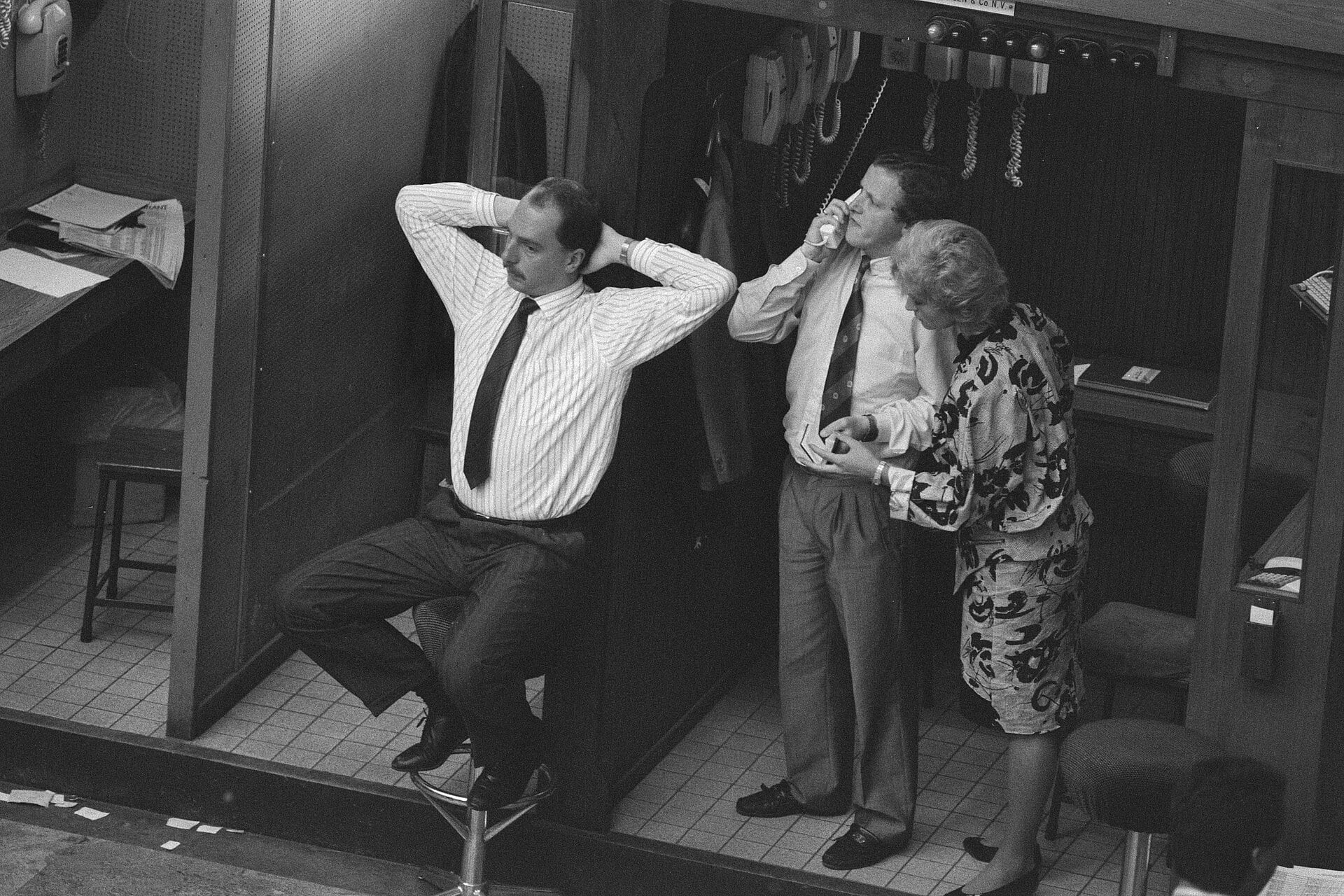 Traders on the Amsterdam stock exchange on October 23rd 1987, four days after Black Monday.
One such idea had long been on the mind of Nate Most, a man in his seventies working in product development at the American Stock Exchange, a New York exchange in trouble: companies preferred to list elsewhere and little traded on its stock market. Most did not come from the world of shares. He had spent his life in commodities, and there he had seen a simple mechanism at work: whoever owns grain does not carry it around. They leave it in a warehouse and get a receipt. Then they buy and sell the receipt, not the grain.
Most asked himself: why not do the same with shares? Put in a "warehouse", that is, with a bank, all the shares of the 500 companies in the S&P 500 index. Then split the receipt into lots of small pieces and have them trade on the exchange, like any share. Whoever buys a piece owns a slice of all 500 companies together, with a single purchase.
Most went to pitch the idea to John Bogle, the founder of Vanguard, the man who had brought index-tracking funds to the general public. Bogle listened politely and said no: listing a fund on the exchange, in his view, would add trading costs, and his company existed to keep costs low. Years later he would also say that a product that trades at every moment pushes people to buy and sell too much.
Most pressed on anyway, with his colleague Steven Bloom. It took years to convince the authorities, because the product did not fit any existing category. Meanwhile, in March 1990, Canada beat them to it: a product tracking the 35 largest Canadian companies debuted on the Toronto Stock Exchange, and it is considered the first ETF in history. Most's arrived in January 1993. It was called SPDR, and on the exchange it was immediately nicknamed "spider".
It was not an instant triumph. In June 1993 barely 18,000 units a day changed hands. Then the American market ran for the rest of the decade, and the spider became the largest and most traded ETF in the world. Most died in 2004, aged 90, without ever receiving royalties for his invention. By August 2026 there were more than 17,000 ETFs in the world, holding over $24trn.
What you really buy
ETF stands for exchange-traded fund. When you buy an ETF you buy a unit of a large basket of securities. A company manages the basket, but you buy and sell the units on the exchange, like a share, at the current price.
The basket almost always follows an index. An index is a list of securities chosen by a precise rule, set by whoever calculates it. The S&P 500 contains about 500 large American companies. The MSCI World, at the end of September 2026, contained about 1,250 from 23 developed countries. An index ETF chooses nothing: it tries to replicate the index, buying what is inside it in the same proportions, or a sample that resembles it, and it updates when the index changes.
The result is that with a single purchase, even of a few tens of euros, you own a small piece of hundreds or thousands of companies. If you remember the guide to shares, it is the difference between betting on one company and putting a foot in an entire market.
Indices do not exist only for shares. There are ETFs that follow bond indices, for example euro-area government bonds, and they work the same way: a basket of loans instead of stakes in companies. There are also ETFs that do not follow an index and leave the choices to a manager, but they are a minority.
There are four things to look at in the basket:
- How it copies the index. A physically replicated ETF really buys the securities in the index, all of them or a representative sample. A synthetic one buys other securities and signs a contract with a bank, called a swap, that pays it the index's return. Synthetic replication adds a risk: that the bank does not pay. The European UCITS rules set a ceiling: the fund cannot be exposed to a single bank counterparty for more than 10% of its assets, 5% if the counterparty is not a bank. It is a limit, not a guarantee: if the counterparty fails, that part can be lost, which is why many issuers take securities as collateral. Physical replication remains the simplest to understand.
- What it does with dividends. A distributing ETF passes on the dividends or coupons it receives, usually every three or six months. An accumulating one reinvests them inside the fund, and you find them in the unit price.
- Who issues it. The biggest names are iShares (owned by BlackRock), Vanguard and State Street, which between them manage almost 60% of the money invested in ETFs worldwide.
- Where the fund lives. European ETFs are usually domiciled in Ireland or Luxembourg and follow the European rules known as UCITS, which set limits on diversification, risk and transparency.
All of this is written in the name, if you know how to read it. Take one of the most popular ETFs in Europe: iShares Core MSCI World UCITS ETF USD (Acc). iShares is the issuer, Core its cheapest range, MSCI World the index, UCITS the European rules, USD the currency the fund keeps its accounts in, Acc means accumulating. Then there is the ISIN, the code that identifies the fund, in this case IE00B4L5Y983: the first two letters say it is Irish.
A detail that fools many people: the currency in the name is not the currency of your risk. You buy that ETF in euros on the Milan exchange, but inside it holds companies that are almost 73% American and priced in dollars. You carry the currency risk anyway, whatever the label says.
And your money, if the issuer goes bust? The fund's securities do not belong to the company that manages it: they are a separate pool of assets, held by a custodian bank, and the company's creditors cannot touch them. The more concrete risk is another: that the issuer closes an ETF that has attracted little money. In that case it gives you back the value of your units at that moment, which is not necessarily the moment you would have chosen.
One last thing: why does the price on the exchange stay close to the value of the securities inside? It is not a given. On the exchange you buy a unit from another investor, at a price set by supply and demand. The value of the securities inside the unit is calculated by the fund instead, and is called NAV, net asset value. Nothing forces the two numbers to match.
Keeping them close is the job of a few large banks and financial firms, the authorised participants. They have a privilege you do not: they can deal directly with the fund, wholesale. They can hand it the securities and receive new units in exchange, or return units and take back the securities.
An example with simple numbers. The securities inside one unit are worth €100, but on the exchange lots of people want to buy and the price rises to €101. The authorised participant buys on the market the securities needed for one unit, spending €100. It hands them to the fund, receives a new unit and sells it on the exchange for €101. It makes €1. But in doing so it puts extra units up for sale, and the price heads back towards €100.
It works the other way too. If people sell and the price falls to €99, the participant buys the unit on the exchange for €99, returns it to the fund and receives the securities, worth €100. It sells them and makes €1. By buying units it takes them off the market, and the price rises again.
The participants do not do it for you; they do it to make money. But it is precisely that profit that keeps the price in place: as soon as the gap exceeds the cost of the operation, someone takes advantage of it and closes it. In reality these operations are done only in large blocks, those of the original SPDR were 50,000 units, and the gaps that trigger them are much smaller than a euro.
It is Nate Most's warehouse at work. It does not guarantee that price and contents match at every instant. On a thinly traded ETF, or when the exchange of the securities it holds is closed, the gap can widen. But on the biggest ETFs it stays minimal, which is why you can buy them on the exchange without paying more than they are worth.
How you make money
An ETF makes money exactly like whatever it holds. It has no source of profit of its own: if the securities in the basket rise, so does the unit.
The price. If the index rises 10% in a year, your unit rises more or less 10%, minus costs. You only really make money when you sell at a higher price than you bought at. Until then it is a paper gain, which the market can take back.
Dividends and coupons. The companies in the basket pay dividends, the bonds pay coupons. With a distributing ETF they land in your account. With an accumulating one they stay in the fund, are reinvested and raise the value of the unit.
The real strength, though, is another. With an ETF you do not have to guess which company will win. All the companies in the index are inside, and when one grows to become among the biggest in the world, its weight in the basket grows with it, without you doing anything. When a company shrinks, it weighs less and less and eventually leaves the index. In exchange you give up the big hit: an index ETF does not try to beat the market, it replicates its result, minus costs and a few small deviations we will see further on.
And the market's result, over the long term, has been good. From the end of 2000 to September 2026 the MSCI World index returned an average of 7.46% a year in dollars, with dividends reinvested net of withholding taxes. On average: inside are years like 2008, when stock markets collapsed all over the world. It is a figure from the past, not a promise.
This is where compound interest comes in, the return earned on returns already made. Say you invest €10,000 and it earns 6% a year, the same every year, a number chosen just for the example. The first year you make €600. The second you earn 6% on €10,600, that is €636. After 20 years you have about €32,000: more than triple, without adding anything. With an accumulating ETF this mechanism works on its own, because dividends are reinvested as soon as they arrive.
With ETFs, time matters more than the moment you get in. The same example over 30 years gives about €57,000: the extra ten years add more gain than the first twenty put together.
How you lose money
An ETF spreads risk across many companies. It does not eliminate it.
The whole market falls. If a single company in the basket fails, you barely notice. But there are moments when they all fall together, and then the ETF falls with them. During the financial crisis the MSCI World lost 57.8% between October 31st 2007 and March 9th 2009, in dollars. Anyone with $10,000 in the whole world found themselves, at the worst moment, with less than half. Those who sold then turned that loss into a real one. Those who waited recovered, but it took years.
Less diversified than you think. An index weights companies by how much they are worth. In October 2026 the top ten companies in the S&P 500 made up almost 38% of the index: out of 500 names, ten count for more than a third. And in the MSCI World, which is called "world", at the end of September 2026 almost 73% was America. Buying the world index means, in large part, betting on big American companies.
Thematic ETFs. Not all ETFs follow a whole market. There are ones on a sector or a trend: artificial intelligence, electric cars, biotechnology. The narrower the basket, the more it behaves like a single bet. The most famous example is ARK Innovation, Cathie Wood's ETF of "innovative" companies, which rose more than 150% in 2020. From its peak in February 2021 to its low in December 2022 its market price fell 81%. The typical problem is timing: a theme becomes fashionable after it has already risen, and people buy when it is expensive.
The currency. We saw it with the ETF's name. If it holds American companies, you are exposed to the dollar. If the dollar loses 10% against the euro, all else being equal, you lose 10%. There are currency-hedged versions, usually with "Hedged" in the name, which cost a little more.
Leveraged ETFs. Some products promise two or three times an index's return, or its opposite. The catch is that the multiple applies to a single day, and day after day the sums do not add up. If the index rises 10% and falls 10% the next day, it goes from 100 to 110 and then to 99: it loses 1%. A 2x leveraged ETF goes from 100 to 120 and then to 96: it loses 4%. If the market goes up and down for months, the index can stay flat while the leveraged ETF wears away. These are high-risk products built for a one-day target: held for a long time without watching them, they can deliver results very far from what you expect.
The rule is the same as for shares: spread the risk. An ETF on the whole world market and an ETF on a fashionable theme share the same acronym, but they are two very different things.
Taxes vary from country to country
As with shares and bonds, every country has its own rules, but the levies are similar: a tax on gains, one on dividends, sometimes a tax on the account. Here too we use Italy as an example. You can find your own country's rules on the national tax authority's website or by asking your broker.
The tax on gains. In Italy gains and dividends from a European ETF are taxed at 26%. If the ETF holds Italian government bonds or those of white-list countries, that part pays 12.5%, as if you had bought the bonds yourself. The reduced share is calculated on the average percentage of government bonds in the fund, taken from the latest half-yearly and annual reports. An ETF investing only in euro-area government bonds therefore pays 12.5% on almost everything, while one mixing government and corporate bonds pays something in between. If you use an Italian broker under the managed regime, the most common case, it calculates and withholds everything.
The loss anomaly. Here is the rule that surprises almost everyone. For the Italian taxman the gain on selling an ETF is capital income, while the loss is "other income". They are two separate drawers that do not talk to each other. The result is that if you sell one ETF at a €3,000 loss and another at a €3,000 gain, you still pay €780 in tax on the second. The loss is set aside, and you can only use it against gains on shares, bonds or other instruments in the right drawer, until the fourth following year. If you have none, it expires. The 2023 tax reform was meant to merge the two drawers. The deadline to do so, extended to August 29th 2026, expired without that part being implemented.
Accumulating or distributing. With a distributing ETF you pay 26% on each dividend as it arrives. With an accumulating one you pay nothing until you sell, and in the meantime that money stays invested and keeps working. In both cases, inside the fund, dividends may already have suffered withholding by the country they come from: for an Irish ETF it is 15% on American dividends. How much the difference is worth, in numbers, and when distributing still makes sense, we cover in the guide on accumulating and distributing funds.
Taxes on the account. Italy's 0.2% annual stamp duty also applies to ETFs. It is charged on the value of the units, not the gain: on €20,000 it is €40 a year, even in years when the ETF loses money.
ETFs that are not European. American ETFs, like Nate Most's SPDR, usually cannot be bought in Europe by retail investors: they do not publish the information document required by European rules. And even if you hold them, in Italy the treatment changes. The 26% rate applies to UCITS funds and to those established in the European Union, or the European Economic Area, with a supervised manager. Outside these conditions, as with American ETFs, the income is added to your other income and taxed at Irpef rates, from 23% to 43% plus local surcharges. That is why in Europe people buy the Irish or Luxembourg versions of the same indices. Anyone who already holds foreign ETFs of this kind would do well to consult an accountant.
What you don't see
ETFs are famous for being cheap, and it is true. But they do cost, and part of what you pay never passes through your account.
The TER. This is the fund's annual cost, written as a percentage. No bill arrives: a small slice is taken each day from the unit's value. The iShares Core MSCI World has a TER of 0.20%, the iShares Core S&P 500 0.07%, while ARK Innovation, the one that lost 81%, costs 0.75%. They look like decimals, but time multiplies them. Take the €10,000 at 6% gross for 30 years again, the same every year, with the cost deducted from the return. With a 0.07% cost you reach about €56,300, with 0.20% €54,300, with 0.75% €46,400. Almost €10,000 of difference between the first and the last, which is what you invested to begin with.
The spread. As with shares, on the exchange there is a price you buy at and a slightly lower one you could sell at right away. On big ETFs the difference is minimal, often a few cents per €100. On small ETFs or distant markets, perhaps traded when their home exchange is closed, it widens.
Broker commissions. Every purchase and every sale has a cost, fixed or as a percentage. On a single investment it weighs little. On many small purchases, for example €100 a month with a €5 commission, it is 5% of every payment, more than twenty years of TER on a 0.20% ETF.
Currency exchange. If you buy an ETF listed on an exchange in another currency, the broker converts your euros and applies a margin. The same ETF is often listed in Milan or Frankfurt in euros too: buying it there avoids the conversion. It does not avoid the currency risk of what is inside, which remains.
None of these items appears in a single number. But together they decide how much ends up in your pocket, and you can see them all before you buy. You just need to know where to look.
The information in this article does not constitute financial advice: before making any investment decision, assess your personal situation or consult a licensed adviser.
Image credits
- Cover: image generated with artificial intelligence.
- In the text: "Effectenbeurs Amsterdam, Bestanddeelnr 934-1112.jpg", photo by Bart Molendijk / Anefo, October 23rd 1987, Nationaal Archief, via Wikimedia Commons, Creative Commons Zero (public domain). Resized.
Sources
- Federal Reserve History — "Stock Market Crash of 1987": the Dow Jones down 22.6% on October 19th 1987, the largest daily fall in its history.
- State Street — "SPY: The Idea That Spawned an Industry", document filed with the SEC, 2013: Most and Bloom at the American Stock Exchange, the birth of SPDR and of the name "spider".
- Institutional Investor — "Happy 20th Birthday, ETFs: A Look Back at Nate Most", July 3rd 2013, with Most's 2004 interview: warehouse receipts, the meeting with Bogle, authorised participants, no royalties.
- Royal London Asset Management — "A brief history of ETFs": debut in January 1993, 18,000 units a day in June 1993, Most's death in 2004.
- TMX Group — "Toronto Stock Exchange Celebrates 35 Years of ETF Innovation", March 6th 2025: TIPs, March 9th 1990, the world's first ETF.
- Markets Media on an ETFGI release — "Global ETF Assets Top $24 Trillion for First Time", end of August 2026: $24.03trn, 17,713 ETFs, shares of iShares, Vanguard and State Street.
- Structured Retail Products on ETFGI data — "Global ETF AUM tops US$24 trillion", September 18th 2026.
- MSCI — "MSCI World Index (USD)" factsheet, data as of September 30th 2026: 1,249 companies, 23 countries, United States at 72.94%, net annual return of 7.46% since December 29th 2000, maximum drawdown of 57.82% from October 31st 2007 to March 9th 2009.
- justETF — "iShares Core MSCI World Acc vs iShares Core S&P 500 Dist", October 16th 2026: TER of 0.20% and 0.07%, top ten companies at 37.76% of the S&P 500.
- CESR — consultation on counterparty risk, with Directive 2009/65/EC, article 52: limit of 10% to a bank counterparty, 5% in other cases.
- Fiscoinvestimenti — "ETF a replica fisica o sintetica: che differenza c'è".
- Northern Finance — "Perdita totale dell'ETF": assets segregated from the issuer.
- Business Insider — "Cathie Wood's flagship ARK fund has dropped over 60% from its 2021 high": a rise of more than 150% in 2020, peak of $159.70 on February 16th 2021.
- Benzinga — "Cathie Wood's Ark Invest earns $300m in fees while investors lose", March 2023: price from $159.70 to $29.43, –81.6%, 0.75% fee.
- Italian Ministry of Economy — ministerial decree of December 13th 2011: the reduced share for funds equal to the average percentage of government bonds in the last two half-yearly or annual reports.
- Fiscoinvestimenti — "ETF nel 2026: come funziona la tassazione": 26%, 12.5% on the government-bond share, distribution, 0.2% stamp duty.
- Vision SCF — "Minusvalenze: cosa sono e come si compensano nel 2026", updated October 20th 2026: capital income and other income, the €3,000 example.
- Avviso Pubblico — Law no. 120 of 2025, extension of the tax-reform deadline: the delegation of Law 111/2023 extended to August 29th 2026.
- Milano Finanza — "Fisco e finanza, scatta la rivoluzione sulle tasse", October 8th 2025: article 5 of the delegation, a single category of financial income.
- Idealista — "Delega fiscale 2026: cosa cambia e cosa manca", August 7th 2026: the reform of financial income not implemented.
- Fiscoinvestimenti — "ETF domiciliati in Irlanda: fiscalità dei dividendi": 15% withholding on American dividends inside the fund.
- Euroconference News — "Le indicazioni della circolare n. 21/E sui fondi di investimento alternativi": the substitute tax regime extended to EU/EEA funds with a supervised manager.
- Fiscomania — "Tassazione ETF": income from non-harmonised ETFs taxed at Irpef rates from 23% to 43%.
- justETF — "US-domiciled ETFs: why they are no longer available from many online brokers": American ETFs not available to European retail investors without a KID.
- guides
- ETFs
- indices
- MSCI World
- S&P 500
- taxes
- investing