Why shares exist
At the start of the seventeenth century, bringing a cargo of pepper and nutmeg from Asia to Europe was the most profitable business in the world. It was also the most dangerous. A ship could be away for two or three years, sink in a storm, fall into the hands of pirates or come back with half its crew. No merchant, however rich, could afford to risk everything on a single voyage.
Dutch merchants organised themselves like this: they pooled money for an expedition, waited for the ship to return, split the profit and wound up the company. Every voyage meant a new round of fundraising and a new risk, all concentrated on a handful of people.
In 1602 things change. The Dutch East India Company, the VOC, is founded, and the real novelty is not the ships but the way they are paid for. Anyone can buy a stake, not just the big merchants: in Amsterdam alone more than a thousand people subscribe, small savers among them. The money is not handed back at the end of each voyage; it stays in the company. And anyone who wants their money back does not have to wait for any ship to come home: they sell their stake to someone else.
Those stakes were the first modern shares, and the place in Amsterdam where people traded them is considered the first true stock exchange. The underlying idea has stayed the same for more than four centuries: a venture too big for a single backer spreads the risk across thousands of people. Each puts in a little, no one loses everything if it goes badly, everyone gains if it goes well.
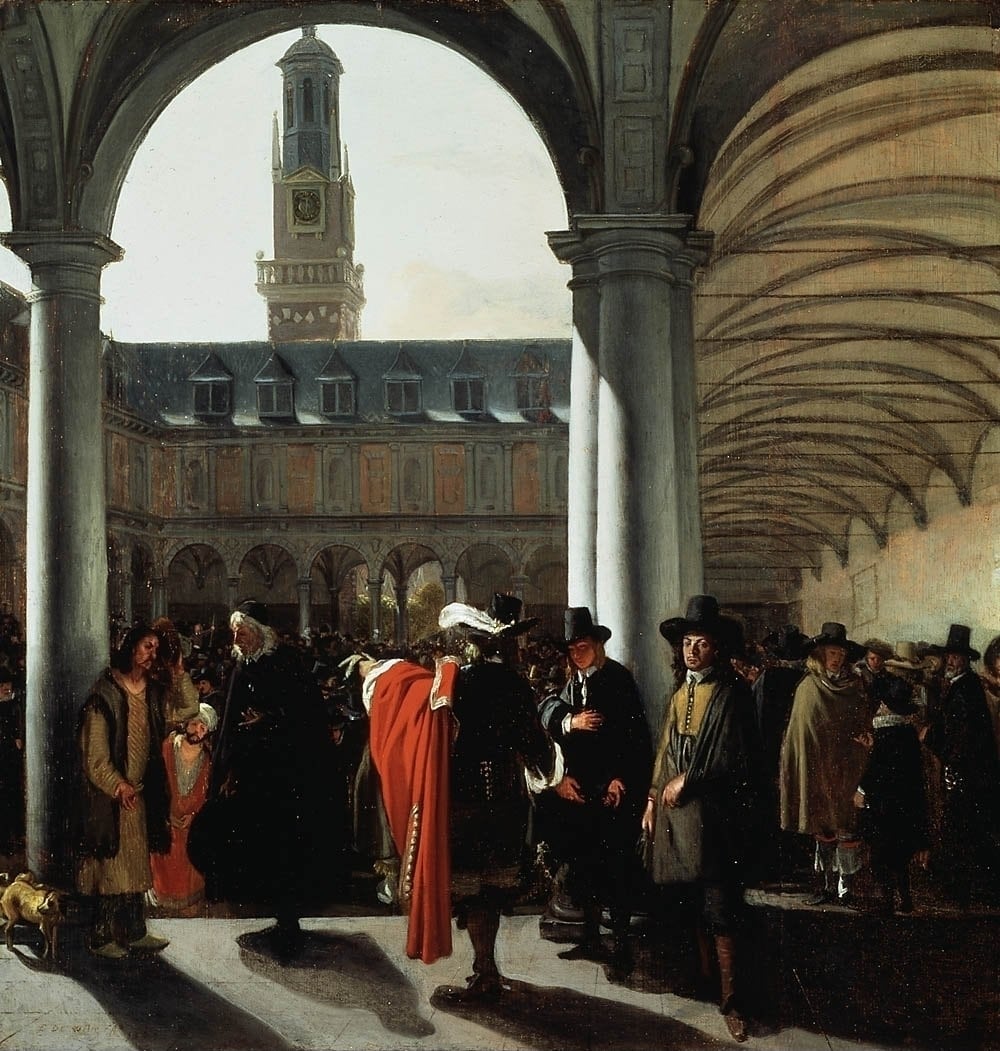 The courtyard of the Amsterdam Exchange in a 1653 painting by Emanuel de Witte.
What you really buy
When you buy a share you buy a piece of a company. You are not lending it money and you are not betting on a number: you become a part-owner. If a company is divided into 100 shares and you buy 10, you own 10% of the company: a tenth of its plants, brands, customers, debts and future earnings. In large listed companies there are millions of shares and your slice is much smaller, but the principle is the same.
Being a shareholder gives you three things:
- A right to profits. When the company makes money it can decide to pay out part of the profit to its shareholders. That part is called a dividend.
- A right to vote. You can take part in the shareholders' meeting, which approves the accounts and appoints the people who run the company. With 10 shares out of 100 you have 10% of the votes. In a large listed company with millions of shares your vote carries little weight, but it exists.
- Limited liability. If the company goes bust you lose at most what you paid for the shares. Its creditors cannot come and take your house.
Here we are talking about ordinary shares, the most common kind. There are also classes without voting rights, but the principle does not change.
There is a difference worth pinning down straight away, because it will come back in the guide on bonds. Someone who buys a bond lends money to the company and is entitled to get it back, with interest. Someone who buys a share lends nothing: they are an owner. And the owner has no guarantees. They gain if the company does well and, if it does badly, they are paid last, after banks, suppliers, employees and bondholders.
The shares we are talking about are listed ones, meaning traded on a stock exchange: in Italy that is Piazza Affari, in Milan, while in the United States the two main ones are the New York Stock Exchange and the Nasdaq, both in New York. To buy them you need a securities account with a bank or a broker. That is where your shares are held, and it is through there that costs and taxes will pass too, as we will see.
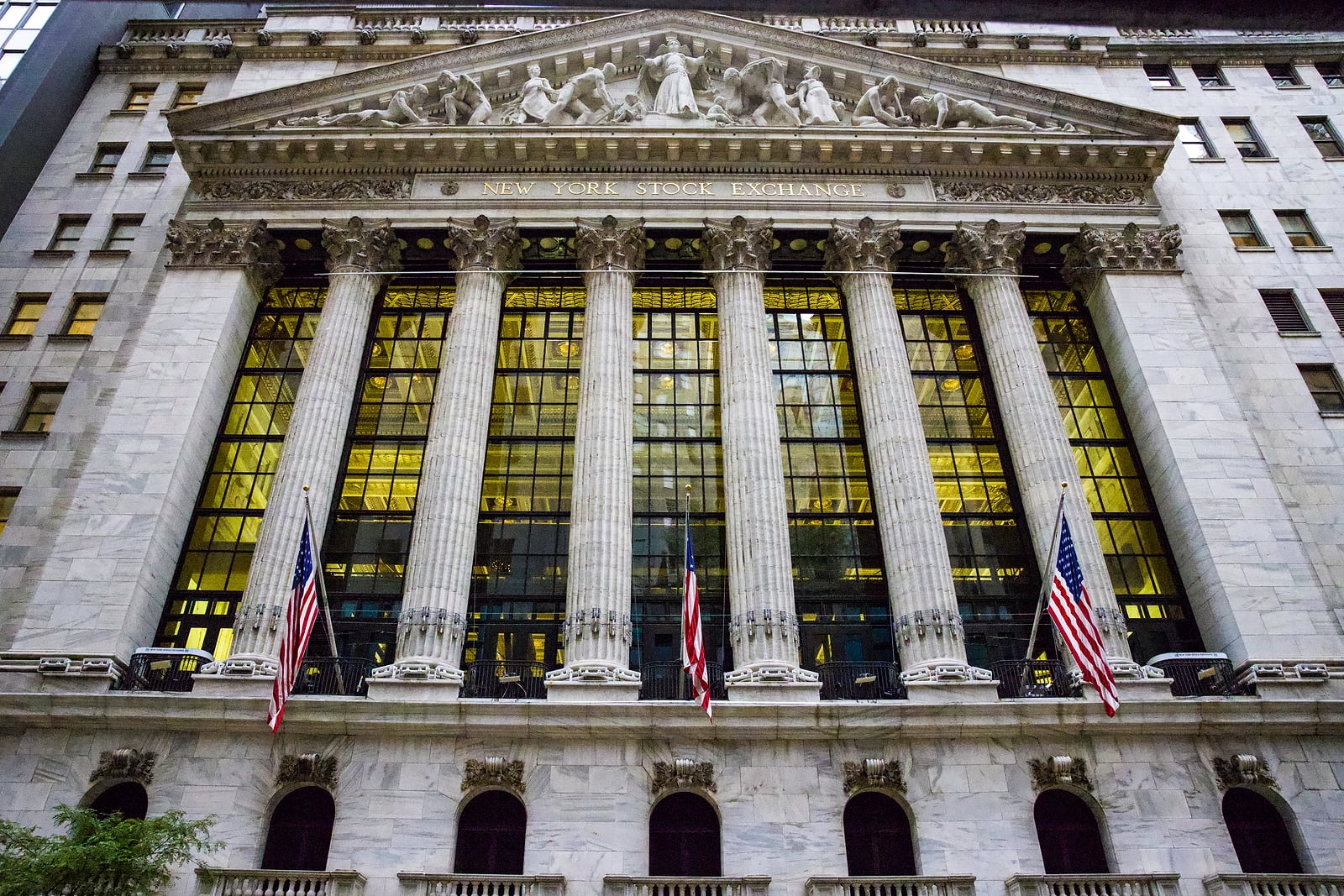 The facade of the New York Stock Exchange, on Wall Street, lit from inside, in September 2021.
How you make money
There are two ways to make money from a share.
The dividend. Say a company decides to pay out €0.50 per share: with a thousand shares you collect €500 before tax. But a dividend is not a fixed entitlement like the interest on a bond. The company decides it every year, and can raise it, cut it or cancel it. Many companies, especially those that are growing, do not pay one at all: they prefer to reinvest all their profit in the business.
The price. You buy a share at €10 and sell it a few years later at €14: you have made €4 per share. That difference is called a capital gain. But why does the price go up?
The price of a share is what someone is willing to pay today for a slice of that company's future profits. If the company sells more, earns more, or even if the market simply becomes convinced that it will, that slice is worth more and the price rises. In the short term the price moves for a thousand reasons, often emotional ones. In the long term it tends to follow just one thing: how much the company really earns. That is why in the articles in the Companies section we look at the history and the accounts of businesses, not at an afternoon's charts.
Historically, in the major markets, shares have been the instrument within a saver's reach that has paid the most over the long term, more than bonds and deposit accounts. It is not a gift: it is the reward for risk. Those who accept having no guarantees are paid, on average, more than those who insist on them.
The two important words in that sentence are "on average" and "long term". The next part explains why.
How you lose money
The ways to lose are the same as the ways to gain, turned upside down, plus one.
The price falls. If you sell below the price you paid, the loss is real. And the falls can be deep: between October 2007 and March 2009 the S&P 500, the index of the 500 largest American companies by stock market value, lost more than half its value, and it took about five and a half years to get back to where it had been. Anyone who needed the money in that period had to sell at a loss. Anyone who could wait got it back. That is what "long term" means: shares are suited to money you will not need for years, not to the money you need for a new car.
Source: Yahoo Finance, weekly closes of the S&P 500 index.
The dividend is cut. When a company goes through a hard patch, that is usually the first thing to go. Anyone counting on that income sees it disappear, and the price often falls at the same time.
The company goes bust. This is the real risk. When a company fails, its assets go to pay those who stand in line before the shareholders: creditors, employees, bondholders. Shareholders are usually left with nothing. Even the VOC, the company where it all began, ended in bankruptcy and was dissolved in 1799. No company is too big or too famous to disappear.
There is, however, a huge difference between the risk of a single company and that of a hundred. One company failing is something that happens. A hundred companies from different sectors and countries all failing at once is another matter. That is why the first mistake beginners make is often not picking the wrong share, but owning too few. It is the same reasoning as the VOC's, seen from the investor's side: the risk is shared out.
Taxes vary from country to country
So far we have talked about things that hold everywhere. Taxes do not: every country has its own rates and rules. The types of levy, though, look alike almost everywhere, and knowing them shows you the difference between what you think you have earned and what you actually keep. For the numbers we use Italy as an example. You can find your own country's rules on the national tax authority's website or by asking your broker.
The tax on gains. Almost every country taxes capital gains and dividends. In Italy the rate is 26%: you buy a thousand shares at €10 and sell them at €14, you make €4,000, the state takes €1,040 and you keep €2,960. In some countries, Italy among them, if you use a local bank or broker it is the intermediary that calculates and withholds the tax. Elsewhere you have to declare it yourself.
Losses are not wasted. In many countries a loss realised by selling a share can be used to pay less tax on future gains. In Italy this applies until the fourth following year, and only against certain kinds of gain: not against dividends, and not against gains on most ETFs either. These are details that matter, and you will find them again in the guide on ETFs.
They are also rules that change. In Italy there has been talk for years of a reform that would allow all losses to be offset against all gains, but in September 2026 it was postponed once again. Wherever you live, always check the rules in force in the year you sell.
Foreign dividends are taxed twice. If you buy shares from a country other than your own, that country usually withholds part of the dividend, and then your own country taxes what is left. Take an Italian who buys an American share: the United States withholds 15% (if they have filled in the W-8BEN form, otherwise 30%), then Italy applies 26% to the rest. Out of €100 of gross dividend, €15 goes to the United States, €22.10 to Italy and €62.90 to them. Reclaiming part of the foreign tax is sometimes possible, but it is slow and with small sums it is often not worth it.
Taxes on the account. Some countries also tax the simple fact of holding investments, whether you make money or not. In Italy there is a stamp duty of 0.2% a year on the value of the securities account: with €50,000 invested that is €100 a year, whether you gain or lose, whether you sell or not.
Taxes when you buy. Some countries charge a levy on every purchase of shares in their own companies. In the United Kingdom it is 0.5%. In Italy the Tobin tax, doubled from 1 January 2026, is 0.2% on listed companies with an average market capitalisation above €500 million: buying €5,000 of a large Piazza Affari stock costs €10 in tax alone, before any commission. This tax depends on the company you buy, not on where you live: a foreigner buying Italian shares pays it too.
What you don't see
On top of taxes come costs. The broker's commission on every purchase and every sale. The spread, meaning the small difference between the price you buy at and the price you could sell at in the same instant. Currency conversion, if you buy shares in dollars, which you usually pay twice: when you convert euros to buy and when you convert the dollars back after selling.
Taken on its own, each of these items looks negligible. A few euros here, 0.2% there. The problem is that they never come alone and, above all, they repeat: every year, every trade, for as long as you stay invested. And every euro that goes out today is a euro that is not working for you over the next twenty years. On a long-term investment, the sum of many small items can matter more than the choice between one share and another.
The good news is that these costs can be seen, measured and compared. You just need to know where to look.
If you want to see how all this works on real companies, in the Companies section you will find their stories: how they were born, how they make money, what they have returned to their shareholders.
The information in this article does not constitute financial advice: before making any investment decision, assess your personal situation or consult a licensed adviser.
Image credits
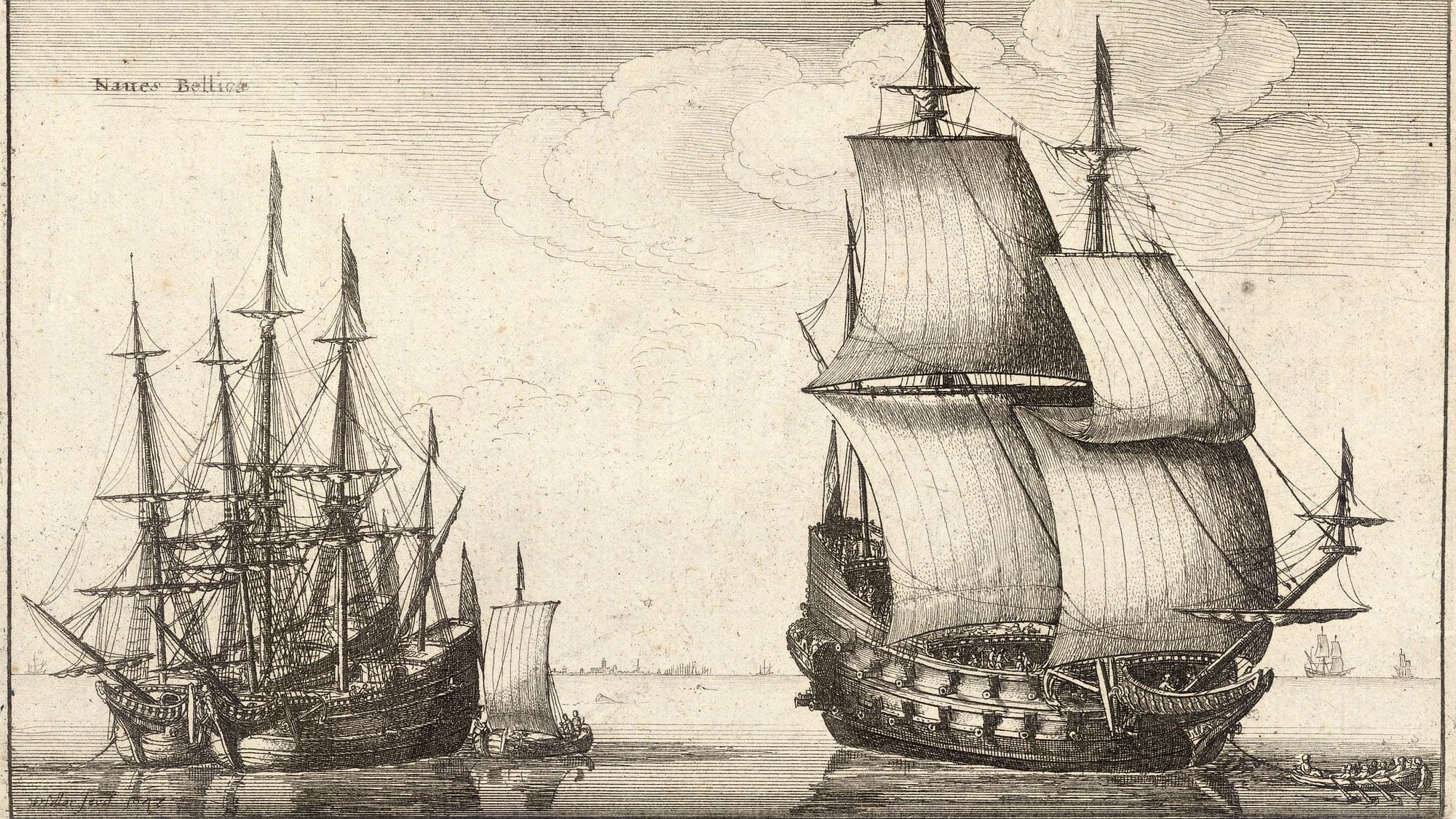
- Cover: "Wenceslas Hollar - Dutch East Indiaman (State 2).jpg", etching by Wenceslaus Hollar (1607-1677), via Wikimedia Commons, public domain. Cropped to 16:9 (removing the engraved title at the top) and resized.
- In the text: "Emanuel de Witte - De binnenplaats van de beurs te Amsterdam.jpg", painting by Emanuel de Witte, 1653, via Wikimedia Commons, public domain.
- In the text: "New York Stock Exchange, interior lit edition (51693281831).jpg", photo by Billie Grace Ward, 5 September 2021, via Wikimedia Commons, Creative Commons Zero (public domain). Resized.
Sources
- PMI.it — "Cripto-attività, rinviata la riforma dei redditi finanziari", 9 October 2026: the postponement of the reform announced by Deputy Minister Leo.
- EC News — "Legge di bilancio 2026: raddoppio delle aliquote della Tobin Tax", 9 January 2026.
- MoneyViz — "Come funziona la tassazione degli ETF in Italia?", 16 August 2026: capital losses, the four-year window, investment income and other income.
- Fiscoinvestimenti — "Imposta di bollo sul dossier titoli: 0,2%", updated 8 October 2026.
- Yahoo Finance — weekly closes of the S&P 500 index from 2007 to 2013, for the chart.
- guides
- shares
- stock market
- dividends
- taxes
- investing