In the spring of 1933 a company is founded in Germany with a reassuring and very German name: Metallurgische Forschungsgesellschaft, the Society for Metallurgical Research. Its shareholders are four large industrial groups, Krupp, Siemens, Gutehoffnungshütte and Rheinmetall, which lend it their names. It is a front company: it makes nothing and has nothing to do with research.
What it does is something else. It signs bills of exchange. Billions of marks' worth, with which Hitler's Germany pays for guns, tanks, aircraft and submarines without rearmament ever appearing in the state budget. Insiders call it by its initials, MEFO, and for five years it will be one of the best-kept secrets of the Third Reich.
This is where the story of the Reich's finances begins. A story of accounting tricks, prices frozen by decree, confiscated wealth and occupied countries forced to pay their own occupiers. And of a banker who built the machine and then tried, too late, to switch it off.
How do you finance a gigantic rearmament in a country with no money, without the debt showing up in the accounts and without anyone noticing?
A country afraid of inflation
To understand the problem you have to go back ten years. In 1923 Germany had lived through one of the most violent hyperinflations in history: prices doubled within days, wages were collected twice a day and spent at once, before they lost their value. The middle class's lifetime savings had turned into worthless paper.
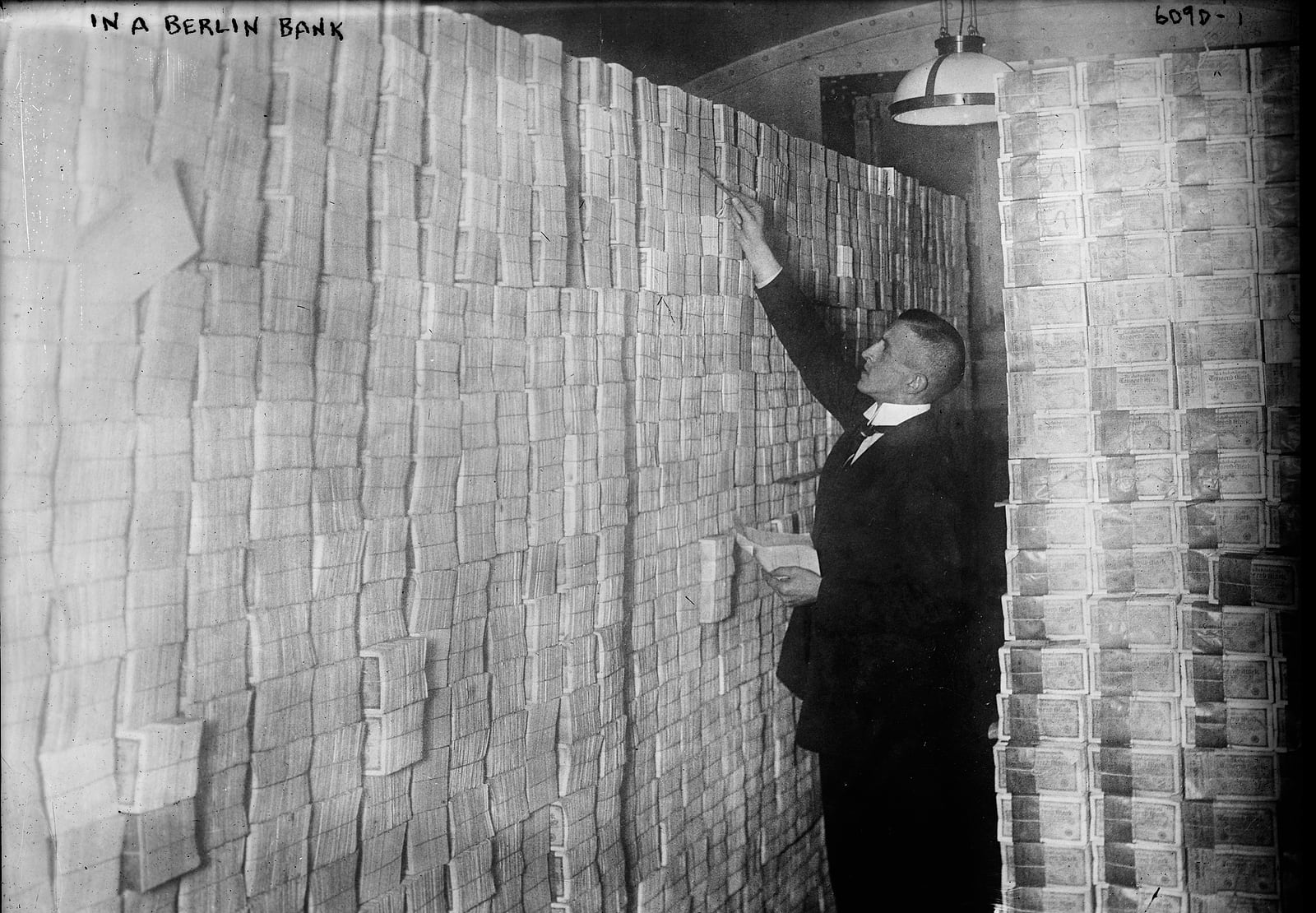 Berlin, 1923: bundles of banknotes stacked in a bank during the hyperinflation.
The man who had stopped the hyperinflation was Hjalmar Schacht. In 1923, as currency commissioner, he had led the programme that stabilised the mark, and at the end of that year he had become president of the Reichsbank, the German central bank. To Germans he was the wizard who had saved the currency. He resigned in 1930, drew closer to the right and supported Hitler's appointment as chancellor. In March 1933 Hitler put him back in charge of the Reichsbank.
The Germany Schacht returns to is a country on its knees. The Great Depression has left around six million unemployed, world trade has collapsed, and the country is crushed by foreign debts it can no longer pay. And the new government has a goal that defies every rule of financial prudence: to rebuild within a few years an army that the Treaty of Versailles had cut to a hundred thousand men.
There was an obstacle, though, written into law. After the hyperinflation, the 1924 reform had placed a very strict cap on direct loans from the Reichsbank to the state: 100 million marks, a token sum. And rearmament paid for with taxes or ordinary public borrowing would have had another flaw: it would have been visible. It would have alarmed France and Britain while the German army was not yet ready.
How the trick worked
Schacht's solution was MEFO. Here is how it worked.
Take a factory that receives an order for tanks from the army. Not necessarily one of MEFO's four shareholders: the system applied to every supplier of the armed forces. The factory delivers the tanks, but the state does not pay it in cash. Instead of money it receives a bill signed by MEFO, that is, a written promise to pay that sum within six months.
On paper, then, the debt belongs to MEFO, a private company. But MEFO has no money of its own: behind it stands the guarantee of the state, and it is the state that will have to pay in the end. MEFO exists only to put a private name in between, so that the debt does not appear in the public accounts.
For the factory, meanwhile, that piece of paper is as good as money. It can keep it, use it to pay its own suppliers, or take it to a bank and change it straight into cash. The bank, in turn, can pass it on to the Reichsbank, which gives it banknotes in exchange. That is the moment when hidden debt becomes printed money.
The six months, moreover, could be renewed three months at a time, and a bill could stay in circulation for years. They paid 4% interest, more than ordinary commercial bills, and so a sizeable share stayed in the portfolios of banks and companies. That was the point: as long as they stayed in the drawer, they did not become banknotes and did not push up prices.
This is how the Reichsbank financed rearmament, getting round the 100 million limit. According to historical reconstructions, between 1934 and 1936 about half of all arms purchases were paid for this way. When the system was shut down, on April 1st 1938, MEFO bills issued came to around 12 billion marks. By comparison, the Reich's official debt at the end of March 1938 was 19.2 billion, and MEFO bills were not part of it. Alongside the debt everyone could see there was another, enormous one, whose existence almost nobody knew about.
More tanks than motorways
Meanwhile unemployment was genuinely falling, and the regime took all the credit. Propaganda spoke of a "battle for work", showed workers with shovels on the first motorways, and promised a car for every family.
The numbers tell a different story. The economic historian Adam Tooze has reconstructed where the money really went. Military spending as a share of national income went from 1% in 1933 to 10% in 1935, a shift of resources that, in his words, no capitalist country had ever seen in peacetime. By the government's second year the military was already taking more than half of state spending on goods and services. The motorways and great civil works, so prominent in the newsreels, carried far less weight than is still claimed today. What filled the factories was above all army orders.
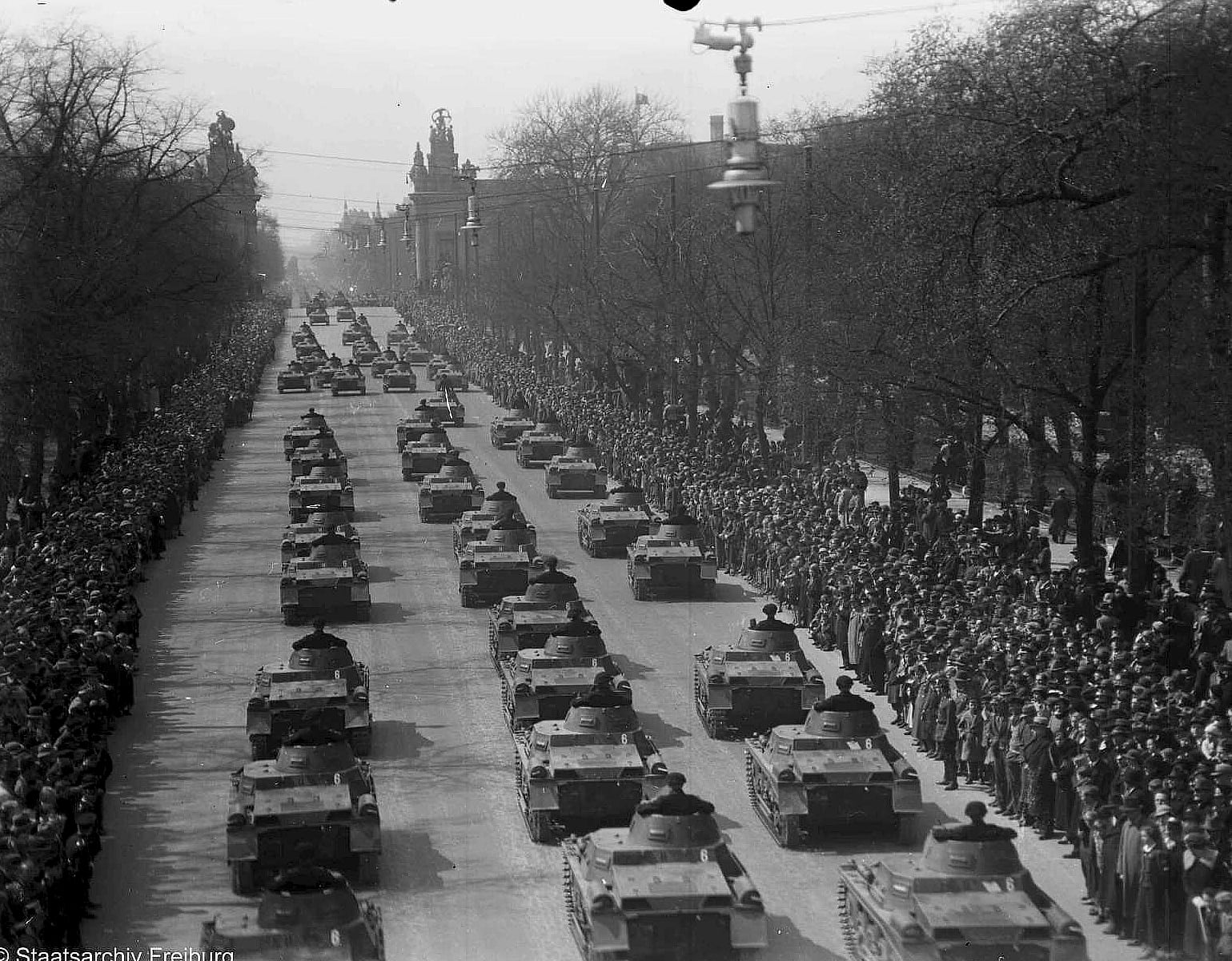 Berlin, April 20th 1936: Wehrmacht tanks on parade through the crowds.
Then there was the problem of foreign trade. To rearm, Germany needed raw materials it did not have: oil, rubber, copper, iron ore. And to buy them it needed foreign currency, which it lacked. From July 1st 1934 the government suspended payments on its medium- and long-term foreign debt. In September Schacht, now also economics minister, launched the "New Plan": every import had to be authorised, and trade was governed by bilateral clearing agreements. In practice Germany bartered industrial goods for grain and raw materials.
Prices frozen by law
More money in circulation and fewer goods available to consumers is the classic recipe for inflation. The regime dealt with it in the most direct way: by banning it.
In October 1936 Hitler put Hermann Göring in charge of the Four-Year Plan, with the task of making the economy ready for war within four years. Schacht had opposed it, convinced that the cost of the programme would wreck the currency. From then on his influence began to wane. The following month came the price freeze: a decree of November 26th banned any increase. Wages had been under control since 1933, set by "trustees of labour" appointed by the regime. In November 1937 Schacht left the economics ministry.
Inflation had not gone away. It had just been swept under the carpet. Official prices stayed put, but money kept growing and goods grew scarce: butter, meat and good-quality clothes became hard to find. Economists call it repressed inflation. You do not see it on price tags; you see it in empty shelves and in savings that pile up because there is nothing to buy.
By 1938 the machine was at its limit. Banks and companies needed liquidity and were starting to present their MEFO bills to the Reichsbank, and the state did not have the money to redeem them. Rearmament was no longer a secret to protect, and military spending had passed 19% of national income. New money was needed, and the regime went looking for it where it was easiest to take.
The plunder began at home
Before plundering Europe, the Third Reich plundered its own Jewish citizens, with forms, tax offices and payment deadlines.
The first tool already existed. The Reich Flight Tax had been introduced in 1931, before Hitler, to discourage capital flight during the crisis. The regime turned it into a trap for those trying to emigrate: between the tax, forced transfers and punitive exchange rates, by 1938 anyone leaving Germany lost on average more than 90% of their assets. In April 1938 Jews with assets of more than 5,000 marks were required to declare them. The ministry estimated that about five billion marks could be made available to the German economy, in other words confiscated.
Then came the night of November 9th to 10th 1938, Kristallnacht. More than a thousand synagogues destroyed, shops wrecked. From November 10th and in the days that followed, around 30,000 Jewish men were arrested and locked up in concentration camps. On November 12th Göring gathered government, party and insurers to discuss the consequences. The decision was that the victims should pay for the damage. German Jews were hit with a collective "atonement fine" of one billion marks: every Jew with assets above 5,000 marks had to pay 20% to the state, in four quarterly instalments, the first in December. In 1939 a fifth was added, bringing the levy to 25%. The compensation that insurance companies should have paid for the destruction, around 225 million, was collected directly by the state. In the end the levy raised more than expected: 1.127 billion marks.
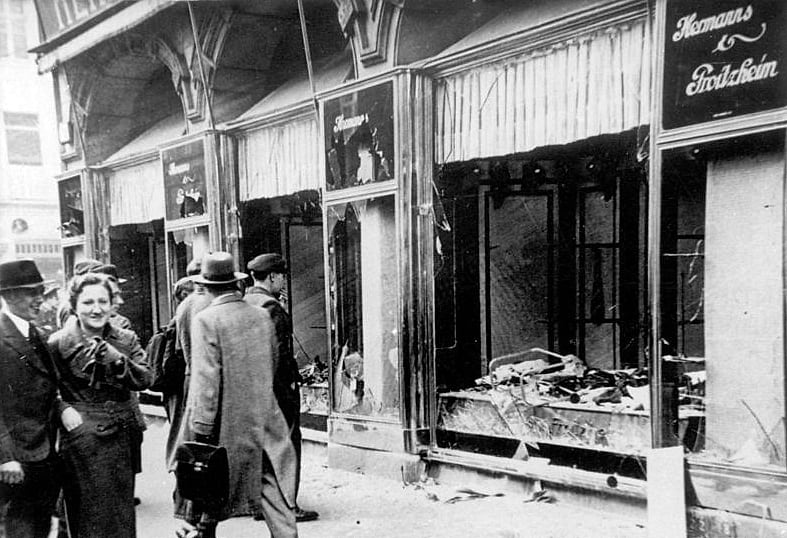 Magdeburg, November 1938: Jewish shops wrecked during Kristallnacht.
It was no token sum. At that moment the Reich's budget was in serious trouble, and documents from the time show that for Göring the matter was also an accounting one: the money was needed to plug a hole. On top of these sums came "Aryanisation", the forced sale of Jewish businesses and property at derisory prices.
The letter that cost the wizard his job
On January 2nd 1939 Schacht met Hitler and asked him to cut military spending. Five days later, on January 7th, he handed him a memorandum signed by the entire board of the Reichsbank.
The document did not challenge rearmament as such. It recalled that the Reichsbank had supported the programme from the start, and had done so on one condition: avoiding inflation, which would destroy confidence in the regime without bringing any real benefit. Now that condition was no longer being met, and the only way to save the currency, they wrote, was to slash arms spending drastically and return to a balanced budget.
The numbers proved the bankers right. Over the course of 1938 the banknotes in circulation had grown by billions of marks, partly because banks and companies had begun bringing MEFO bills back to the Reichsbank and asking for cash in return.
The answer came in less than two weeks. On January 20th 1939 Schacht was removed as president of the Reichsbank. In his place Hitler installed Walther Funk, already economics minister and a loyalist of the regime, with no pretence of independence. A few months later a new law placed the central bank directly under the Führer's orders. The brake the German system had built after 1923 had been removed. On September 1st 1939 Germany invaded Poland.
Others pay for the war
With the war everything changed. The problem was no longer hiding military spending, but finding the money for spending that grew without limit. The regime did it in two ways.
The first has gone down in history under a precise name: silent war financing. From August 1939 consumer goods were rationed, prices frozen, shops ever emptier. Germans worked, earned, and had nothing to buy. The money ended up in savings-bank passbooks and bank accounts. And the banks, by obligation or for lack of alternatives, invested it in Reich bonds. The state thus financed itself with its citizens' savings, without even asking them to subscribe to a war loan as in 1914. German savers did not know they were the war's creditors. They would find out later, and in the worst way.
The second way was to make the occupied countries pay. France is the best-documented case. The armistice of June 1940 required France to bear the cost of the German troops on its territory. Germany set that cost at 20 million marks a day. It had already imposed the exchange rate by fiat in May: one mark for twenty francs, far more favourable to the mark than the pre-war rate. The result was an indemnity of 400 million francs a day, well above what the troops actually cost. The French delegation protested, and the Germans refused any discussion. In May 1941 the sum was cut to 300 million francs a day; after the Germans also occupied the free zone in November 1942, it rose to 500 million.
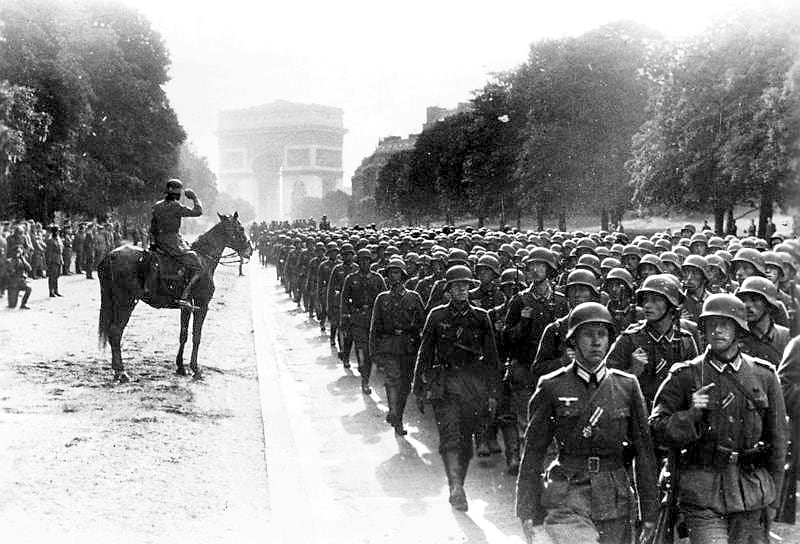 Paris, June 14th 1940: the German 30th Infantry Division parades along the Avenue Foch, with the Arc de Triomphe in the background.
At that exchange rate, German soldiers' marks were worth far more than they should have been in France, and purchasing offices paid for French goods with the francs France itself had handed over as occupation costs. Formally everything was paid for, with a proper invoice. In substance it was plunder organised with monetary tools. The same pattern was repeated in Belgium, the Netherlands, Norway and Greece: occupation costs, imposed exchange rates, trade credits that Germany piled up and would never settle.
Historians still debate exactly how much these weighed in total war spending, but they all agree the sums were enormous.
The bill
In May 1945 the Reich surrendered. The bill for its finances was written in the numbers: the Reich's debt was estimated at more than 400 billion marks, over four times pre-war national income. On the black markets of the ruined cities a kilo of coffee could cost up to 1,500 marks, and the real currency had become American cigarettes.
For three years repressed inflation stayed there, suspended. Official prices were still those of the freeze, but there was nothing in the shops and people bartered. The reckoning came on Sunday June 20th 1948, in the three western zones occupied by the Americans, the British and the French. The Reichsmark was abolished and replaced by the Deutsche Mark. Every citizen received 40 new marks in cash, followed later by another 20. Wages, rents and pensions were converted at par, one for one. Savings were not: after all the steps, for every 100 old marks deposited in a bank you got 6.50 new ones.
The next day the shops filled up as if by magic. The goods that shopkeepers had kept hidden reappeared in the windows, because they could now be sold for real money, and because at the same time Ludwig Erhard, who ran the economy of the American and British zones, began abolishing price controls. For many Germans that Monday marks the start of the economic miracle.
But the miracle had a price, and it was paid by the very people who had financed the war without knowing it. The deposits built up in the years of rationing, which the banks had invested in Reich bonds, lost 93.5% of their nominal value. The war debt was never repaid: it was made to disappear along with the currency it was written in. For the second time in twenty-five years, German savers watched the fruit of their work evaporate. In 1923 through hyperinflation, in 1948 through a currency reform.
And Schacht? Arrested by the Gestapo after the July 1944 plot against Hitler, he ended the war in a concentration camp. At Nuremberg he was tried alongside the regime's leaders, accused of having prepared the war financially. On October 1st 1946 the tribunal acquitted him on all counts, with the Soviet judge dissenting. Walther Funk, the man who had taken his place and put the Reichsbank at the service of the war, was sentenced to life imprisonment.
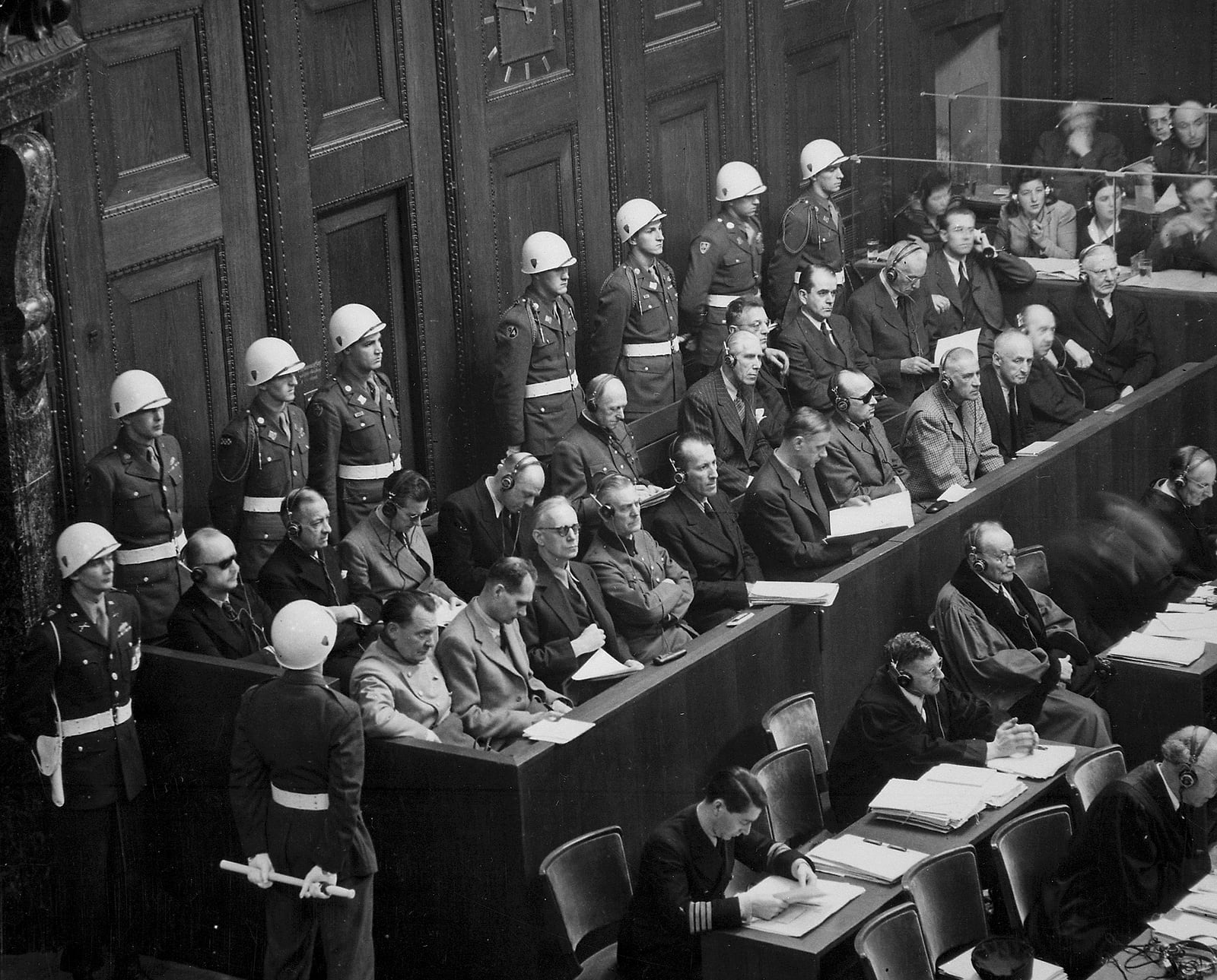 Nuremberg, 1945-1946: the defendants' dock before the International Military Tribunal.
The story of the Third Reich's finances is often told as that of a monetary genius who revived a country with brilliant tricks. It is a far less elegant story. The tricks worked as long as they served to hide the bill. Then the bill arrived, and it was paid by those who could not get away: German Jews, the occupied countries and, in the end, German savers, who had believed they were putting something aside for the future.
The bill for a war always arrives: why is it almost never paid by those who wanted it?
Image credits
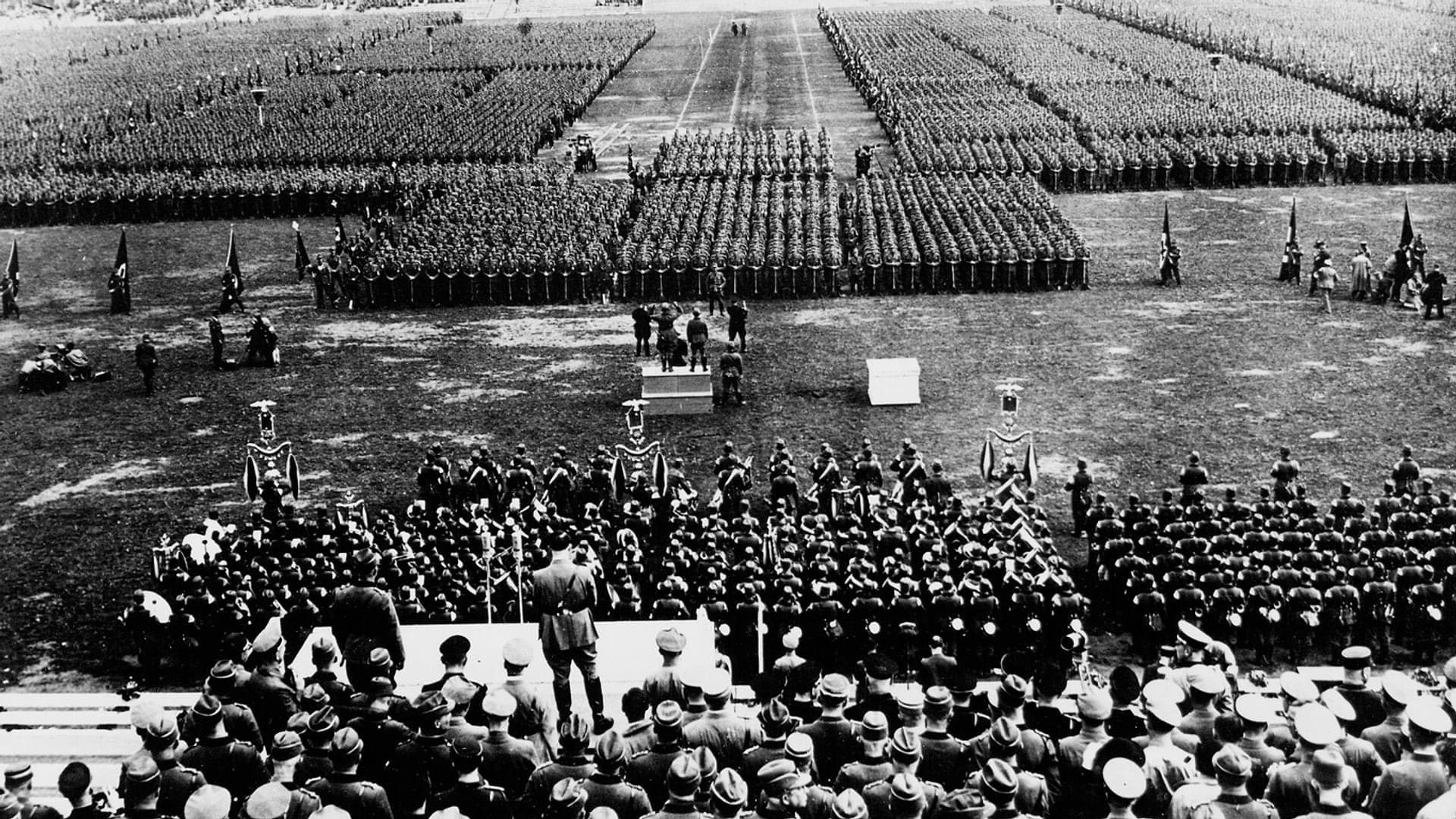
- Cover: Konstantin Hierl reports the roll call of some 52,000 men of the Reich Labour Service (RAD) to Hitler, seen from behind on the stage, on the Zeppelin Field at the Nazi party rally in Nuremberg, September 1934. Photo ACME Newspictures, La Presse collection, Bibliothèque et Archives nationales du Québec (no. 4175907), via Wikimedia Commons, public domain. Cropped, enlarged and tone-adjusted.
- In the text: "In a Berlin Bank", Berlin, 1923, Bain News Service, George Grantham Bain Collection, Library of Congress (LCCN 2014716642), via Wikimedia Commons, public domain. Cropped and tone-adjusted.
- In the text: "Berlin: Parade der Wehrmacht", April 20th 1936, photo by Willy Pragher, Landesarchiv Baden-Württemberg, Staatsarchiv Freiburg, W 134 Nr. 008645, via Wikimedia Commons, licence CC BY 4.0. Cropped, converted to black and white and tone-adjusted.
- In the text: destroyed Jewish shops in Magdeburg, November 1938. Bundesarchiv, Bild 146-1970-083-42 / CC-BY-SA 3.0, via Wikimedia Commons, licence CC BY-SA 3.0 DE. Tone-adjusted; the modified version is distributed under the same licence.
- In the text: victory parade on the Avenue Foch, Paris, June 14th 1940. Bundesarchiv, Bild 183-L05487 / Folkerts / CC-BY-SA 3.0, via Wikimedia Commons, licence CC BY-SA 3.0 DE. Tone-adjusted; the modified version is distributed under the same licence.
- In the text: the defendants' dock at the Nuremberg trial, 1945-1946, photo by Ray D'Addario, U.S. National Archives (NARA 540127), via Wikimedia Commons, public domain (work of the US government). Cropped and tone-adjusted.
Sources
- Adam Tooze, The Wages of Destruction: The Making and Breaking of the Nazi Economy, Allen Lane, 2006.
- International Military Tribunal at Nuremberg, judgment on Hjalmar Schacht, October 1st 1946. avalon.law.yale.edu
- Harvard Law School, Nuremberg Trials Project, document EC-436 on the financing of rearmament through MEFO bills. nuremberg.law.harvard.edu
- Harvard Law School, Nuremberg Trials Project, document EC-438, affidavit of Emil Puhl, vice-president of the Reichsbank, November 8th 1945. nuremberg.law.harvard.edu
- Harvard Law School, Nuremberg Trials Project, document EC-369, memorandum from the Reichsbank board to Hitler, January 7th 1939. nuremberg.law.harvard.edu
- German History in Documents and Images (German Historical Institute), entry on Hjalmar Schacht and the MEFO bills. germanhistorydocs.org
- Otto Nathan, Nazi War Finance and Banking, National Bureau of Economic Research, 1944. nber.org
- International Military Tribunal, trial proceedings on French occupation costs (nuremberg.law.harvard.edu) and document 1741-PS, Armistice Commission (avalon.law.yale.edu).
- Kim Oosterlinck, "L'impact de l'économie d'occupation sur le marché", Deutsches Zentrum Kulturgutverluste. kulturgutverluste.de
- Jüdisches Museum Berlin, feature on November 9th 1938 and the Judenvermögensabgabe (jmberlin.de) and the entry "Judenvermögensabgabe", decrees of November 21st 1938 and fifth instalment of 1939 (wikipedia.org).
- German History in Documents and Images, entry on Kristallnacht in Munich. germanhistorydocs.org
- Dunera.de, "Aktionsjuden", on the arrest of some 30,000 Jewish men after the November 1938 pogrom (dunera.de), and EHRI (European Holocaust Research Infrastructure), teaching material on the despoliation of German Jews (training.ehri-project.eu).
- "Opting for the Structural Break: The West German Currency Reform and Its Consequences", in D. Junker (ed.), The United States and Germany in the Era of the Cold War, Cambridge University Press (cambridge.org), and Bernd Sprenger, "50 Jahre Währungsreform 1948 und die wirtschaftspolitischen Folgen", Konrad-Adenauer-Stiftung, 1998 (kas.de).
- Deutsche Bundesbank, "Währungsreform 1948" (bundesbank.de), and Bundesarchiv, "Währungsreform und Berlin-Blockade" (bundesarchiv.de).
- Robert H. Jackson Center, reading of the judgment against Schacht at Nuremberg. roberthjackson.org
- U.S. Department of State, Foreign Relations of the United States, 1934, vol. II, document 295, on Germany's suspension of service on foreign loans from July 1st 1934. history.state.gov
- German History in Documents and Images, "Währungsreform (20. Juni 1948)". germanhistorydocs.org
- Institut für Konjunkturforschung (now DIW Berlin), "Bilanz der Preisbewegung", Wochenbericht no. 48, 1936, on the decree banning price increases from November 26th 1936. diw.de
- financial history
- Germany
- public debt
- inflation
- central banks