On April 7th 2025 SanDisk bottomed out at $27.89. Less than eighteen months later the shares trade above $1,600. The culprit, or the credit, depending on how you look at it, is the appetite of AI data centres for memory. But what does this company actually do?
A company born twice
SanDisk was founded in June 1988 in Sunnyvale, California, under the name SunDisk. Its three founders were semiconductor engineers: Eli Harari, Sanjay Mehrotra and Jack Yuan. The premise was technically ambitious for the time. Flash memory was then expensive and low-capacity. They believed it could get cheap enough to replace magnetic storage across a wide range of devices. In 1995 the company took the name SanDisk and listed on Nasdaq under the ticker SNDK, the same one it carries today. From there it became one of the central names in the spread of flash memory: SD cards, USB sticks, the first SSDs.
Then came the first turn. In 2016 Western Digital, a long-established maker of mechanical hard drives, bought SanDisk for about $15.6bn. The logic was plain: mechanical drives were under pressure from SSDs, and Western Digital wanted to own the technology replacing them outright. For almost nine years SanDisk ceased to exist as an independent listed company and became a division inside Western Digital.
The second turn came nearly a decade later. On February 24th 2025 Western Digital completed the separation of the two businesses. Western Digital kept the hard drives. Sandisk Corporation was reborn as an independent listed company, back on Nasdaq under SNDK.
The detail that makes the story worth telling is the timing. SanDisk regained its independence a few months before demand for AI data-centre memory exploded. Western Digital shareholders, who received SanDisk stock pro rata in the spin-off, found themselves holding one of the best-performing shares of 2026 almost by accident.
What SanDisk sells
SanDisk makes and sells storage devices built on NAND flash technology. In practice, if a device has to remember something permanently without a mechanical disk, it probably does so with a NAND chip. SanDisk is one of the world's main producers of that technology. The product lines are these:
SSDs, or solid-state drives: for PCs, laptops, games consoles and, increasingly, enterprise servers. This is the fastest-growing segment, pulled along by data-centre demand.
Memory cards: SD and microSD cards used in cameras, smartphones and portable devices. This is the legacy product on which SanDisk built its brand through the 1990s and 2000s.
USB sticks: removable consumer flash storage, and one of the most recognisable products the brand makes.
Embedded storage: memory components built directly into other devices, from smartphones and tablets to connected cars, IoT hardware and wearables.
Data-centre storage: high-capacity SSDs designed for cloud providers and AI infrastructure, where each chip handles data volumes far beyond anything a consumer generates. This is the segment now driving revenue growth.
The business model is the standard one for a commodity semiconductor maker. SanDisk sells in bulk to computer manufacturers, cloud providers and distributors, and its revenue is tied closely to the market price of NAND memory, which rises and falls in cycles. One structural detail matters: SanDisk does not make its chips entirely in its own plants. It produces through a long-standing joint venture with Kioxia, formerly Toshiba Memory, at facilities in Japan. The arrangement dates back to the 1990s.
Why everyone is talking about it now
2026 is the year the memory cycle swung sharply in favour of producers. The shares posted one of the steepest climbs on Wall Street, driven by flash storage demand that beat analyst forecasts quarter after quarter.
The mechanism behind the run is a genuine shortage. For the first time data centres have become the main market for NAND memory, overtaking traditional buyers such as PCs and smartphones. Training and running AI models requires storing and moving vastly more data than ordinary consumer use. Supply has not kept pace: building new NAND capacity takes years, not months.
The result is in the numbers. In fiscal 2026 SanDisk booked revenue of $20.25bn, up 175% year on year, with the data-centre segment rising from a few hundred million to $5.15bn, a gain of 437%. But the more interesting figure is not how much more they sold. It is what they sold it for. In the fourth fiscal quarter gross margin went from 26.2% to 84.6% against the same quarter a year earlier, while the volume shipped, measured in exabytes, grew only by a mid-single-digit percentage. In other words, SanDisk is not selling vastly more. It is selling roughly the same amount at much higher prices. When the NAND price rises faster than production costs, the effect on profitability is enormous: most of the price increase drops straight through to gross margin.
One point is worth stating plainly. This industry is historically cyclical. Flash memory has been through price booms and collapses before, whenever world production capacity caught up with demand. The current rally rests on a bet that AI-driven demand is structural and durable rather than a temporary spike. The market is making that bet with conviction. It remains a bet.
Things worth noticing, and some doubts
A few aspects of this story are worth pulling out, because they say more than "the stock is going up".
The timing of the spin-off was close to providential. Western Digital separated SanDisk for industrial reasons — hard drives and flash memory are too different to sit together — not because it foresaw the AI boom. That independence arrived on the eve of a NAND shortage is luck rather than foresight, and worth remembering when the story gets retold with hindsight.
SanDisk is now a single-bet company. Unlike more diversified rivals, its fate depends almost entirely on the NAND price cycle. There is no other business to fall back on if the cycle turns. That magnifies the gains now and the risk when, not if, the cycle reverses.
The independent company has less than two years of history. SanDisk's track record as a standalone listed business starts in February 2025. Everything we know about its ability to handle a cycle, good or bad, without the shelter of a larger group, is being observed in real time rather than verified against years of data.
The advantage and the risk that actually matter
Looking forward, the SanDisk story rests on two opposing forces.
The advantage: the more artificial intelligence matures, the greater the need to store data, not merely to compute it. Even if the rush for GPUs slows, the volume of data required to train and run models would keep growing. That is a tailwind which depends not on a single product but on the direction of the whole industry.
The risk: NAND memory remains a commodity, and SanDisk has no way to differentiate its product from a rival's. The clearest signal comes from China. YMTC, a state-backed producer, has just overtaken Kioxia to become the world's third-largest NAND maker by shipped volume, and according to the Financial Times has told investors in pre-IPO meetings that it aims to be the world's largest by the end of 2027. High prices attract new capacity from every competitor. It has happened before in this industry, and when supply realigns with demand, margins compress as fast as they expanded.
Anyone holding this stock is betting, in the end, on which of the two forces arrives first: the structural growth of AI-driven demand, or the return of the cycle that has always defined this business. Which would you bet on?
This article is for information and editorial purposes. It is not investment advice: consider your own circumstances or consult a licensed adviser before making any investment decision. Market data cited is current as of September 10th 2026 and can change quickly.
Image credits
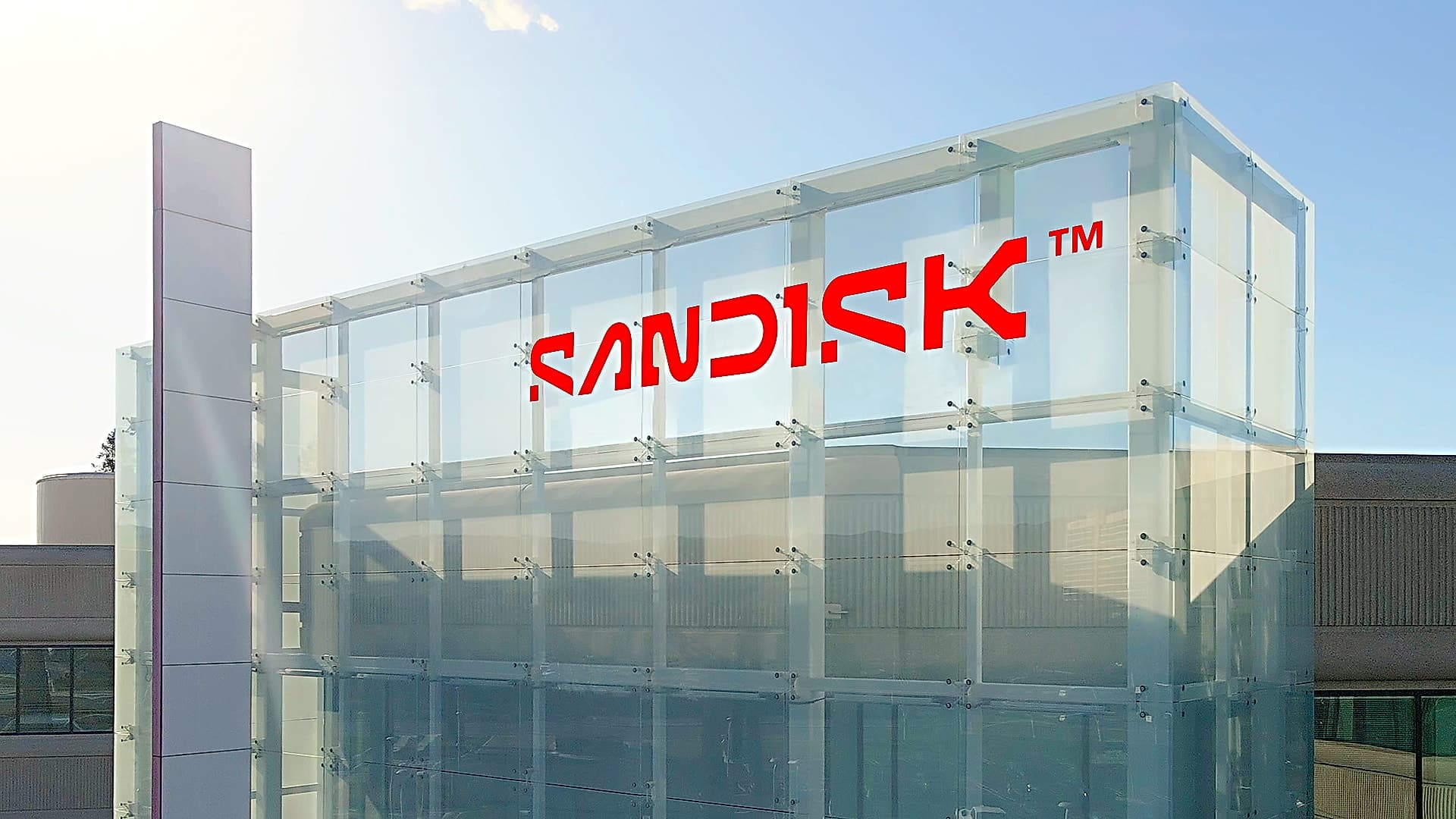
Photo 1: SanDisk headquarters (file Sandisk-HQ.png), by SanDisk, via Wikimedia Commons, licensed CC BY 4.0. Cropped and tonally adjusted.
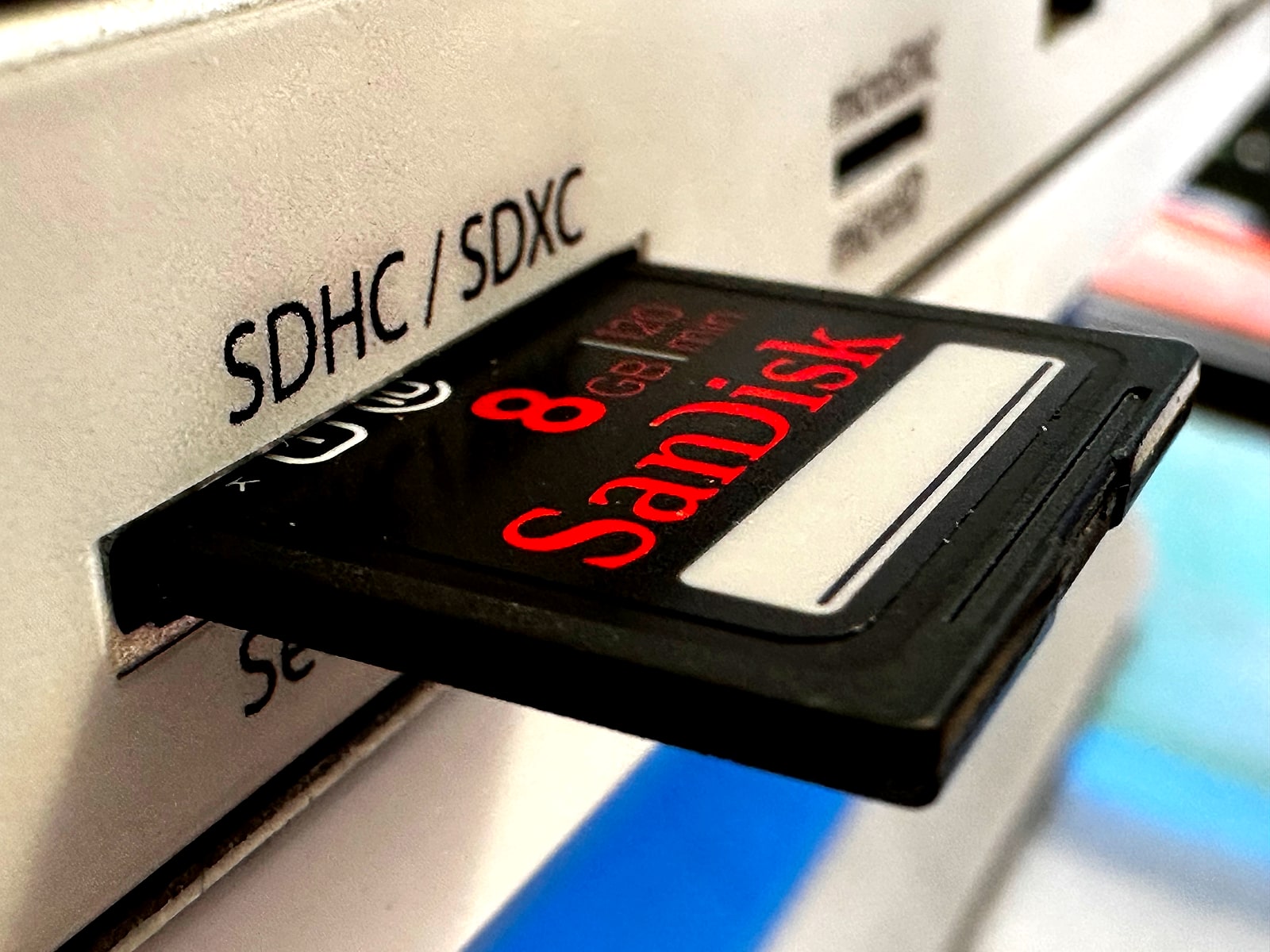
Photo 2: an 8GB SanDisk SD card during a data transfer, by Magpieturtle, via Wikimedia Commons, licensed CC BY 4.0. Tonally adjusted.
- semiconductors
- NAND memory
- artificial intelligence
- data centres
- spin-off
Newsletter
Was this analysis useful?
We publish one a week: a company taken apart piece by piece, or a story that changed the markets. It arrives by email, without the noise.