I'm addicted to winning. The more you win, the more you want to win.
— Larry Ellison
In June 1970 an English researcher working for IBM in California, Edgar Frank Codd, published a paper with a distinctly uninviting title: A Relational Model of Data for Large Shared Data Banks. Inside was a new way of storing and retrieving data inside a computer. IBM believed in it enough to experiment, but not enough to hurry: it already had a storage product in the catalogue that worked and sold well. Thirteen years would pass before it turned the idea into something it could sell.
In 1977, in California, three programmers decided to do something simpler: take that model and turn it into a company straight away. They put together two thousand dollars of capital. One of the three had no degree, had dropped out of two universities, was thirty-three years old and had no savings worth the name. His name was Larry Ellison.
In September 2026 that company holds $664bn of signed contracts, spends far more than it takes in to build sheds full of computers, and its shares have lost roughly 40 per cent from their 2026 highs. In this piece: the past, the present and the future of Oracle.
The boy who never finished anything
Ellison was born in New York on August 17th 1944. His mother was nineteen and could not keep him: at nine months old, after a bout of pneumonia, he was given up for adoption to two of her relatives, who raised him in an apartment on the South Shore of Chicago.
He enrolled at the University of Illinois, was named science student of the year and left in his second year, when his adoptive mother died. He tried the University of Chicago, lasted a term, and there saw for the first time how a computer is designed. In 1966 he moved to California, where for about a decade he made a living as a programmer, changing employers often.
The last of those employers was Ampex, a Silicon Valley electronics company that built the professional tape recorders used by American television — the machines that made the instant replay possible — and that also developed data stores on contract. It was there that Ellison met the two people with whom he would found Oracle: his boss, Bob Miner, and a colleague, Ed Oates. And it was there that the three of them worked on a data store commissioned by the CIA, a project that came to nothing but that had a code name destined to last: Oracle.
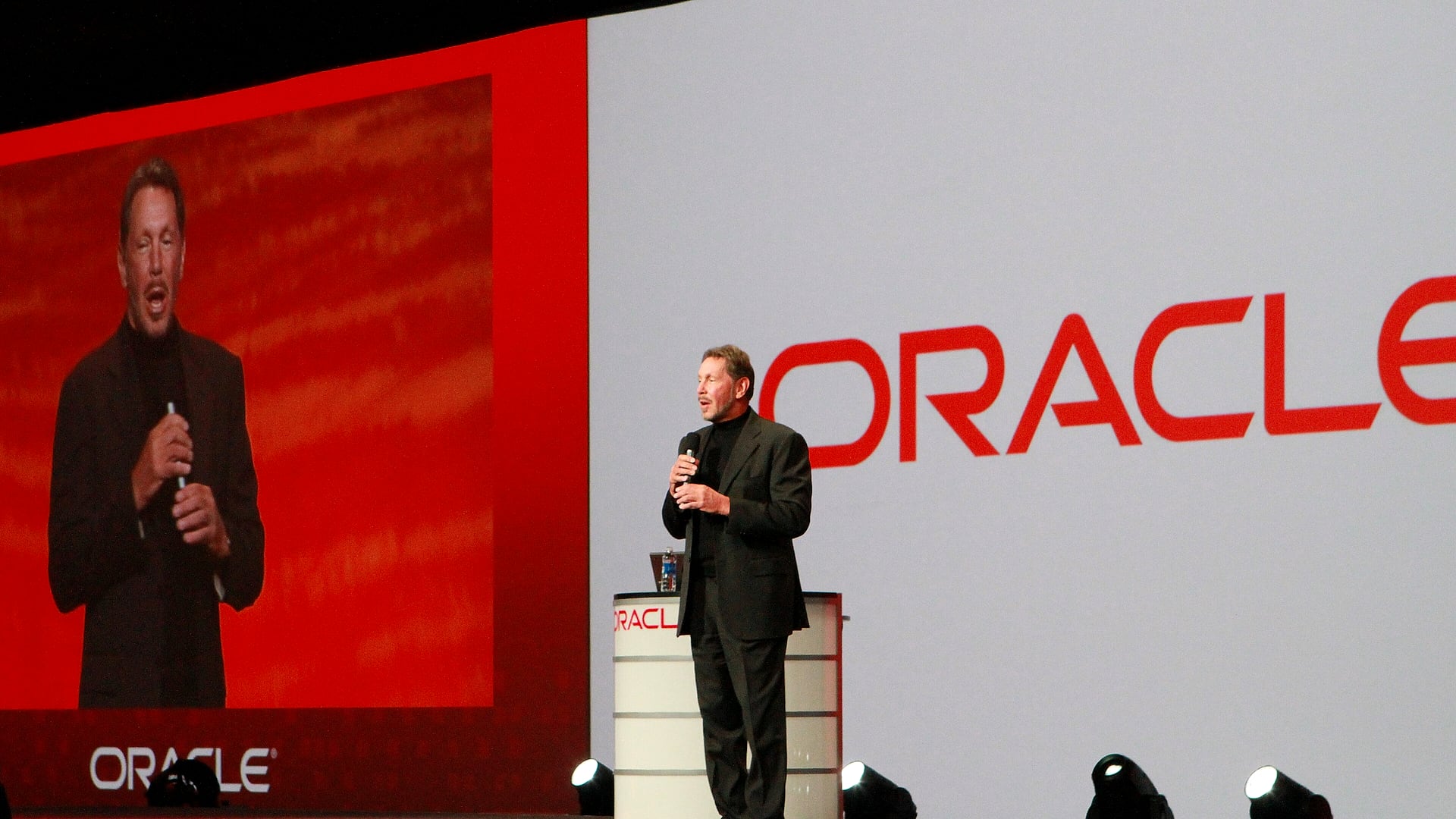 Larry Ellison on stage at Oracle OpenWorld in September 2010: thirty-three years after the two thousand dollars of starting capital.
What they built
What a database is, and why Codd's idea changed everything — technical background, open it if you are interested
A database is an electronic archive. Before the 1970s data was stored in rigid structures in which every piece of information was linked to the next by fixed paths decided by the programmer: to find something you had to know where and how it had been put there, and asking a new question often meant rewriting the program.
Codd's idea is the relational model: data goes into tables, like spreadsheets, and the tables talk to one another through shared values — the customer table and the order table are linked by the fact that both contain a customer code, not by a physical path. On top of that sits a language for asking questions, SQL, with which you ask the computer for "every customer in Parma who has spent more than a thousand euros this year" without having to explain where the data is or in what order to read it.
Put like that it sounds trivial. It is the reason cash machines, airline bookings and supermarket tills work.
IBM, meanwhile, had carried its own idea forward: an experimental project called System R had produced SQL, the language still used by anyone querying a database today. But the product it could sell, DB2, would not arrive until 1983, and by then the three men in Santa Clara had been on the market for four years. According to the company's own official timeline, the version released in 1979 was the first commercial SQL-based relational database. And it was called Version 2, even though a commercial Version 1 never existed: a marketing decision, described inside the company as a way of not arriving on the market with a first release. The first customers were the same people who had commissioned the project behind the code name: American government and military agencies.
The most important aspect of my personality, as far as determining my success goes, has been my questioning conventional wisdom, doubting the experts and questioning authority.
— Larry Ellison
For the first five years, though, Oracle was not called Oracle: that was only the name of the program. The company was founded in 1977 as Software Development Laboratories, became Relational Software in 1979 — the year of the first product sold — and only in 1982 took the name of the program it sold: Oracle Systems Corporation. The name we know today, Oracle Corporation, arrived in 1995.
In 1983 version 3, rewritten in C, could run on different kinds of machine, from corporate mainframes to personal computers: that is the leap that took it everywhere. When it floated on March 12th 1986 it had 450 employees and $55m in revenue. Microsoft went public the following day.
1990
Through the 1980s Oracle grew at close to double the size every year, driven by a sales force paid on commission with one simple objective: get the contract signed. The weak point was how those contracts landed in the accounts. A contract was booked as revenue in full at the moment of signature, even if the customer would pay months later. As long as revenue keeps rising the mechanism holds and nobody looks; when growth slows, it all comes down at once.
It happened on March 27th 1990: Oracle announced quarterly revenue far below expectations and in a single day the shares lost 31 per cent of their value. In the following months the company restated accounts it had already published, laid off around 400 people and settled the shareholder lawsuit for $23.25m.
That is where Oracle learned the hard way something that still holds today: a signed contract is not cash received. Keep it in mind, because a $664bn number made of exactly the same substance is coming shortly.
The art of buying your rivals
How Oracle bought up its competitors — open it if you want the historical detail
Having survived the crisis, Oracle grew by buying. The most famous case is PeopleSoft, a rival in enterprise management software: in 2003 Oracle launched a hostile bid — one aimed directly at shareholders, going over the head of a board that had said no — and closed the deal eighteen months later at $10.3bn. Then Siebel; in 2010 Sun Microsystems for $7.4bn, which also brought the Java language and the MySQL database in-house; in 2016 NetSuite; in 2022 Cerner, the medical records of American hospitals, for $28.3bn, the largest acquisition in its history.
The common thread never changes: buy software companies cannot do without, and that costs more to replace than to keep.
How Oracle actually makes money
There are three engines today, and they are very different from one another.
The first is the dullest and the most profitable: licences and support. You buy the database licence once, then pay an annual maintenance fee — licensing consultants put it at around 22 per cent of the licence value — for updates and assistance. Oracle itself writes that virtually all customers buy support alongside the licence and that most of them renew: you do not switch off the database running a bank's accounts to try another one. In the 2026 financial year, which ended in May, new licences brought in $4.7bn, down 9 per cent; support brought in $19.8bn, essentially unchanged. Most of that revenue comes from purchasing decisions made years ago.
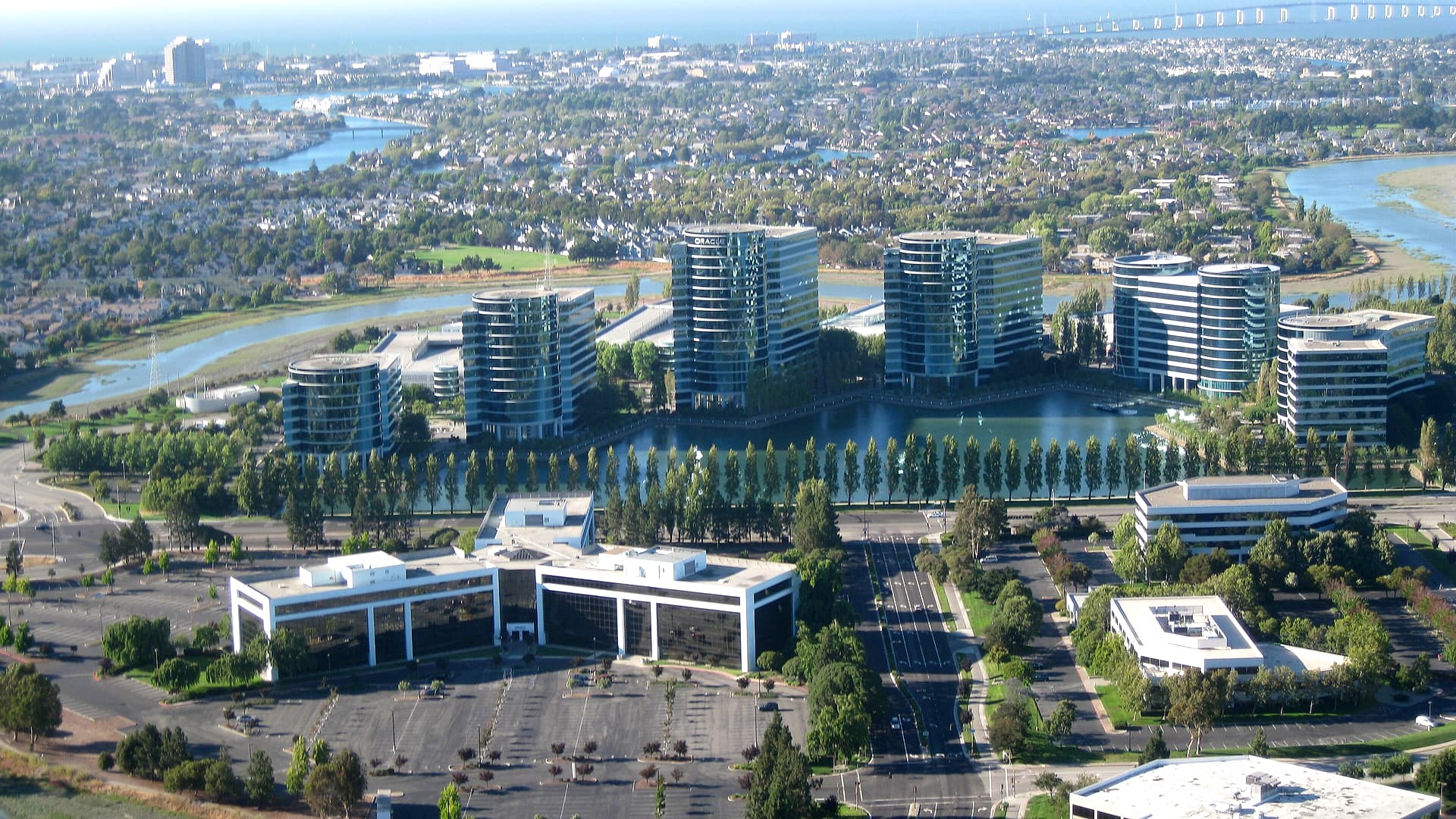 The Redwood Shores headquarters in August 2008: glass towers paid for by thirty years of licences, before the business became building sheds.
Oracle has a particular reputation on this front, and it has earned it: since 2023 Java has been priced on the customer's total headcount — everyone, including people who have no idea what Java is — starting at $15 per person per month.
The second engine is subscription applications, so-called SaaS: instead of installing the management software on the company's own servers, you rent it and reach it over the internet. This is where NetSuite sits, along with the human-resources and accounting software and Cerner's medical records: $15.9bn in the 2026 financial year, up 11 per cent.
The third engine is the one changing the company: selling computing capacity. And this is where it is worth explaining what a data centre is, a term that appears everywhere and that almost nobody explains.
A data centre is a shed full of computers. Not computers like the one at home: machines with no screen and no keyboard, stacked in metal cabinets, working twenty-four hours a day on somebody else's behalf. The binding constraint is not space, it is electricity: those machines draw enormous amounts of power and turn nearly all of it into heat, which has to be carried away by cooling systems that themselves draw power. That is why data centres are measured in megawatts rather than square metres.
Inside are the GPUs, chips born for video games that turned out to be perfect for artificial intelligence, because they perform millions of simple calculations at once rather than a few complex ones one at a time: training an AI model is, essentially, doing that for weeks on end. The site Oracle is building with OpenAI at Abilene, Texas, gives a sense of the scale: according to Data Center Dynamics, eight buildings linked into a single system, more than 450,000 Nvidia GPUs and 1.2 gigawatts of power, which Ellison has compared to the consumption of a million homes.
Here is the point worth being clear about: Oracle does not sell those machines, it rents them. It builds the shed, buys the computers, pays for the power and the cooling, and then lets third parties use them. The customer buys nothing and owns nothing: it uses machines that remain Oracle's for as long as it needs them, and pays according to how much computing it consumes. It is the landlord's trade, applied to computing power — and the tenants, listed by the company itself, are called OpenAI, Meta, Nvidia, xAI, AMD and TikTok.
This is the business that went from $10.2bn to $18.1bn in the 2026 financial year, up 77 per cent, and reached $7.4bn in the quarter ending in August alone.
What the $664bn really is
The number that has made Oracle the most argued-over stock in the sector is called RPO, remaining performance obligations: an accounting line that measures the value of signed contracts for work not yet performed. It is neither revenue nor cash. At the end of the 2026 financial year it stood at $638bn, against $138bn the year before; in the quarter ending in August it rose to $664bn, close to ten times annual revenue.
The heaviest part comes from a single customer. In September 2025 the Wall Street Journal, followed by Reuters, reported that OpenAI had committed to buying roughly $300bn of computing power over five years starting in 2027: Oracle has never confirmed either the figure or the name, and the identification is attributed to the financial press. The market's reaction was immediate: on September 10th 2025 the shares rose 36 per cent in a single session, the best day since 1992, and for a few hours Ellison was the richest man in the world.
One qualification that changes how the risk reads: Oracle is not paying for all of that computing. Part of the large AI contracts provides for the customer to advance the money for the GPUs, or to buy them and supply them directly: at the end of the 2026 financial year those components were worth $75bn. The critical point remains: OpenAI is losing money today, and it will have to pay for those contracts out of revenue that for the most part does not yet exist.
The bill to be paid
Before you can sell that computing capacity, you have to build it. In the 2026 financial year Oracle invested $55.7bn in property and equipment against $32bn of cash generated by operations: free cash flow, what is left after investment, was negative to the tune of $23.7bn, having been negative by just $394m the year before. For 2027 the company is guiding to net investment of around $70bn.
That money has to be found: between bonds and share sales, Oracle has planned to raise $40-50bn a year, and in the quarter ending in August alone it placed $20bn of shares on the market. At the end of the 2026 financial year financial debt stood at around $130bn; S&P, which also counts other liabilities, puts the figure at about $167bn, and in the summer of 2026 it cut the rating to BBB-, one notch above the line separating investment-grade debt from speculative.
Then there is the part that does not appear in Oracle's balance sheet at all: many data centres are not built by Oracle but by outside developers who take on the debt and then lease the buildings to it. On September 18th 2026 the Financial Times, followed by Reuters, reported that $18bn of loans tied to a New Mexico campus destined for Oracle were trading below face value.
Finally the margin, which is the real point. Gross margin is what is left of every dollar taken in after paying the direct costs: in Oracle's traditional software it is very high, because copying a program costs almost nothing. In AI computing, by contrast, the direct costs include power, staff and above all depreciation — a GPU costs tens of thousands of dollars and that cost is spread over a few years of useful life, weighing on the accounts even once the money has gone out. If the chips age faster than expected, that charge is too low and today's profits look better than they are. In October 2025 The Information, on the basis of internal documents that cannot be verified from outside, wrote that AI servers were earning Oracle an average gross margin of 16 per cent; the company did not comment.
Who is in charge now
Since September 22nd 2025 the company has had two chief executives: Clay Magouyrk, who came from the cloud infrastructure side, and Mike Sicilia, who came from applications. The split of roles is a good photograph of the group's two souls.
Ellison remains chairman and chief technology officer with a stake that in recent years has held at around 40 per cent of the shares: he controls the company without having to run it. Outside Oracle he bought 98 per cent of Lanai, one of the Hawaiian islands, in 2012, and financed the merger of Skydance and Paramount, now led by his son David. Above all, he sits at the centre of the TikTok arrangement: in the American joint venture announced on January 23rd 2026, Oracle, Silver Lake and the Emirati fund MGX hold 15 per cent each, ByteDance keeps 19.9 per cent, and Oracle is both shareholder and "trusted security partner", with the content algorithm retrained inside its own cloud. A customer that is also an investee, in a business where your largest customer owes you hundreds of billions.
In the market
2026 is the year part of the market stopped looking only at the backlog and started looking at the cash. On September 18th the shares closed at $147.61, after a high of $329.50 and a low of $114.50 over the previous twelve months: anyone who bought into the enthusiasm of September 2025 has watched the value halve. That is not normal volatility for a software company with fifty years of history.
Closing thoughts
For forty years Oracle made money selling something that cost very little to produce and that customers could not stop paying for. Today it is doing the opposite: building physical infrastructure, expensive and debt-financed, to serve a handful of enormous customers.
The $664bn of contracts is real; what the next few sets of accounts will tell us is how much of that value actually turns into cash, once the bill for the infrastructure has been paid.
This article is for information and editorial purposes. It is not investment advice: consider your own circumstances or consult a licensed adviser before making any investment decision. The financial figures reported here come from Oracle's official releases and filings. The value of the OpenAI contract, the margins on the AI server rental business and the pricing of the loans tied to the New Mexico campus are press reconstructions not confirmed by the company, reported here with their source. Market data is current as of September 18th 2026 and can change quickly. The author holds no positions in the securities mentioned.
Image credits
- Cover: "Oracle Redwood City May 2011 002.jpg" by King of Hearts, via Wikimedia Commons, licensed CC BY-SA 3.0. Cropped, resized and tonally adjusted; the modified version is distributed under the same licence.
- In the text: "Larry Ellison CEO of Oracle Corporation.JPG" by Ilan Costica, via Wikimedia Commons, licensed CC BY-SA 4.0. Cropped, resized and tonally adjusted; the modified version is distributed under the same licence.
- In the text: "Oracle HQ3.jpg" by moppet65535, via Wikimedia Commons, licensed CC BY-SA 2.0. Cropped, resized and tonally adjusted; the modified version is distributed under the same licence.
Sources
- Oracle — the Oracle Timeline and official documentation on the history of the product. oracle.com
- Oracle — the releases on the 2026 financial year results and the first quarter of fiscal 2027. investor.oracle.com
- Oracle — filings with the SEC, for debt, capital expenditure and RPO. sec.gov
- Oracle — "Equity and Debt Financing Plan for Calendar Year 2026", February 1st 2026.
- Oracle — the release announcing Clay Magouyrk and Mike Sicilia as chief executives, September 22nd 2025.
- In Re Oracle Securities Litigation, 829 F. Supp. 1176 (N.D. Cal. 1993): the 1990 restatement and the shareholder settlement.
- S&P Global Ratings — the downgrade of Oracle Corp. to BBB-/A-3, 2026.
- Financial Times, followed by Reuters — the loans tied to the New Mexico campus trading below par, September 18th 2026.
- The Information, followed by Data Center Dynamics — the margins on AI servers, October 2025.
- Data Center Dynamics — the Abilene site and the GPU deployment. datacenterdynamics.com
- Wall Street Journal, followed by Reuters — OpenAI's commitment of roughly $300bn, September 2025.
- TikTok Newsroom — the announcement of the TikTok USDS joint venture, January 23rd 2026.
- CNBC — "Oracle stock gains 36% to post best day since 1992", September 10th 2025.
- software
- databases
- cloud
- artificial intelligence
- data centres