 Bellwether
At the end of 2025 a share of Moderna was worth $29.49. The company that in 2020 had given the world one of the first Covid vaccines had lost almost all of its value on the stock market, and many saw it as a one-product company, finished along with the pandemic. Ten months later the stock is worth more than seven times as much, thanks to a drug that teaches the immune system to recognise one patient's tumour. It is the second time in six years that Moderna has gone from being a company nobody bets on to one the whole world is talking about. How do you come back from the dead twice?
"Covid came along and we took a small detour to try to do our duty and help people... since then we have gone back to our mission." — Stéphane Bancel, chief executive of Moderna, to Euronews (June 2026)
A name with a promise inside
The story starts in a Boston laboratory. In April 2010 Derrick Rossi, a researcher at Boston Children's Hospital and Harvard Medical School, files together with his colleague Luigi Warren a provisional patent application on a method for reprogramming cells using synthetic messenger RNA, the molecule that carries to cells the instructions for making proteins. The problem with messenger RNA, until then, was that the body mistook it for a virus and destroyed it, setting off inflammation. Rossi had built his work on a discovery by two researchers at the University of Pennsylvania, Katalin Karikó and Drew Weissman: by modifying some of the building blocks of the molecule, the RNA went unnoticed. For that discovery, in 2023, Karikó and Weissman would be awarded the Nobel Prize in Medicine.
The idea that comes out of it is simple to say and very hard to carry out: if you can get the right instructions to cells, you can make the body produce the drug it needs. Rossi shares it with his Harvard colleague Timothy Springer, and around the project gather Robert Langer, a professor at MIT and one of the best-known names in American biotechnology, the cardiologist Kenneth Chien and Noubar Afeyan, founder of the Flagship Pioneering fund, which builds companies starting from scientific hypotheses. In September 2010 ModeRNA Therapeutics is born. The name combines "modified" and "RNA". That it also contains the word "modern" is no accident.
"You're crazy, it will never work"
To lead the company Afeyan wants one particular man: Stéphane Bancel, a French engineer who had been at Eli Lilly, where he rose to run the Belgian operations, and was then chief executive of the diagnostics company bioMérieux. Bancel told Forbes how the first meeting went, in 2011, when Afeyan explained the idea: "I told him: you're crazy, it will never work." Afeyan insisted, and Bancel accepted.
Afeyan has turned that reaction into a method. In the same Forbes article he said of himself that he constantly says unreasonable, apparently crazy things. Moderna was the craziest of all: a platform that, if it worked, could produce vaccines and drugs for dozens of different diseases, always starting from the same technology.
The most secretive company in biotech
In its early years Moderna raises money at a speed never seen for a company with no products: before reaching the stock market it pulls together $2.6 billion from private investors. In 2013 AstraZeneca pays it $240 million up front to develop drugs for the heart, metabolism and kidneys, one of the highest initial sums ever paid for a technology that had not yet been tested in humans. In 2016 comes Merck, the American immunotherapy giant: $200 million to develop personalised cancer vaccines together. It is the seed of the story that now moves the stock, but back then almost nobody notices.
What gets noticed is something else. On September 13th 2016 the journalist Damian Garde publishes in STAT, the American health-focused outlet, an investigation based on the accounts of more than twenty current and former employees. The portrait is merciless: Moderna has published no scientific data to support its technology, some candidates have to sign confidentiality agreements before the job interview, the atmosphere inside is described as wearing. A former scientist at the company dismisses it like this: "It's the case of the emperor's new clothes."
The following year Alexion, a partner on a therapy for a rare genetic disease, ends the collaboration: safety problems had kept the project from reaching human trials. Moderna shifts its energy to vaccines, where the road to clinical trials is shorter.
The worst debut
On December 7th 2018 Moderna lists on the Nasdaq. It raises $604 million at $23 a share: the largest listing ever for a biotechnology company. On the first day of trading, however, the stock loses 19% and closes at $18.60. The market is in the middle of a sell-off, and at least one analyst had already warned that the valuation, about $7.5 billion, was out of proportion for a company that after eight years still had not a single product on sale.
In the following months the stock stays below its offer price. Then comes January 2020.
Sixty-three days
At the beginning of January Bancel is on holiday in France when he gets a message from Barney Graham, deputy director of the vaccine research centre at the National Institutes of Health, the American public health institutes. Moderna and Graham's group were already working together, and for 2020 had planned a project on a virus called Nipah. According to Boston Magazine's reconstruction, Graham writes to him that an unidentified virus is circulating in China, and that if it turned out to be a coronavirus they knew what to do.
On January 11th the Chinese authorities publish the genetic sequence of the virus. On January 13th, two days later, the Moderna team and the one at the National Institutes of Health have already defined the vaccine sequence. Bancel has said that the two teams worked each on their own and that, when they compared results after about 48 hours, they had designed exactly the same vaccine. On February 24th the first batch leaves for clinical trials. On March 16th in Seattle Jennifer Haller, a manager at a technology company, becomes the first person outside China to receive an experimental Covid vaccine. From choosing the sequence to the first injection into a human being, 63 days have passed.
On November 16th 2020 Moderna announces an efficacy of 94.5%. In December emergency authorisation arrives in the United States. After ten years, it is the first approved product in its history.
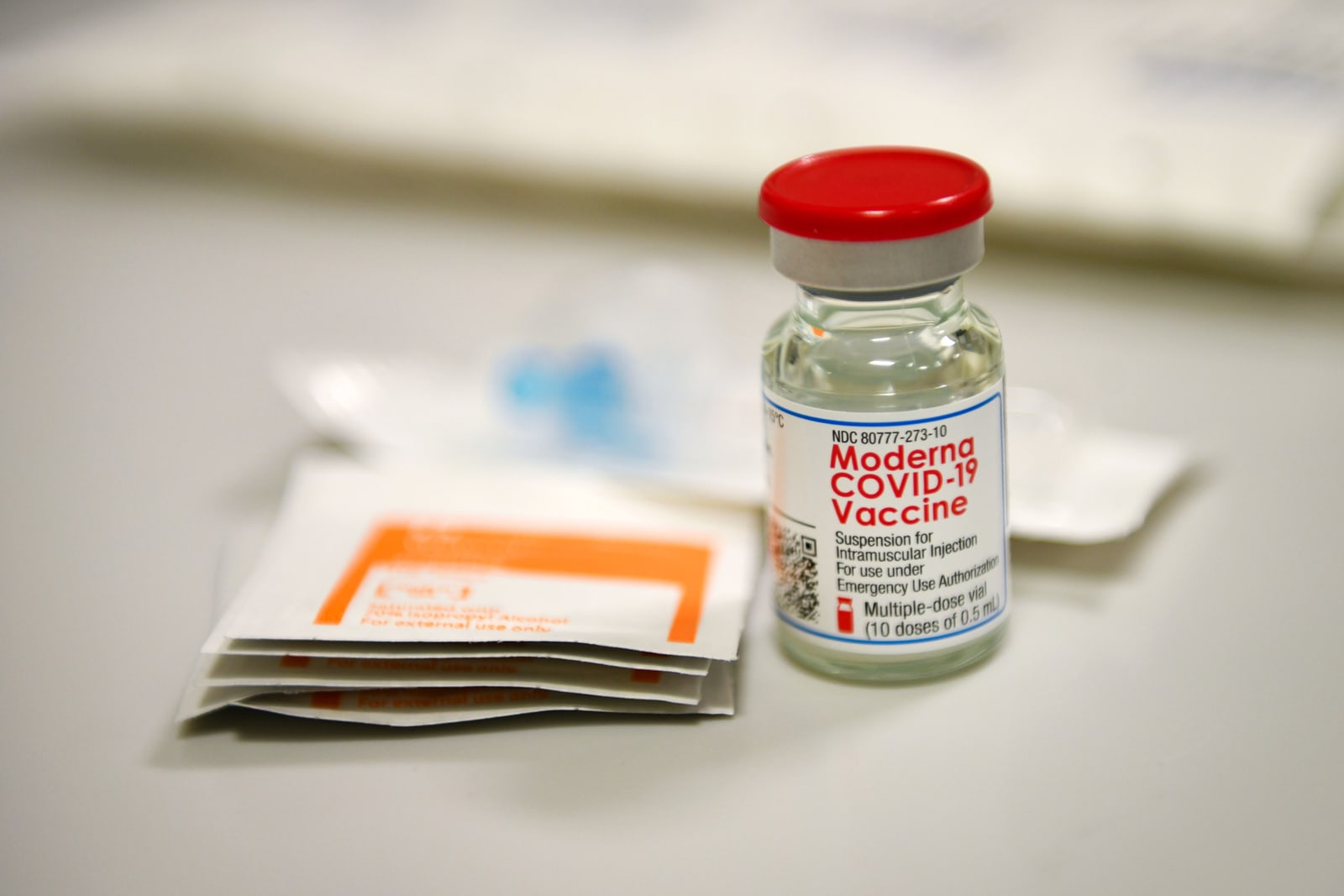 A vial of the Moderna Covid-19 vaccine during the first vaccinations of healthcare workers at the Royal Air Force base at Lakenheath, England, in late December 2020.
Eighteen billion, then nothing
2021 is the year Moderna becomes a name everyone knows. It delivers 807 million doses, collects $18.5 billion in revenue and closes the year with $12.2 billion in net profit. In August 2021 the stock hits its all-time high of $497.49: anyone who had bought at the offer price, $23, had multiplied their investment by more than twenty.
Then the emergency ends and demand collapses. Revenue falls to $6.8 billion in 2023 and $3.2 billion in 2024, a year that closes with a $3.6 billion loss. In 2025 it stops at around $1.9 billion. The vaccine against respiratory syncytial virus, approved in 2024, is not enough to make up for it. The company cuts billions of dollars in costs and reduces staff. In 2022 it sues Pfizer and BioNTech, accusing them of copying its technology, but on the stock market that is not enough: at its lowest point the stock falls to $22.28, more than 95% below the peak.
The detour is over
2026 begins with another blow. On February 3rd the FDA, the American drug agency, refuses even to review the application to approve Moderna's flu vaccine. The company makes the matter public and proposes a different route: full approval for people aged 50 to 64, accelerated approval for the over-65s, the group about which the agency had more doubts because of the vaccine used as the comparison in the trial. On February 17th the FDA accepts the application. On August 5th mFLUSIVA is approved for adults aged 50 and over, with a requirement for a new study to confirm the benefit above 65: it is the first messenger RNA flu vaccine authorised in the United States.
Two weeks later comes the day that rewrites the company's story. On August 19th Moderna and Merck announce that the phase 3 trial, the last before applying for approval, of their personalised melanoma vaccine has met its main goal. The stock closes at $174.38, up 177% in a single session: the biggest in its history. According to estimates from the analytics firm S3 Partners, those who had bet against the stock lose about $5.5 billion in a day.
A vaccine that doesn't prevent
The drug is called intismeran autogene, and calling it a cancer vaccine can mislead. It is not given to healthy people to stop them getting ill. It is used after the surgery that removed the tumour, to reduce the risk that it comes back.
The process is different for every patient. The removed tumour is sequenced, software identifies up to 34 neoantigens, that is abnormal proteins produced by mutations present only in diseased cells, and Moderna makes a custom molecule of messenger RNA that teaches the immune system to recognise them and eliminate the remaining tumour cells. The vaccine is given together with Keytruda, Merck's immunotherapy drug. In practice, each patient receives a drug designed only for them.
The trial involved 1,137 patients with high-risk melanoma who had already had surgery. The full data were due to be presented in Madrid on October 24th, at the congress of the European Society for Medical Oncology, but on October 22nd they appeared early on a medical news site. After a median follow-up of about two years, adding intismeran to Keytruda cut the risk of recurrence or death by 42% compared with Keytruda alone. Overall survival data, by contrast, are not yet mature. The result is positive, but the market had another number in mind: the 49% reduction seen in the earlier, smaller trial, after five years of follow-up. The two trials are not directly comparable, but for investors it was the only benchmark, and the stock had already priced in the best. That day it fell as much as 26% during the session, then closed at $202.63, down 17.6%.
Merck, for its part, called the results one of the most significant advances in the treatment of melanoma since the arrival of immunotherapy. Bancel, in Madrid, told STAT: "It's an incredible feeling. We have been working on intismeran for ten years." There is a piece of Italy in this story too: Paolo Ascierto, an oncologist at the Pascale Institute in Naples, administered the vaccine as part of the trial and spoke of a possible breakthrough in oncology. The same drug is now being tested on other tumours in nine phase 2 and 3 trials.
How Moderna makes money today
Today Moderna has four vaccines against respiratory diseases in its portfolio: two against Covid, Spikevax and mNEXSPIKE, one against respiratory syncytial virus, mRESVIA, and the new flu vaccine mFLUSIVA, which the company expects to have ready for the 2026-2027 season. But the numbers remain small compared with the pandemic years. In the first half of 2026 revenue was $534 million, with a net loss of over $2.1 billion. For the full year the company is aiming for revenue growth of up to 10%.
Intismeran, by contrast, is not yet approved and so generates no revenue. When it does, it will not all belong to Moderna: in 2022 Merck paid another $250 million to exercise the option provided for in the 2016 agreement, and today the two companies split costs and profits down the middle.
The stock
At the close on October 28th 2026 a share of Moderna was worth $214.17, for a market capitalisation above $80 billion. Since the start of the year the gain exceeds 600%, and yet the stock is still about 57% below its August 2021 peak. Moderna will present its third-quarter results on November 6th.
Source: Yahoo Finance, weekly closing prices. Data as of 28 October 2026.
The market, however, is divided. On September 30th Citi cut its rating to sell, arguing that the optimism about oncology is already all in the price: by the bank's calculations, to justify a share price around $200 would take roughly $26 billion a year in sales of cancer drugs, of which about $13 billion would go to Moderna.
Doubts to keep in mind
The first is manufacturing. A vaccine that has to be made from scratch for every patient, starting from their tumour, is an industrial undertaking very different from producing millions of identical doses, as Moderna did with Covid.
The second is the price. Moderna and Merck have not yet announced how much intismeran will cost. According to analysts' estimates reported by Forbes Italia, a full course of treatment could cost from $100,000, and convincing health systems and insurers to pay for it will not be automatic.
The third is the authorities. Approval has not yet arrived, and the flu vaccine affair showed that with the current FDA, which under Health Secretary Robert F. Kennedy Jr. has stepped up scrutiny of vaccines, nothing can be taken for granted.
The fourth is competition. BioNTech, the German company that with Pfizer developed the other messenger RNA Covid vaccine, has been working for years on personalised cancer vaccines.
The fifth is the share price. As in 2021, the stock market is today discounting a commercial success that will be seen, if it is seen, only in a few years.
Moderna is a company born from a discovery that almost nobody took seriously, led by a manager who at first called it madness, accused of secrecy, exploding with Covid and then written off. Now it is staking everything on a promise even more ambitious than the first: a different drug for every cancer patient.
Science has given the first answer. Now it is the numbers' turn.
The drug is not yet approved, and the market has already put it in the price. Does the promise count for more, or the price already paid?
Latest resultsThird quarter 2026 (July-September) · published 6 November 2026
- Revenue
- $1.31bn+29%
- vs the same quarter a year earlier
- Net income
- $162ma year earlier: loss of $200m
- Earnings per share
- $0.38
- US revenue
- $780m
Company outlook
2026 revenue growth between 15% and 25%
Source: Moderna official press release
Figures reported by the company. Items marked as adjusted exclude certain one-off components according to the company's own definitions. We do not report analyst estimates.
The information contained here does not constitute financial advice: before making any investment decision, consider your own personal situation or consult a qualified adviser. The stock market and financial data cited are as of October 28th 2026 and may change quickly. The author holds no positions in the securities mentioned.
Image credits
- Cover: "Moderna Headquarters, December 2020.jpg" by Fletcher, via Wikimedia Commons, licence CC BY 4.0. Cropped and resized.
- In the text: "A vial of Moderna COVID-19 vaccine 201229-F-ZB805-0008Y.jpg" by Senior Airman Madeline Herzog, U.S. Air Force, via Wikimedia Commons, public domain. Resized.
Sources
- Moderna, filings with the SEC: 2021, 2024 and 2025 results, second-quarter 2026 results (8-K) and the announcement of the date of the third-quarter 2026 results.
- FDA, mFLUSIVA page and timeline of the approval application (BLA 125869); Moderna, press release on the approval (August 5th 2026); Moderna and Merck, press release on exercising the option on mRNA-4157/V940 (October 12th 2022).
- AstraZeneca, press release on the agreement with Moderna Therapeutics (March 21st 2013).
- STAT, Damian Garde, "Ego, ambition, and turmoil: Inside one of biotech's most secretive startups" (September 13th 2016) and interview with Stéphane Bancel (October 26th 2026).
- Forbes, Amy Feldman, profile of Noubar Afeyan and Flagship Pioneering (November 2021).
- Boston Magazine, "The Untold Story of Moderna's Race for a COVID-19 Vaccine" (2020); Science, on the first volunteer Jennifer Haller (April 3rd 2020).
- Pharmaceutical Technology, Bloomberg, Renaissance Capital and Fortune, on the December 2018 listing.
- Merck, press release on the phase 3 results of INTerpath-001 presented at ESMO 2026; Boston Globe, EMJ and TIKR, on the results and the data leak of October 22nd 2026; Outlook Business and Dow Jones, on the August 19th 2026 session.
- Forbes Italia, "Crollano le azioni di Moderna: Citi abbassa il rating a sell", and Investing.com, on Citi's rating (September 30th 2026); Panorama, on Paolo Ascierto's comments; Euronews, interview with Stéphane Bancel (June 15th 2026).
- US patent 8,802,438 by Derrick Rossi and Luigi Warren (priority April 16th 2010); Merck, page on the INTerpath programme (August 2026); The Daily Upside, on the launch of mFLUSIVA; Yahoo Finance, for the October 28th 2026 close and the stock's all-time highs and lows.
- biotechnology
- vaccines
- messenger RNA
- cancer
- melanoma
- Merck
- Nasdaq
- Covid
- Stéphane Bancel