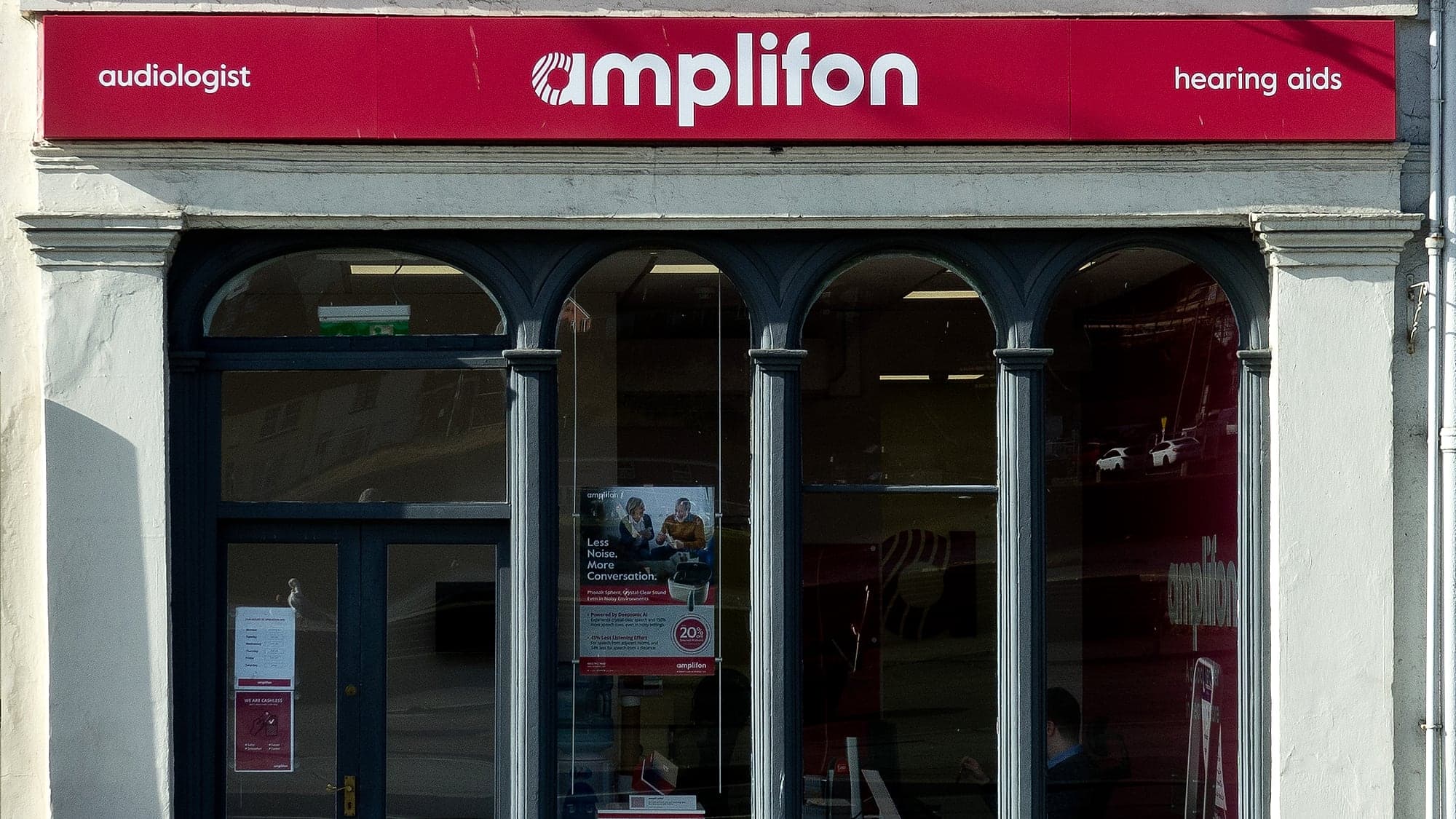
In 1944 a major in the British army parachutes onto the Apennines of Emilia to support the Allied troops and the Italian Resistance. His name is Algernon Charles Holland. When the war ends he does not go home: he runs the Allied army's telecommunications in northern Italy, marries a woman from Milan, Anna Maria Formiggini, and notices a problem nobody is dealing with. Many Italians have come out of the bombings with damaged hearing, and deafness is seen as a fate to be accepted. At the start of 1950 Holland opens a business in a basement at Via Cerva 24, a short walk from Piazza San Babila, and names it by joining two English words: amplify and phone. Seventy-five years later Amplifon has around 10,000 stores in 26 countries, and it got there without ever owning a hearing aid factory. So what exactly does it sell?
An English major in a Milan basement
Amplifon's early years have nothing of the shop as we know it today. According to the account the company put together for its 75th anniversary, Holland drove around Milan in equipped vans, the "travelling acoustic laboratories", taking hearing tests straight to people. Only later came the permanent centres: the first in Milan, the second in the centre of Turin. From there the network spread across Italy, and between the 1960s and the 1970s Amplifon became the country's leading operator. In 1971 it also opened a Research and Study Centre devoted to audiology.
The least visible contribution of those years is cultural. In Italy Amplifon created the role of the hearing care professional as a healthcare specialist, distinct from a simple salesperson. The whole model still rests on this today: someone who walks into an Amplifon centre does not buy a product off the shelf, but a process that starts with a hearing test and continues with the fitting of the device and the follow-up checks.
From Italy to the world
The international turn came late, at the end of the 1990s. Amplifon Iberica was set up in 1992, then between 1998 and 2000 the group entered Switzerland, Austria, France, the Netherlands and above all the United States. The decisive step came in 1999, when Amplifon bought Miracle-Ear, one of the best-known brands in America, from Bausch & Lomb. Miracle-Ear had started in 1948 as Dahlberg Electronics, a Minnesota company that made pillow radios for hospitals and motels before it made hearing aids, and since 1984 it had been organised as a franchise: stores run by independent business owners who use the brand and pay a fee to the parent company. Today it has more than 1,500 centres in the United States.
In 2001 Amplifon listed on the Milan stock exchange. The Holland family kept control through the holding company Ampliter: the founder's daughter, Susan Carol Holland, joined the top of the company as vice-chair in 1993 and became chair in 2011. In 2015 Enrico Vita became chief executive, and he still runs the group today.
The years that followed were a long series of acquisitions: Australia and New Zealand in 2010, then India, Turkey, Poland, Brazil, and hundreds of stores in Germany, Canada, France and Portugal. The largest, until 2026, was the Spanish group GAES in 2018: 528 million euros for about 600 stores, 500 of them in Spain, which made Amplifon the leader in the Spanish market too and took it into Latin America.
How Amplifon makes money
The model is simpler than it looks. The world's hearing aids are made by a handful of large industrial groups: Switzerland's Sonova (the Phonak brand), Denmark's Demant (Oticon), WS Audiology (Signia and Widex), America's Starkey and Denmark's GN. Amplifon buys them from these manufacturers, including the ones it sells under its own brand, and delivers them to the end customer as part of a process: the hearing test, the choice of device, the custom fitting and the care in the years that follow. The customer is not paying only for an object, but for the object plus the work of the hearing care professional who adapts it to their ear and follows them over time. The margin comes from this mix of product and service, and it grows with scale: the bigger the network, the better the prices Amplifon gets from suppliers and the more fully each store is used. Who pays varies from country to country: sometimes the customer out of their own pocket, sometimes partly the public health service or an insurer.
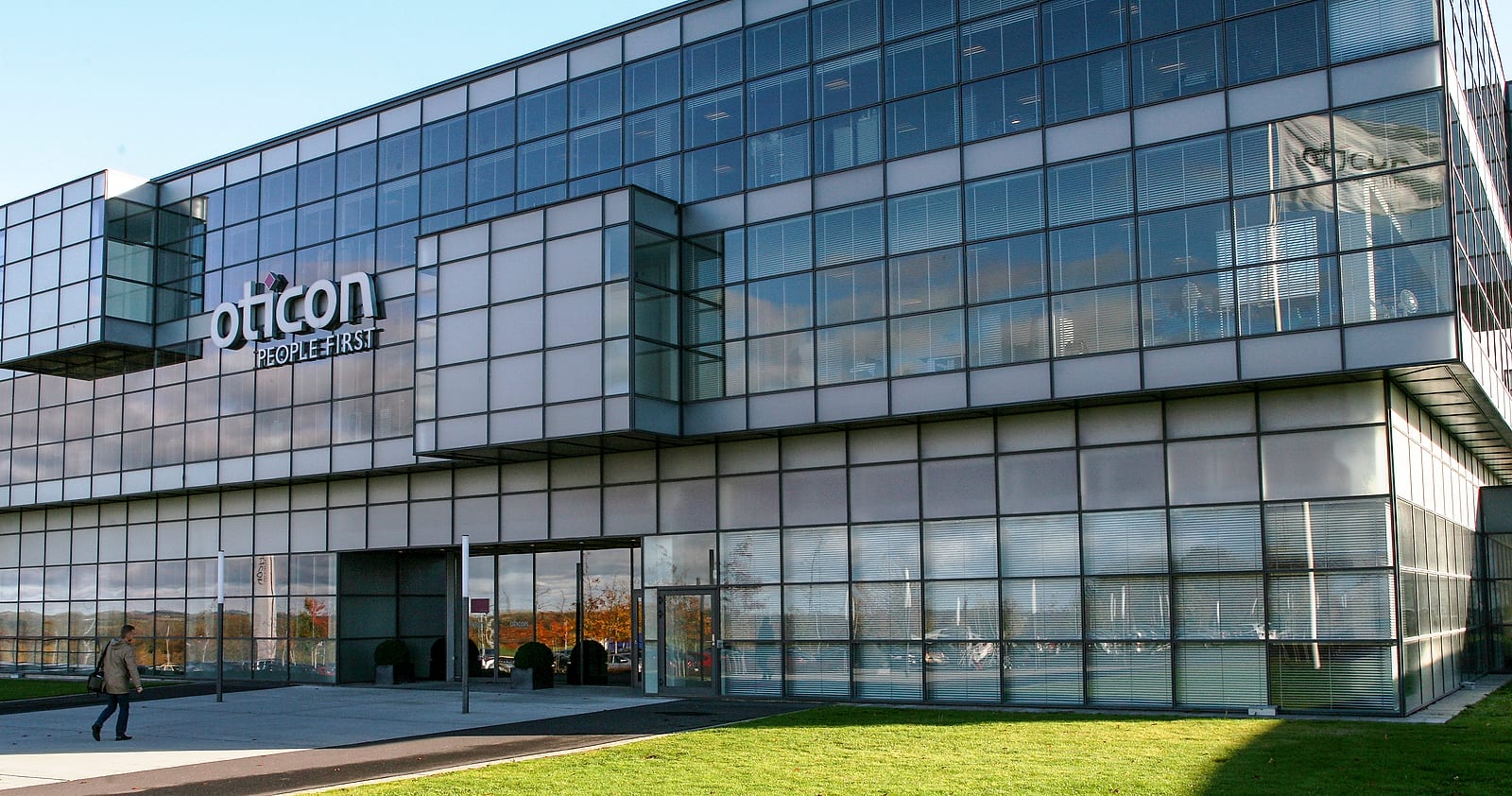 Oticon's headquarters in Smørum, Denmark, in October 2013. Oticon is the main brand of Demant, one of the manufacturers Amplifon buys its devices from.
The network rests on three channels. There are the directly operated stores, run by the group. There are spaces inside other shops, the shop-in-shops, for example inside optician chains or department stores. And there are franchised stores, the Miracle-Ear model in the United States. In 2024, according to the group's annual report, there were about 5,480 direct stores, 3,310 shop-in-shops and 1,210 franchised stores.
In the United States there is also a fourth piece, less visible: Amplifon Hearing Health Care. It is not a chain of stores, but a network that manages the hearing benefits offered by health insurers and Medicare Advantage plans. Amplifon sits between the insurer and more than 8,800 independent hearing care professionals in its network: it advances the cost of the device, bills the insurer directly and pays the professional. A detail that will matter later: on its website Amplifon has always presented this network as independent because it "is not owned by a hearing aid manufacturer".
The underlying engine of the business is demographic. According to the World Health Organization, more than 430 million people worldwide have disabling hearing loss, and over the age of 60 more than one person in four is affected. By 2050 the number of people needing hearing care could exceed 700 million. As the population ages, the pool of potential customers grows every year.
In 2025 Amplifon had revenue of about 2.4 billion euros, 1.7% more than the year before at constant exchange rates, with adjusted net profit (that is, stripped of one-off items) of 159 million. In the first half of 2026 revenue was 1.19 billion. Of this, about 776 million came from the region covering Europe, the Middle East and Africa, about 229 million from the Americas and 181 million from Asia-Pacific. Italy and Europe therefore remain the heart of the group.
2025, the year the market stopped growing
For a company used to growing every year, 2025 was a rude awakening. The chief executive spoke of a sector growing "below historical levels", with international tensions holding back consumer confidence: a hearing aid is a purchase that can be put off, and many people put it off. On 30 July 2025, after first-half results below expectations and a cut to the full-year guidance, the stock lost 22% in a single session, falling to its lowest level since 2019.
The response was an efficiency plan called Fit4Growth: about 160 centres closed in ten countries, the sale of the least profitable businesses in the United Kingdom and a reorganisation of the offices. The first effects show in the 2026 accounts: in the second quarter organic growth, that is excluding acquisitions and currency effects, was 4.7%, the best in two years. The half-year adjusted gross operating margin (in the jargon, the adjusted EBITDA margin) rose to 25.1% of revenue, and adjusted net profit grew by 12%.
Why Amplifon bought GN Hearing
On 16 March 2026 Amplifon announced the biggest deal in its history: the purchase of GN Hearing, the hearing aid division of the Danish group GN Store Nord, for 2.3 billion euros. GN is no ordinary competitor. It is one of the industry's big manufacturers, with brands such as ReSound and Beltone, about a billion euros of revenue in 2025, four factories across Denmark, China, Malaysia and the United States, and half of its sales in the Americas. Enrico Vita called it "the most transformational acquisition in our 75-year history".
The point of the deal lies in the word analysts use most: vertical integration. For seventy-five years Amplifon bought its devices from others, including the ones sold under its own brand. With GN it controls the manufacturing directly, and it can put devices made in-house in its own stores in place of those bought from Sonova, Demant or Starkey. This is exactly where most of the promised savings should come from: Amplifon is targeting net synergies of 60 to 80 million euros of gross operating margin a year, fully in place by the end of 2029. To get there it expects about 80 million euros of one-off integration costs, spread over the two to three years after closing. It is not a new idea in the industry: Sonova and Demant, besides making devices, have had their own store chains for years. Amplifon is taking the opposite route, from the store to the factory.
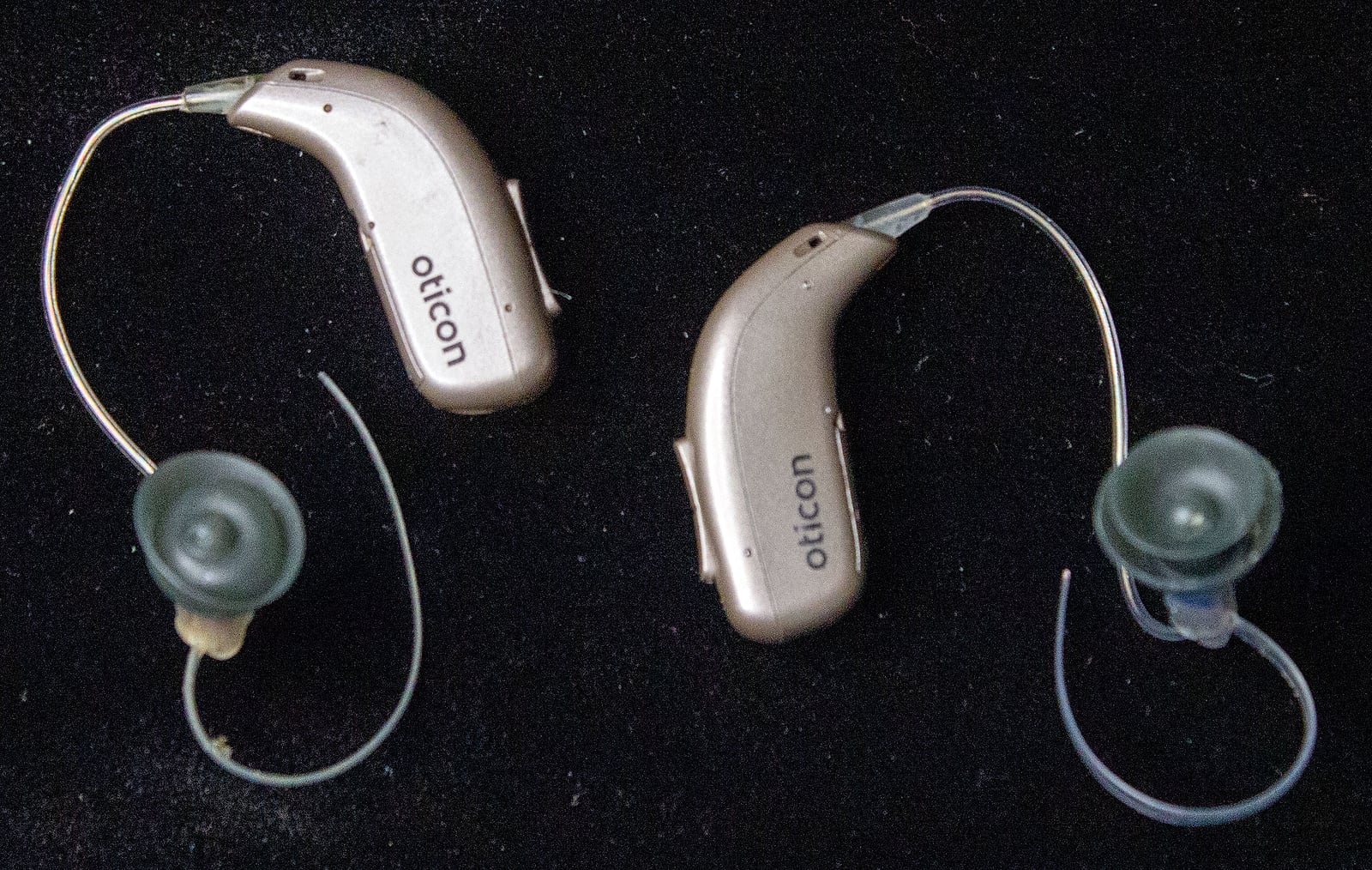 Two Oticon behind-the-ear hearing aids, from the Demant group, photographed in September 2024: the kind of product Amplifon has always bought from others.
There is also a very concrete effect in the United States. Beltone, GN's brand, has a store network that according to HearingTracker numbers between 1,200 and 1,350 locations. Put together with Miracle-Ear's roughly 1,600, two long-standing rivals end up under the same roof. HearingTracker also estimates that the combined group could come to control 12 to 15% of the American market for prescription hearing aids, close to retail giants such as Costco.
The payment comes in two parts: 1.69 billion euros in cash and 56 million new Amplifon shares going to GN Store Nord, issued at 11.267 euros each (the average price over the previous three months). To raise the cash, in May Amplifon sold new shares to institutional investors for 453 million euros, with Ampliter and Tamburi Investment Partners among the buyers, and on 23 June it signed a 1.35 billion euro loan with a group of thirteen banks. According to the figures released by Amplifon, once the deal closes GN Store Nord will own 17.09% of the capital and become the second-largest shareholder, but with only 9.13% of the votes. Ampliter, the Holland family's holding company, will fall to 32.07% of the capital but keep 63.69% of the voting rights, thanks to the loyalty voting approved in 2024: a mechanism that gives extra votes to shares held for a long time. On 29 October 2026 the shareholders' meeting is due to vote on the capital increase reserved for GN. Closing is expected by the end of 2026, after clearance from the antitrust authorities.
The stock
For anyone holding Amplifon, the last two years have been hard. According to Milano Finanza, in June 2024 the stock was worth more than 30 euros. Then came the market slowdown, the crash of July 2025 and, on the day GN Hearing was announced, another fall of almost 9% that took it to around 9 euros, its lowest since 2017. The market, in short, first greeted the news with fear: a lot of debt and a complex deal for a company already in trouble. GN Store Nord's shareholders, by contrast, celebrated with a 37% jump in Copenhagen.
Since then the mood has changed. After the first-quarter results the stock climbed back above 10 euros, and several investment banks raised their ratings. In August Equita pointed out that Amplifon trades at about 6.6 times the gross operating margin expected for 2027, a discount of about 40% to Sonova and Demant. On Friday 2 October the stock closed at 11.555 euros, for a market value of about 3.1 billion, still down about 19% from a year earlier.
Source: Yahoo Finance, weekly closing prices. Data as of 2 October 2026.
The doubts to keep in mind
The first concerns the suppliers. Until yesterday Sonova, Demant and Starkey sold their devices in Amplifon's stores. From tomorrow Amplifon will also be their competitor, with every interest in pushing GN's products, which will probably make relations tenser. And Amplifon Hearing Health Care's American network, which presented itself as independent precisely because it was not tied to a manufacturer, will have to convince the professionals in its network that this will not change.
The second is integration. A company that sells and a company that designs and builds technology have different cultures, timescales and skills. Announcing the deal, as one analyst put it, is the easy part.
The third is debt. At the end of June 2026, before closing, net debt stood at 1.87 times gross operating margin. At the time of the announcement Amplifon estimated that, once the deal was done, the ratio would rise to around 3 times, before synergies. If the hearing aid market were to slow again as it did in 2025, that weight would be felt.
The fourth is technology coming from outside. Since 2022 the United States has had a category of hearing aids sold over the counter, without a prescription, designed for adults with mild to moderate hearing loss. In 2024 the Food and Drug Administration authorised in this category an Apple software feature that turns compatible AirPods Pro into hearing aids. For now they only concern people with mild or moderate loss, but they touch the very point on which Amplifon has built everything: the idea that hearing better requires a professional in a store.
Amplifon was born to treat the hearing of people who had survived the bombings, and for seventy-five years it grew by selling devices made by others. With GN Hearing it changes its nature: it becomes a manufacturer as well, just as technology is trying to take the hearing aid out of the store. Will this be the move that revives the stock?
The information in this article does not constitute financial advice: before making any investment decision, assess your personal situation or consult a licensed adviser. The market data cited is as of 2 October 2026 and can change quickly.
Image credits
- Cover: "Amplifon, 2 The Quay, Bideford - geograph.org.uk - 7988480.jpg" by Roger A Smith, via Wikimedia Commons (from Geograph), licensed CC BY-SA 2.0. Cropped at the sides, top and bottom, slightly brightened and resized.
- In the text: "Oticon headoffice-2 (10470622214).jpg" by News Øresund (photo by Peter Mulvany), via Wikimedia Commons, licensed CC BY 2.0. Cropped at the bottom and resized.
- In the text: "Oticon hearing top view.jpg" by Bastique, via Wikimedia Commons, licensed CC BY 4.0. Cropped, slightly brightened and resized.
Sources
- Amplifon — press release "Amplifon: 75 anni di storia in un podcast" (2025), on the origins and history of the group.
- Forbes Italia — "Amplifon compie 75 anni: dal sottoscala alla leadership mondiale" (8 January 2025) and "Amplifon acquisisce GN Hearing per 2,3 miliardi, il titolo soffre in borsa" (16 March 2026).
- Amplifon — press release "Amplifon to acquire GN Hearing" (16 March 2026) and press release on the acquisition of GAES (24 July 2018).
- Amplifon — press releases on the first-half 2026 results (30 July 2026) and on the 1.35 billion euro loan (23 June 2026).
- Teleborsa — 2025 results (4 March 2026) and the 453 million euro capital increase (22 May 2026).
- Websim — "Amplifon - Convocazione assemblea per approvare Aucap riservato a GN" (18 September 2026) and "Il 29 ottobre l'assemblea per l'aumento di capitale" (29 September 2026); Hearing Health Matters, on the terms of the capital increase reserved for GN (source: Amplifon).
- Borsa Italiana — Amplifon stock page (price as of 2 October 2026); Milano Finanza, "Sentire la crescita" (22 August 2026); Sky TG24, "Amplifon crolla in Borsa, ai minimi dal 2019" (30 July 2025).
- HearingTracker — "Will the Amplifon-GN deal redraw the U.S. hearing aid map?" (2026).
- World Health Organization — fact sheet "Deafness and hearing loss"; Food and Drug Administration, authorisation of Apple's Hearing Aid Feature (September 2024).
- Amplifon Hearing Health Care — "Managed care" page (amplifonusa.com); Wikipedia, entries "Amplifon" and "Miracle-Ear".
- hearing aids
- GN Hearing
- Miracle-Ear
- Milan stock exchange
- healthcare
- acquisitions